Project overview
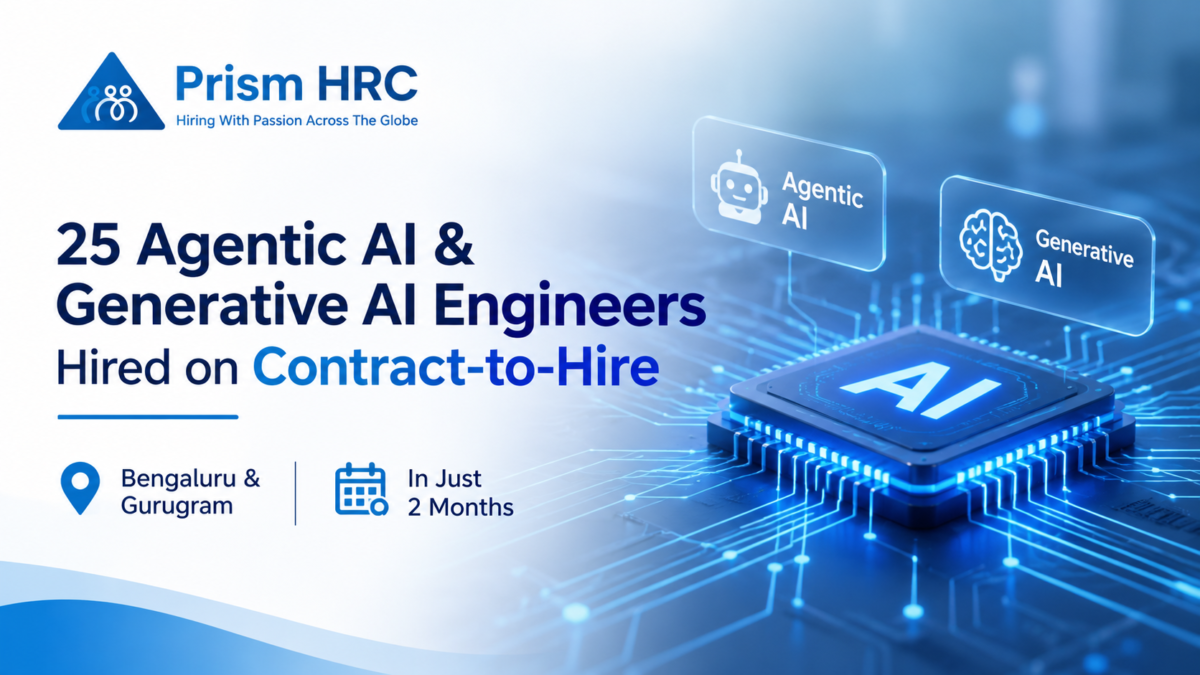
In May 2026, a client came to us needing to grow its AI engineering team quickly across Bengaluru and Gurugram. The brief was 25 engineers with Agentic AI and Generative AI skills, hired on contract to begin with, with conversion to permanent roles on the table after six months.
The market was unforgiving. Demand for experienced AI professionals was running hot, and good candidates usually had several offers in play at once. What the client needed was a recruitment partner who could find relevant talent fast, actually hold on to the people they selected, and support a hiring model that gave them room to assess fit before committing to permanent offers.
Prism HRC ran a focused hiring campaign and closed all 25 hires by August 2026. Given the volume, we offered the client a bulk hiring discount. Selected candidates were first employed on Prism HRC’s payroll to secure them, then onboarded to the client’s projects under the contract-to-hire arrangement.
The hiring requirement
The client wanted to expand its AI engineering capacity with people who could contribute to work involving Agentic AI and Generative AI. The plan called for 25 engineers split across Bengaluru and Gurugram, starting on contract, with a possible move to permanent employment after six months.
Three things came together in that requirement:
- Specialist skills in a fast-moving area of technology
- A sizeable hiring target to be met in a short window
- A contract-to-hire structure that had to work for the client and the candidates alike
On top of that, the client needed an approach that could genuinely secure suitable people in a market where skilled AI professionals were in short supply and high demand.
The hiring challenge
1. Strong competition for AI talent
The market for Agentic AI and Generative AI professionals was intensely competitive. Anyone with relevant skills was likely weighing up multiple employers at the same time. That made it essential to identify the right people quickly and keep them engaged all the way through the process.
2. A focused skills requirement
The client was after Agentic AI and Generative AI capabilities specifically. The search had to stay tight on those areas and separate candidates with real hands-on experience from those carrying only general AI exposure.
3. A high-volume hiring target
Twenty-five engineers needs a pipeline that keeps flowing, not one that delivers in fits and starts. Our team had to carry multiple roles across two cities at once, and keep screening and coordination consistent while doing it.
4. Contract-to-hire expectations
These roles opened as contract positions, with the client planning to weigh up permanent employment after six months. Candidates had to understand the initial arrangement properly, and what the conversion pathway actually involved. The model also had to let the client get engineers onboard without project work stalling in the meantime.
5. Securing selected candidates
In a market like this one, a strong candidate can accept a different offer if the process drags. So we used our payroll arrangement to employ selected candidates first, then onboard them to the client. That gave the client a practical way to lock in people while project onboarding was coordinated.
Skills hired
The drive focused exclusively on Agentic AI and Generative AI skills, tailored to the client’s specific requirements within those two areas.
Agentic AI
We sourced professionals with experience relevant to building or supporting AI agents and agent-based workflows. Depending on the role, that could mean designing agent behaviour, developing workflows that use tools or APIs, connecting agents with enterprise data, and supporting testing and deployment.
Candidates also needed to grasp how agentic systems fit into real applications and workflows, including how reliability, permissions and human oversight get managed where required.
Generative AI
The search also covered engineers with Generative AI experience, including work with large language models and the applications built around them. Relevant capabilities included developing LLM-powered features, prompt design, retrieval-augmented generation (RAG), integrating models with applications and data sources, and evaluating the quality of AI outputs.
Exactly which skills got assessed varied according to the client’s role requirements. Our screening concentrated on how relevant a candidate’s Agentic AI or Generative AI experience actually was, their project exposure, and their readiness for the contract-to-hire arrangement.
Prism HRC’s approach
Targeted sourcing
We ran a focused search for professionals with Agentic AI and Generative AI experience. Rather than treating this as a general software engineering drive, the team aligned sourcing and screening with the client’s stated AI skill areas.
Candidates were considered for roles in Bengaluru and Gurugram, with location preferences and availability discussed openly during the process.
Candidate screening
The team assessed candidates on the skills the roles required, their relevant project experience and their interest in the contract-to-hire model. Screening established whether someone had experience aligned with Agentic AI, Generative AI, or both, as the client required.
The initial employment arrangement and the possibility of permanent conversion after six months were spelled out too, so candidates could make an informed decision rather than a hopeful one.
Payroll-first candidate engagement
To secure selected candidates in a competitive market, we hired them on our own payroll first. Once employed, they were onboarded to the client’s projects under the agreed arrangement.
This moved candidates into the client’s teams while giving them a clear employment and onboarding pathway. It also let us support the client through the transition from selection to project onboarding.
Bulk hiring discount
With 25 hires involved, we offered the client a bulk hiring discount. That supported the commercial terms for a drive of this size while giving the client access to recruitment support for the volume required.
Coordination across locations
We coordinated recruitment and onboarding for candidates joining work in Bengaluru and Gurugram, supporting communication between candidates and the client as profiles moved through selection and into onboarding.
Hiring execution
The campaign began in May 2026. We concentrated on finding relevant Agentic AI and Generative AI engineers, keeping the pipeline active and coordinating the process across both locations.
Because competition for AI talent was so strong, securing selected candidates became a central part of delivery, not an afterthought. We hired selected candidates on our payroll first, then onboarded them to the client. That let the client move forward with people while the contract-to-hire structure stayed intact.
The team completed the hiring of 25 AI engineers within two months, with the overall drive wrapped up by August 2026.
Results
- 25 AI engineers brought on board
- The hiring stayed focused on Agentic AI and Generative AI skills throughout
- Roles filled across Bengaluru and Gurugram
- All 25 hires closed inside two months
- Campaign ran from May 2026 through to completion in August 2026
- Candidates joined Prism HRC’s payroll first, then moved onto the client’s projects
- Contract-to-hire structure built around possible permanent conversion at the six-month mark
- Bulk hiring discount extended for the volume involved
The contract-to-hire model
The arrangement handed the client six months of working alongside the engineers before any permanent decision had to be made. They got AI talent into their projects straight away, while keeping the option to see how the working relationship and the role fit actually played out.
Candidates got something useful out of it too. A clear way into the client’s projects on a defined contract, with permanent conversion a real possibility later, subject to the client’s call and the terms agreed.
The impact
The drive helped the client expand its Agentic AI and Generative AI engineering capacity across Bengaluru and Gurugram. Despite strong competition for specialist AI talent, we delivered 25 hires within two months.
The payroll-first approach secured selected candidates and supported their onboarding. The six-month contract-to-hire period gave the client a structured pathway to consider permanent employment, while the bulk hiring discount supported the commercial requirements of a high-volume engagement.
Key takeaway
Hiring specialist AI engineers at scale takes focused sourcing, clear communication about employment terms, and a process that can genuinely secure candidates in a competitive market.
On this engagement, Prism HRC brought together targeted Agentic AI and Generative AI recruitment, a payroll-first hiring approach, location-based onboarding and a bulk hiring discount to help the client hire 25 engineers within two months. The drive began in May 2026 and was completed by August, with a six-month contract-to-hire period before the client’s planned consideration of permanent conversion.