
- Industry: Enterprise Technology / HR Transformation
- Hiring Requirement: Workday & HRIS Professionals
- Hiring Model: Hybrid – Direct Payroll Hiring + Contract Staffing
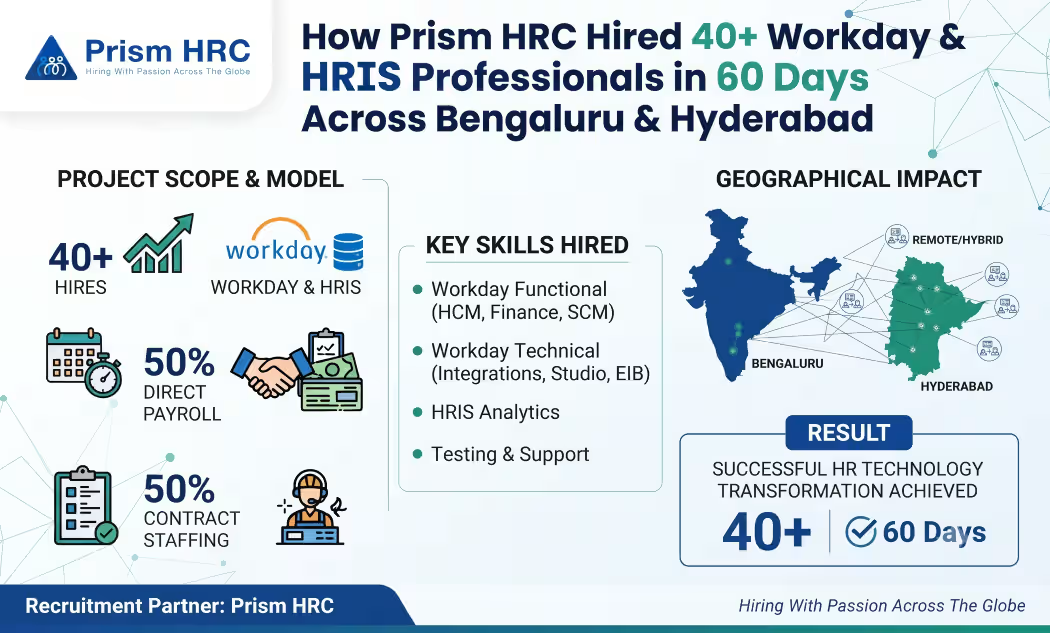
- Workforce Mix: Approx. 50% Direct Payroll | 50% Contract Staffing
- Primary Locations: Bengaluru & Hyderabad
- Work Models: On-site / Hybrid / Remote for Select Positions
- Professionals Hired: 40+
- Timeline: 60 Days
- Recruitment Partner: Prism HRC
Executive Summary
A large enterprise organisation brought Prism HRC in to support a critical HR technology transformation program, one that needed 40+ Workday and HRIS professionals within roughly 60 days. It was a mandate with several layers of complexity stacked on top of one another.
The client needed talent across a range of Workday functional and technical areas, HCM, integrations, reporting, HRIS, testing, data migration and production support among them. The workforce also had to be built through two different hiring models at once: roughly 50% direct payroll hiring and roughly 50% contract staffing.
Bengaluru and Hyderabad were the primary hiring locations, and for us these were familiar ground. We've been recruiting technology professionals across Bengaluru, Hyderabad and other major Indian technology hubs for more than 15 years. Our recruiter team knows these geographies well, and understands the location specific factors that quietly shape a search:
- Where relevant technology talent is concentrated
- Candidate movement between major technology companies
- Compensation differences across locations
- Availability of niche technology skills
- Candidate relocation preferences
- Notice period patterns
- Commute and office location considerations
- Candidate expectations around hybrid working
- Competition for specialised enterprise technology talent
That geographical understanding proved especially valuable during the Workday mandate. For some of the harder to fill positions, we also worked with the client to reconsider whether physical presence in Bengaluru or Hyderabad was genuinely necessary. Where the skill mattered more than the location, we recommended opening selected positions to hybrid or remote arrangements and after discussion and approval for specific roles, that widened the pool well beyond the immediate locations.
By pulling together our technology recruitment experience, geographical understanding, skill based recruiter allocation, permanent hiring and contract staffing capabilities and a flexible approach to the difficult positions, we helped the client hire and deploy 40+ Workday and HRIS professionals within roughly 60 days.
Understanding the Client's Requirement
The client was in the middle of a major HR technology and digital transformation initiative, with Workday forming an important part of its HR technology environment. That created real demand for specialised functional, technical and operational professionals. The overall requirement covered:
- Workday Functional Consulting
- Workday HCM
- Workday Integrations
- Workday Reporting
- HRIS Operations
- Testing
- Data Migration
- Production Support
- HR Technology Administration
This was not a conventional permanent recruitment mandate, though. The client wanted a balanced workforce made up of both permanent employees and contract professionals.
Approximately 50% – Direct Payroll Hiring
Around half of the selected professionals needed to join the client's payroll directly. These positions lined up mainly with longer-term needs:
- Building internal Workday capability
- HR technology ownership
- Knowledge retention
- Business continuity
- Ongoing system administration
- Long term functional and technical expertise
For these, our recruiters had to weigh not just technical suitability but whether the candidate was genuinely interested in building a longer term career with the client.
Approximately 50% – Contract Staffing
The rest were hired through Prism HRC's contract staffing model, which gave the client the ability to:
- Add specialised talent faster
- Increase project capacity
- Access niche Workday skills
- Support implementation and transformation activities
- Maintain workforce flexibility
- Scale resources according to project requirements
This created two recruitment tracks that had to run at the same time.
Skills We Were Asked to Hire
The mandate spanned several distinct talent pools within the Workday and HRIS ecosystem.
1. Workday Functional Consultants
We worked on requirements across modules such as:
- Workday HCM
- Workday Compensation
- Workday Benefits
- Workday Recruiting
- Workday Talent Management
- Workday Absence Management
- Workday Time Tracking
- Workday Payroll
One of our first screening priorities was pinning down a candidate's actual hands-on module experience. Our recruiters evaluated:
- Relevant Workday module
- Years of module specific experience
- Configuration exposure
- Implementation experience
- Enhancement projects
- Production support
- Client-facing responsibilities
- Current project responsibilities
A resume listing several Workday modules did not automatically qualify someone for every requirement.
2. Workday Integration Consultants
The technical requirements included:
- Workday Studio
- Enterprise Interface Builder (EIB)
- Core Connectors
- Workday Web Services
- APIs
- XML / XSLT
- Third-party integrations
- Integration troubleshooting
For these, we focused on telling apart candidates who'd merely supported integrations from professionals who'd actually:
- Designed integrations
- Developed interfaces
- Configured integrations
- Troubleshot integration failures
- Worked with third-party systems
- Supported implementation and production environments
These were among the more specialised requirements in the mandate.
3. Workday Reporting & Analytics
The client also needed people experienced in:
- Workday Reports
- Advanced Reports
- Calculated Fields
- Dashboards
- Workday Prism Analytics
- HR reporting
- Data analysis
Our screening tried to establish whether candidates had genuinely:
- Developed reports
- Created calculated fields
- Built dashboards
- Worked on complex reporting requirements
- Interacted with business stakeholders
- Troubleshot reporting issues
4. HRIS Professionals
The broader HRIS requirements covered:
- HR master data
- Employee lifecycle management
- HR systems administration
- System configuration
- Data management
- HR operations
- User support
- HR technology processes
5. Testing, Data Migration & Support
We also worked on positions covering:
- Functional testing
- Integration testing
- User Acceptance Testing
- Regression testing
- Defect management
- Data migration
- Data validation
- Go-live support
- Production support
So the mandate involved far more than simply sourcing 40 people with "Workday" experience. We were effectively running several specialised recruitment projects side by side.
The Key Hiring Challenges
1. A Limited Workday Talent Pool
Workday is a specialised enterprise technology ecosystem, and the pool shrinks considerably once you factor in every required parameter together:
- Specific Workday module
- Relevant hands-on experience
- Project exposure
- Employment preference
- Compensation
- Location
- Notice period
- Joining availability
- Work model
For some niche positions, finding candidates who ticked every box became genuinely challenging.
2. Managing Direct Hiring and Contract Staffing Simultaneously
With roughly half the workforce going directly onto the client's payroll and the other half engaged through contract staffing, we kept separate candidate pipelines.
For direct payroll positions, we evaluated:
- Permanent employment interest
- Long term career alignment
- Compensation expectations
- Relevant technical experience
- Location preference
- Notice period
- Existing offers
For contract staffing positions, we evaluated:
- Openness to contract employment
- Project-specific experience
- Availability
- Commercial expectations
- Deployment readiness
- Joining commitment
Raising the employment model right at the initial screening helped us cut down on later-stage withdrawals caused by misunderstandings about the nature of the employment.
3. Hiring 40+ Professionals Within 60 Days
The sheer scale was demanding in itself. We couldn't follow a traditional process where one requirement gets closed before the next begins. Multiple activities had to run in parallel:
- Candidate mapping
- Sourcing
- Screening
- Client submission
- Interview scheduling
- Technical interviews
- Final interviews
- Compensation discussions
- Documentation
- Joining follow-up
While one group of candidates was interviewing, our recruiters kept building the next pipeline. That continuous recruitment cycle was critical to hitting the numbers inside the 60-day window.
4. Bengaluru & Hyderabad – Leveraging 15+ Years of Hiring Experience
One of our real advantages here was our familiarity with the Bengaluru and Hyderabad technology talent markets, where we've been recruiting for more than 15 years. Over that time, our recruiters have handled technology requirements across:
- Software Engineering
- Cloud
- Data & Analytics
- ERP
- HRIS
- Cybersecurity
- AI & Machine Learning
- Enterprise Applications
- Digital Transformation
As a result, our team didn't treat Bengaluru and Hyderabad as just two locations named in a job description, we understood the talent geography sitting behind them.
Our understanding of the local talent market helped with:
- Candidate Mapping – identifying organisations and technology environments where relevant enterprise technology talent was more likely to be found.
- Location-Based Sourcing – building search strategies separately for Bengaluru and Hyderabad rather than leaning on one generic Pan-India search.
- Compensation Alignment – spotting situations where pay expectations diverged from the available market.
- Relocation Conversations – identifying candidates already weighing a move between technology hubs and raising relocation right at the start.
- Work Model Expectations – recognising that candidates increasingly judge opportunities on office location, commute, number of office days, hybrid flexibility and remote possibilities, so understanding these early helped prevent avoidable dropouts.
5. Solving Difficult Positions Through Remote & Hybrid Hiring
Some positions stayed difficult even after extensive sourcing in Bengaluru and Hyderabad. In those cases, our response wasn't just to keep combing the same pool over and over. We reviewed the requirements with the client and asked a pointed question: does this position genuinely need the professional physically present in Bengaluru or Hyderabad, or does the specialised skill matter more than the location? For certain roles, daily physical presence simply wasn't required, so we recommended the client consider hybrid or remote options for selected difficult-to-fill positions.
Expanding the Talent Pool. Once the client approved specific positions, we widened the search beyond Bengaluru and Hyderabad. That let us consider:
- Candidates in other Indian technology hubs
- Professionals unable to relocate immediately
- Candidates seeking hybrid opportunities
- Specialised professionals preferring remote work
- Candidates who matched the technical requirement but had previously been excluded because of geography
This meaningfully increased the addressable pool for some niche requirements.
A Flexible Approach – Not a Blanket Remote Policy. Remote working wasn't applied across the board; the approach stayed requirement-specific. We assessed each position on:
- Business requirements
- Project dependencies
- Client interaction
- Team structure
- Security considerations
- Technical specialisation
- Availability of local talent
Where office presence was essential, Bengaluru or Hyderabad remained mandatory. Where specialised technical expertise mattered more than physical location, we discussed hybrid or remote flexibility with the client. That practical approach unlocked candidates for some of the tougher requirements.
Prism HRC's Recruitment Strategy
1. Requirement Calibration
Before any large scale sourcing, we broke the mandate down by:
- Workday module
- Functional or technical role
- Mandatory skills
- Preferred skills
- Experience
- Location
- Hiring model
- Work model
- Compensation
- Notice period
- Joining timeline
- Priority
That turned a broad ask for "40+ Workday resources" into multiple clearly defined recruitment pipelines.
2. Skill-Based Recruiter Allocation
We assigned recruiters by technology cluster.
Workday Functional recruiters focused on:
- HCM
- Compensation
- Benefits
- Recruiting
- Talent
- Absence
- Time Tracking
- Payroll
Workday Technical requirements included:
- Workday Studio
- EIB
- Integrations
- APIs
- Web Services
- Core Connectors
Reporting & Analytics covered:
- Advanced Reporting
- Calculated Fields
- Dashboards
- Prism Analytics
HRIS / Testing / Support recruiters covered:
- HR systems
- Testing
- Data migration
- Production support
- HR technology operations
Working repeatedly on related skills gave our recruiters a stronger feel for the relevant candidate pools.
3. Multi-Channel Sourcing
To build enough pipeline depth, we sourced candidates through:
- Prism HRC's existing candidate database
- Major Indian job portals
- Existing recruiter networks
- Technology talent communities
- Candidate references
- Previously engaged candidates
- Referral-based sourcing
We searched on skill combinations rather than generic Workday queries. Examples included:
- Workday + HCM + Compensation
- Workday + Recruiting + Talent
- Workday + Studio + EIB
- Workday + Integration + API
- Workday + Advanced Reporting
- Workday + Prism Analytics
For approved remote or hybrid positions, the geography was widened further still.
4. Structured Candidate Screening
Before any candidate reached the client, our team assessed four major areas.
A. Technical Fit. We captured:
- Total experience
- Relevant Workday experience
- Module experience
- Current project responsibilities
- Implementation exposure
- Configuration experience
- Integration experience
- Reporting experience
- Testing/support experience
B. Employment Fit. We checked:
- Current organisation
- Current employment model
- Permanent/contract preference
- Current location
- Preferred location
- Willingness to relocate
- Hybrid/remote expectations
C. Commercial Fit. We discussed:
- Current compensation
- Expected compensation
- Contract staffing expectations, where applicable
- Existing offers
D. Availability. We verified:
- Official notice period
- Current notice status
- Last working date
- Earliest joining date
- Other active interviews
- Existing offers
This made sure the profiles we submitted were not only technically relevant but commercially and operationally viable too.
5. Running Multiple Recruitment Pipelines in Parallel
At any given point, candidates could be at completely different stages:
- Sourcing
- Screening
- Client review
- Interview
- Selection
- Offer discussion
- Documentation
- Joining
Our recruiters kept sourcing even while others were interviewing, which mattered because a selection didn't necessarily guarantee a joining.
6. Interview Coordination & Fast Feedback
With multiple requirements across different skills and locations, interview management became a significant part of the engagement. Our team coordinated:
- Candidate availability
- Interview slots
- Interview confirmations
- Reminders
- Rescheduling
- Candidate feedback
- Client feedback
- Subsequent rounds
- Final selection communication
Keeping things moving quickly mattered especially for specialised candidates who were interviewing with several organisations at once.
7. Candidate Engagement Until Joining
We never treated selection as the final milestone, instead following selected candidates right through to joining. Our recruiters tracked:
- Resignation status
- Notice-period progress
- Counteroffers
- Competing offers
- Documentation
- Joining confirmation
- Changes in candidate expectations
- Potential delays
For professionals hired through contract staffing, we additionally tracked documentation and deployment readiness.
8. Backup Candidate Pipelines
For critical positions, we kept backup candidates wherever possible, which protected the project against:
- Candidate withdrawals
- Counteroffers
- Joining delays
- Compensation changes
- Relocation concerns
- Competing offers
Rather than restarting a difficult requirement after a dropout, we could simply move another relevant candidate forward.
Our Phased Execution Model
Phase 1 – Requirement Mapping
We:
- Identified all positions
- Classified direct hiring and contract staffing requirements
- Prioritised critical skills
- Allocated recruiters
- Created Bengaluru and Hyderabad pipelines
- Identified immediate and short-notice candidates
Phase 2 – Parallel Hiring
Our recruiters simultaneously worked across:
- Workday Functional
- Workday Technical
- Reporting
- HRIS
- Testing
- Support
Interviews began while sourcing continued.
Phase 3 – Solving Difficult Requirements
For niche positions, we:
- Revisited mandatory requirements
- Expanded candidate mapping
- Discussed market availability with the client
- Recommended hybrid flexibility where appropriate
- Requested remote-work approval for selected positions
- Expanded sourcing geography after approval
Phase 4 – Selection & Joining
As selections increased, we focused on:
- Compensation closure
- Offer coordination
- Documentation
- Notice-period tracking
- Candidate engagement
- Joining confirmation
- Contract staffing deployment
Phase 5 – Final Gap Closure
The final stage concentrated on:
- Hard-to-fill positions
- Candidate replacements
- Backup candidates
- Joining-risk management
- Final onboarding
The Result
Within roughly 60 days, Prism HRC helped the client hire and deploy 40+ Workday and HRIS professionals.
- Primary Locations: Bengaluru, Hyderabad
- Hiring Mix: Approximately 50% direct payroll hiring, approximately 50% contract staffing
- Work Models: Depending on business and skill requirements, office-based, hybrid, or remote for selected approved positions
- Skills Covered: Workday Functional, Workday HCM, Workday Integrations, Workday Reporting, HRIS, Testing, Data Migration and Production Support
Business Impact
1. 40+ Specialised Professionals Added in 60 Days
The client was able to rapidly build the HR technology workforce its transformation program needed.
2. Balanced Direct Hiring + Contract Staffing Model
The hybrid model delivered a combination of:
- Long-term internal capability
- Permanent workforce stability
- Project-specific expertise
- Contract staffing flexibility
3. Wider Access to Niche Talent
For the difficult positions, approved remote and hybrid arrangements let us reach candidates who'd otherwise have been unavailable because of location restrictions.
4. Better Use of Local Talent Intelligence
Our 15+ years of recruiting across Bengaluru and Hyderabad meant we approached the market already understanding its:
- Technology talent clusters
- Compensation expectations
- Candidate movement
- Location preferences
- Relocation
- Work-model expectations
5. Reduced Pressure on the Client's Internal Recruitment Team
Prism HRC managed:
- Sourcing
- Initial screening
- Candidate coordination
- Interview scheduling
- Follow-ups
- Joining tracking
- Contract staffing deployment
That freed the client's team to concentrate more heavily on technical assessment, final decisions and transformation delivery.
What Made This Engagement Successful?
The success here wasn't about simply sourcing a large number of resumes. Several factors worked together:
- 15+ years of Prism HRC recruitment experience
- Strong understanding of the Bengaluru and Hyderabad talent markets
- Recruiters familiar with technology hiring geography
- Skill-specific sourcing
- Separate direct hiring and contract staffing pipelines
- Structured candidate screening
- Parallel recruitment execution
- Multi-channel sourcing
- Active joining management
- Backup candidate pipelines
- Flexibility around remote and hybrid hiring for selected positions
- Continuous communication with the client about market realities
Most importantly, we didn't treat every difficult requirement as merely a sourcing problem. Sometimes the answer was to change the search strategy. Sometimes it was to expand the geography. And for certain niche positions, the answer was to work with the client and reconsider the work model itself.
Key Takeaways
- Requirement: Workday & HRIS hiring for an enterprise HR transformation program.
- Total Hiring: 40+ professionals.
- Timeline: Approximately 60 days.
- Primary Locations: Bengaluru & Hyderabad.
- Hiring Model: Approximately 50% direct payroll hiring + 50% contract staffing.
- Work Model: Office-based, with hybrid and remote flexibility approved for selected difficult-to-fill positions.
Key Challenges
- Specialised Workday talent
- Multiple functional and technical modules
- 40+ hires within 60 days
- Direct hiring and contract staffing simultaneously
- Location constraints
- Notice periods
- Compensation alignment
- Candidate dropouts
- Niche skill availability
Prism HRC's Solution
- Leveraged 15+ years of technology hiring experience
- Used recruiter knowledge of the Bengaluru and Hyderabad talent markets
- Segmented requirements by skill, geography and hiring model
- Created dedicated direct hiring and contract staffing pipelines
- Used multi-channel sourcing
- Screened candidates before submission
- Ran recruitment activities simultaneously
- Maintained backup pipelines
- Worked with the client to introduce hybrid/remote flexibility for selected difficult positions
- Managed candidates through joining and deployment
Outcome
40+ Workday and HRIS professionals hired and deployed within approximately 60 days.
Conclusion
This engagement shows how specialised technology hiring takes more than access to job portals or a big candidate database. It takes an understanding of the technology, of candidate availability, of hiring models, of geography, and of the realities of the talent market.
The client's requirement was genuinely complex: 40+ Workday and HRIS professionals to be hired within roughly 60 days across Bengaluru and Hyderabad, with the requirement split about equally between direct payroll hiring and contract staffing. Prism HRC's 15+ years of recruitment experience, particularly our familiarity with technology hiring across Bengaluru and Hyderabad, meant we came to the mandate already understanding these talent markets.
Our recruiter team knew that location itself can influence:
- Candidate availability
- Compensation expectations
- Commute considerations
- Relocation decisions
- Joining probability
- Willingness to accept an opportunity
For the most challenging requirements, we went a step further. Rather than repeatedly working a restricted local pool, we talked the market situation through with the client and got approval to introduce hybrid and remote options for selected positions where physical presence wasn't essential. That let us expand the talent pool and reach suitable professionals outside the original geography, without compromising on the core skill requirement.
By combining:
- Direct payroll hiring
- Contract staffing
- Technology-focused sourcing
- Local talent-market knowledge
- Remote and hybrid hiring flexibility
- Structured screening
- Parallel execution
- Joining management
We helped the client build a 40+ member Workday and HRIS workforce within the targeted 60-day period.
For Prism HRC, the engagement reflects an important principle behind our recruitment approach: the objective isn't simply to send more resumes. It's to understand the client's requirement, understand the available talent market, identify the barriers to hiring, and create a recruitment strategy that helps close the gap.
Prism HRC | Workday Recruitment | HRIS Hiring | Direct Hiring | Contract Staffing | Bengaluru Hiring | Hyderabad Hiring | Enterprise Technology Recruitment