
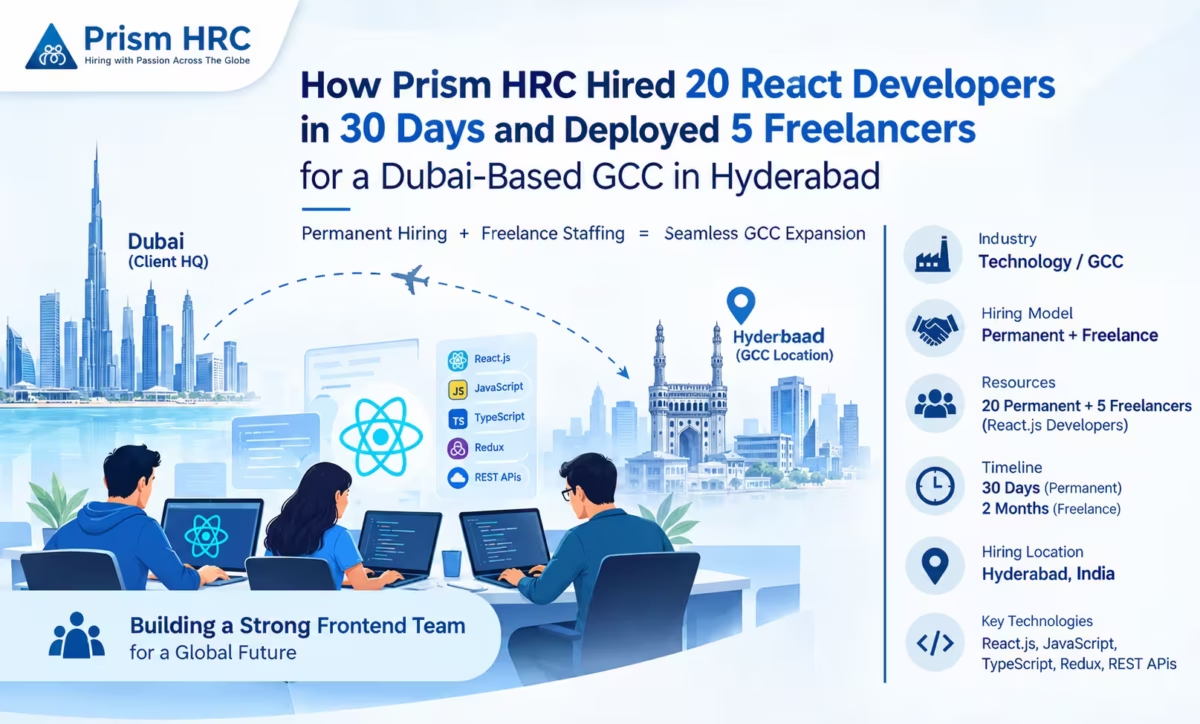
- Industry: Technology / Global Capability Centre (GCC)
- Client: Dubai-Based Technology Company
- Hiring Location: Hyderabad, India
- Permanent Hires: 20 React.js Developers
- Freelance Developers: 5 React.js Developers
- Permanent Hiring Timeline: 30 Days
- Freelance Engagement: 2 Months
- Recruitment Partner: Prism HRC
- Key Technologies: React.js, JavaScript, TypeScript, Redux, REST APIs
Client Background: Transitioning Technology Operations from Dubai to Hyderabad
A Dubai-based technology company was growing its footprint in India, and that growth meant setting up a Global Capability Centre (GCC) in Hyderabad. Part of the plan was to move its frontend development work out of Dubai and into India.
The goal was straightforward enough on paper: build a skilled development team in Hyderabad that could own ongoing application development, product enhancements, and whatever technology initiatives came next.
Moving development responsibilities across borders, though, carries a real catch. The company needed experienced React.js developers who could get their heads around existing applications quickly, work smoothly with international stakeholders, and start contributing without throwing ongoing operations off course.
So the organization set itself a clear target: hire 20 React developers in Hyderabad within 30 days. On top of that, it needed temporary frontend resources to keep existing projects moving while permanent recruitment ran its course and the new hires found their feet.
To cover both fronts, the company partnered with Prism HRC, an IT recruitment agency in India, for permanent recruitment and short-term freelance staffing.
Client Requirement: 20 Permanent React Developers and 5 Freelance Developers
The client came in with two immediate recruitment needs.
The first was a permanent team of 20 React.js developers, built within a month. These were the people who’d join the Hyderabad GCC and take charge of frontend application development, maintenance, and enhancements.
The second was 5 experienced freelance React developers for 2 months. These temporary hands would keep development ticking along during the recruitment process and the early stretch of the transition.
Technical Skills Required
What the client wanted was frontend developers with real, practical experience across modern JavaScript technologies.
- Core Frontend Technologies
- React.js and React Hooks
- JavaScript (ES6+) and TypeScript
- HTML5 and CSS3
- Responsive Web Design
- Component-Based Architecture
- State Management & Frontend Development
- Redux and Redux Toolkit
- Context API
- React Router
- Reusable UI Components
- Frontend Performance Optimization
- API Integration & Collaboration
- REST API Integration
- JSON and Axios
- Git and Version Control
- Agile Development Methodologies
- Collaboration with Backend and UI/UX Teams
Beyond the technical side, candidates had to communicate well and hold their own working with Dubai-based stakeholders.
The permanent developers needed to fit the client’s long-term technology roadmap. The freelance professionals, meanwhile, simply had to be available for a defined two-month stint.
That mix is what made this project trickier than your run-of-the-mill frontend hiring brief.
Key Recruitment Challenges
Challenge 1: Hiring 20 React Developers Within 30 Days
The timeline was aggressive, and for good reason: the Hyderabad GCC had to be up and running quickly.
Pulling in 20 experienced React developers inside a month meant sharp candidate sourcing, relevant technical screening, tight interview coordination, and hiring decisions that didn’t drag.
A conventional recruitment process could easily have stalled the whole Dubai-to-India handover.
Challenge 2: Maintaining Project Continuity During the Transition
The client simply couldn’t hit pause on frontend development while it recruited the permanent team.
And even once people were hired, fresh developers would need time to learn the existing applications, the development workflows, and the business requirements.
So temporary React.js resources were needed to keep things moving through that gap.
Challenge 3: Finding Technically Relevant React Developers
React.js shows up everywhere in web development, but what a candidate has actually done with it varies a lot.
The client wanted developers with genuine hands-on experience in React components, JavaScript, TypeScript, Redux, API integrations, and real application development.
Finding people who’d worked on relevant production applications mattered far more than ticking off technology keywords on a resume.
Challenge 4: Candidate Availability and Notice Periods
Experienced frontend developers come with notice periods all over the map, anywhere from available-right-now to 90 days out.
The client needed people whose joining timelines actually matched its GCC expansion schedule.
For the freelance roles, availability mattered even more, since the whole engagement ran just two months.
Challenge 5: Competition for Frontend Talent in Hyderabad
Hyderabad’s tech recruitment market is crowded, with multinationals, GCCs, IT services firms, and product companies all chasing experienced React developers.
Strong frontend talent tends to field several offers at once.
That made timely communication, efficient interview scheduling, and steady candidate engagement non-negotiable.
Prism HRC’s Recruitment Strategy
Prism HRC took a dual hiring approach to tackle the client’s immediate and long-term needs at once.
Our specialized IT recruitment team ran permanent React developer recruitment and, in parallel, lined up freelance professionals for temporary project support.
Step 1: Understanding the Client’s Technology Requirements
Our recruiters started by getting a clear picture of the client’s frontend stack, development responsibilities, hiring budget, experience expectations, and transition timelines.
We mapped out the technical competencies needed across React.js, JavaScript, TypeScript, Redux, API integration, and frontend architecture.
We also drew a firm line between the permanent positions and the freelance assignments, so candidates were judged against the right yardstick for each.
Step 2: Targeted React Developer Sourcing
Prism HRC drew on its established candidate database, professional networks, job portals, and technology recruitment channels to surface experienced React developers.
Our recruiters went after candidates with real project experience rather than leaning on technology keywords alone.
For permanent hiring, we weighed technical experience, career interests, compensation expectations, and willingness to work in Hyderabad.
For freelance hiring, the priorities were relevant React.js experience and availability for a two-month assignment.
Step 3: Technical CV Screening
Every shortlisted profile was checked for practical frontend development experience.
Our recruiters looked at how candidates had worked with React Hooks, Redux, TypeScript, reusable components, responsive design, and API integrations.
We also dug into the nature of their past project responsibilities, specifically to spot developers who’d worked on relevant applications.
That sharpened the shortlist and cut down on wasted interviews.
Step 4: Candidate Availability and Salary Alignment
With the clock ticking, our team raised notice periods, compensation expectations, location preferences, and candidate interest early rather than late.
For the freelance developers, those conversations also covered project duration, availability, and engagement expectations.
Handling this upfront lined candidates up with the client’s requirements before a single interview was booked.
Step 5: Interview Coordination and Hiring Follow-Ups
Prism HRC set up interviews with the client’s hiring team and kept in regular touch with shortlisted candidates.
Our recruiters chased interview feedback, compensation discussions, offers, and joining-related questions.
By running permanent and freelance recruitment side by side, Prism HRC kept the client’s hiring momentum going right through the transition.
Deploying 5 Freelance React Developers for Immediate Project Support
One of the real linchpins of this engagement was the client’s need for temporary frontend resources.
While the permanent React team in Hyderabad was still being built, ongoing projects weren’t going to wait.
The client also recognized that hiring permanent staff was only half the transition. New developers would need time to absorb the existing applications, internal processes, development standards, and collaboration requirements.
To plug that temporary gap, Prism HRC supplied 5 experienced freelance React developers for a two-month engagement.
These freelancers kept frontend development activities running while permanent recruitment wrapped up and the new team settled in.
Why the Freelance Hiring Model Worked
The short-term freelance setup brought a few clear advantages.
Immediate Development Support: The client got experienced React developers straight away, without waiting for the full permanent team to be in place.
Flexible Resource Engagement: The developers came on for a defined two-month window, matching the client’s temporary project needs.
Reduced Transition Disruption: Freelancers kept frontend development moving through the Dubai-to-Hyderabad shift.
Support During Team Stabilization: Temporary hands stayed available while new employees got comfortable with the client’s applications and development environment.
No Unnecessary Long-Term Hiring Commitment: The client handled a temporary workload spike without padding its permanent headcount beyond the planned 20.
It’s a neat illustration of what pairing permanent recruitment with project-based freelance staffing can do.
For companies looking to hire freelance frontend developers in India, short-term engagements offer genuine flexibility during technology migrations, product launches, GCC expansions, and temporary resource crunches.
Supporting the Dubai-to-Hyderabad GCC Transition
This recruitment assignment tied directly into the client’s bigger goal: standing up frontend development capabilities in India.
Global Capability Centres are doing more and more for international businesses, software engineering, product development, digital transformation, and plenty of other technology functions.
But setting up a GCC takes far more than office space. Companies have to recruit genuinely capable people who can work with existing systems, grasp business requirements, and collaborate with global teams.
Here, Prism HRC backed the client’s transition through two complementary recruitment models.
The 20 permanent React developers became the backbone of the client’s long-term Hyderabad frontend team.
The 5 freelance React developers covered the recruitment and settling-in period.
Together, that combination let the organization meet its immediate operational needs while steadily building its permanent engineering capability in India.
It’s a good example of how flexible recruitment models can carry international companies through technology team transitions and GCC expansion.
Recruitment Results: 25 React Developers Across Two Hiring Models
Prism HRC delivered on both fronts, hiring 20 permanent React developers within 30 days and providing 5 freelance React developers for a two-month engagement.
Key Recruitment Outcomes
|
Recruitment Metric |
Result |
|
Client Headquarters |
Dubai, UAE |
|
GCC Location |
Hyderabad, India |
|
Technology |
React.js / Frontend Development |
|
Permanent React Developers Hired |
20 |
|
Permanent Hiring Timeline |
30 Days |
|
Freelance React Developers Provided |
5 |
|
Freelance Engagement Duration |
2 Months |
|
Total Professionals Hired / Provided |
25 |
|
Recruitment Models |
Permanent hiring+ freelancing staffing |
|
Business Objective |
Transition Frontend Operations from Dubai to India |
Business Impact
1. Permanent Team Built Within 30 Days
Prism HRC helped the client hire 20 React.js developers inside a month, backing its plan to establish a frontend development team in Hyderabad.
2. Immediate Project Support Through Freelancers
The 5 freelance React developers kept ongoing development needs covered while permanent recruitment was underway.
3. Continuity During Team Transition
The two-month freelance engagement bridged the stretch where new hires were settling in and getting familiar with the development environment.
4. Flexible Workforce Planning
By blending permanent and freelance hiring, the client handled both long-term engineering needs and short-term project demands.
5. Recruitment Support for International GCC Expansion
The engagement showed Prism HRC’s ability to support international technology companies growing their engineering operations in India.
Why Specialized Frontend Recruitment Matters for GCCs
Hiring frontend developers for a GCC usually calls for a closer read on technical skills, project experience, and what the organization actually expects.
Take React.js: a developer building basic website interfaces brings a different skill set from someone shipping complex enterprise applications with TypeScript, Redux, reusable components, and a web of API integrations.
In the same way, a freelancer on a short assignment may need to hit the ground running, while a permanent hire also has to line up with long-term product development goals.
Prism HRC’s specialized recruiters know these distinctions and judge candidates against the client’s specific technology and engagement requirements.
For businesses looking to hire frontend developers in India, picking the right recruitment model matters just as much.
Permanent recruitment generally suits long-term product development, application ownership, and in-house engineering capability.
Contract and freelance hiring help organizations ride out temporary workloads, specialized projects, urgent development needs, and technology transitions.
A mix of both can be especially handy for companies setting up or scaling GCC operations in India.
What This Case Study Demonstrates About Prism HRC
This engagement showcases Prism HRC’s track record with specialized frontend recruitment, the kind that comes with aggressive timelines and more than one engagement model in play.
With 15+ years of IT recruitment experience, Prism HRC supports technology companies, consulting firms, IT services organizations, and GCCs across their software development hiring needs.
Our recruitment reach covers React.js, Angular, Vue.js, JavaScript, TypeScript, UI/UX design, graphic design, and other frontend technologies.
In the last year alone, Prism HRC has hired 150+ frontend developers, UI/UX designers, and graphic design professionals for a range of companies across diverse industries.
We help organizations recruit junior developers, senior frontend engineers, technical leads, frontend architects, UI/UX specialists, and graphic designers.
- Our hiring models include:
- Permanent Recruitment
- Contract Staffing
- Contract-to-Hire
- Freelance Developer Hiring
- Dedicated Frontend Team Hiring
- Bulk Technology Recruitment
Whether an organization needs a single freelance React developer for a quick project or a whole frontend team for a new GCC, Prism HRC tailors its recruitment support to the technology requirements, budget, and timelines at hand.
The Dubai-to-Hyderabad GCC engagement shows how pairing permanent and freelance recruitment can help businesses manage technology transitions without waiting around for their full long-term team to come online.
Looking to Hire React Developers or Freelance Frontend Developers in India?
Planning to hire React developers in India, build a frontend development team, or expand your GCC operations in Hyderabad, Bengaluru, Pune, Mumbai, or other major technology hubs?
Prism HRC helps businesses hire skilled React.js, Angular, Vue.js, and frontend developers through permanent, contract, and freelance hiring models. Connect with our specialized IT recruiters to build your technology team faster.
Website: www.prismhrc.com