
Project Snapshot
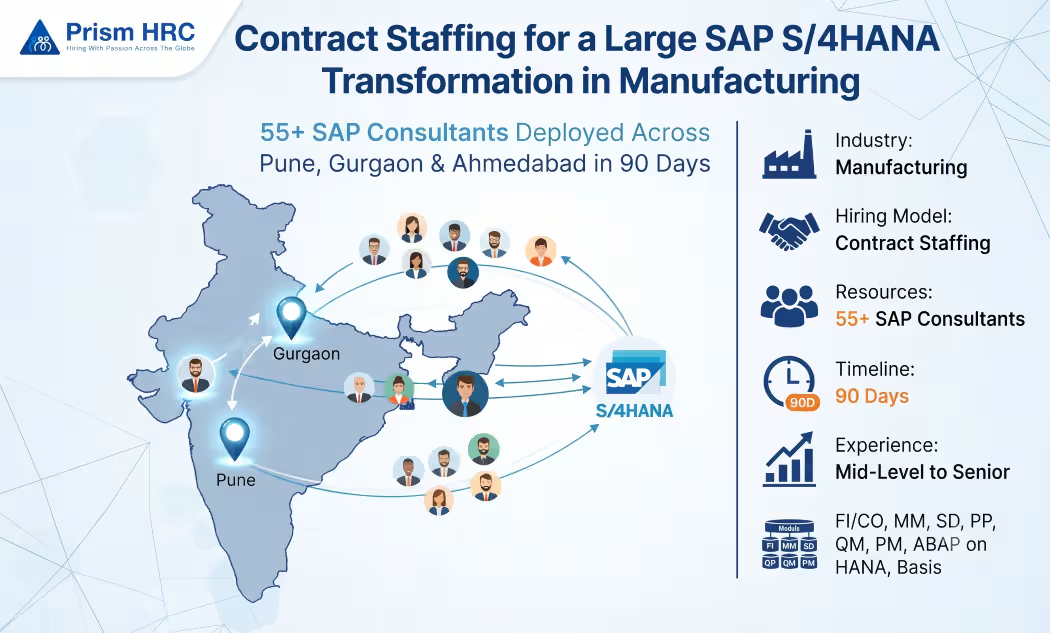
| Parameter | Details |
|---|---|
| Industry | Manufacturing |
| Project | SAP S/4HANA Transformation |
| Hiring Model | IT Contract Staffing |
| Resources Deployed | 55+ SAP Consultants |
| Timeline | 90 Days |
| Locations | Pune, Gurgaon & Ahmedabad |
| Experience Level | Primarily Mid-Level to Senior Professionals |
| Core Skills | SAP FI/CO, MM, SD, PP, QM, PM, ABAP on HANA & SAP Basis |
The Business Requirement
A large manufacturing organisation was in the middle of an enterprise-wide SAP S/4HANA transformation, one that touched several critical business and plant operations. The program called for hiring SAP consultants across both functional and technical areas. And because it was running against fixed implementation timelines, the organisation needed to scale its SAP team up quickly, without leaning entirely on permanent hiring. So the client turned to contract staffing for a significant chunk of the project workforce.
Prism HRC was brought in as a SAP recruitment agency to identify, screen and deploy 55+ SAP consultants within roughly 90 days, spread across three locations:
- Pune
- Gurgaon
- Ahmedabad
The requirement meant hiring across multiple SAP modules at once, with candidates expected to bring the right blend of technical expertise, project exposure, location suitability and joining availability. This was never a volume CV-sourcing exercise. The real goal was to build a project-ready SAP talent pool that could support the different workstreams of the manufacturing transformation.
Understanding the SAP S/4HANA Manufacturing Environment
Before any large-scale sourcing began, the Prism HRC team mapped the requirements against the client's overall manufacturing environment. In a manufacturing organisation, the different SAP modules are tightly interconnected, and the project broadly spanned:
- Finance and controlling
- Procurement and materials management
- Sales and distribution
- Production planning
- Quality management
- Plant and equipment maintenance
- SAP technical development
- SAP system administration
This mattered because an SAP consultant's suitability simply couldn't be judged on keywords alone. An SAP PP consultant working on a manufacturing transformation, for instance, needs to understand how production planning interacts with materials and inventory. FI/CO professionals, similarly, may need experience around costing and integration with operational processes. So the recruitment strategy zeroed in on relevant SAP experience, but always within the context of manufacturing and S/4HANA transformation projects.
SAP Skills Hired for the Project
The mandate concentrated on eight major SAP skill areas.
1. SAP S/4HANA FI/CO
FI/CO consultants were needed to support finance, accounting, controlling and manufacturing-related financial processes. The key experience areas we looked at:
- Financial accounting
- Controlling
- Cost center accounting
- Product costing
- Integration with MM and SD
- S/4HANA implementation or transformation exposure
Candidates with manufacturing-environment experience were especially relevant here, given how important costing and integration with plant operations are.
2. SAP S/4HANA MM
Materials Management was a big part of the transformation, thanks to the client's procurement and inventory needs. The team looked for experience around:
- Procurement processes
- Purchase orders
- Inventory management
- Material movements
- Vendor-related processes
- MM integration with FI/CO
- MM integration with PP and QM
Relevant manufacturing exposure was preferred wherever the role required it.
3. SAP S/4HANA SD
SAP SD consultants supported the commercial side of the organisation's SAP landscape. Relevant areas included:
- Sales order processing
- Pricing
- Billing
- Delivery processes
- Distribution
- SD-MM integration
- SD-FI integration
The focus fell on professionals who'd worked on enterprise SAP environments, rather than candidates with only limited support exposure.
4. SAP S/4HANA PP
Production Planning was one of the core skill areas for a manufacturing transformation. PP consultants were evaluated on experience around:
- Production planning
- Material requirements planning
- Production orders
- Manufacturing processes
- Bills of material
- Work centers
- PP-MM integration
- PP-QM integration
For these positions, understanding a candidate's previous manufacturing environment really mattered. A consultant who'd worked on actual manufacturing implementations often brought far more relevant project exposure than someone whose experience was largely confined to application support.
5. SAP S/4HANA QM
Quality Management consultants were needed to support quality-related processes across procurement and manufacturing. Relevant areas included:
- Quality planning
- Quality inspections
- Inspection lots
- Quality notifications
- Procurement quality processes
- Production quality processes
- Integration with MM and PP
The pool of experienced QM professionals was smaller than for some of the larger SAP modules, which made targeted sourcing important.
6. SAP S/4HANA PM
Plant Maintenance consultants were needed to support maintenance processes for manufacturing plants and equipment. The hiring team looked for experience around:
- Equipment management
- Preventive maintenance
- Maintenance orders
- Maintenance planning
- Notifications
- Plant-related processes
- Integration with MM and FI/CO
Candidates from manufacturing, engineering or other asset-intensive environments were particularly relevant.
7. SAP ABAP on HANA
Alongside the functional teams, the transformation needed SAP technical development professionals. ABAP on HANA consultants supported areas such as:
- Custom developments
- Enhancements
- Reports
- Interfaces
- Forms
- Technical integrations
- S/4HANA-related development requirements
The team specifically distinguished candidates with more recent SAP S/4HANA and HANA exposure from those whose experience was largely rooted in older SAP environments.
8. SAP Basis
SAP Basis consultants supported the technical SAP environment throughout the transformation. These positions required experience across:
- SAP system administration
- System monitoring
- Performance management
- User and environment support
- Transport management
- Technical troubleshooting
- SAP landscape management
Together, these eight skill areas provided the core functional and technical talent the manufacturing transformation needed.
The Hiring Challenges
Deploying more than 55 SAP consultants in 90 days threw up several challenges that had to be handled at once.
1. Multiple SAP Modules Had to Be Hired in Parallel
The client couldn't wait for one module's hiring to wrap up before starting the next. FI/CO, MM, PP, SD and technical positions were all moving simultaneously, while the more specialised requirements like QM and PM had to be addressed too. So Prism HRC set up separate recruitment pipelines for:
Functional SAP:
- FI/CO
- MM
- SD
- PP
- QM
- PM
Technical SAP:
- ABAP on HANA
- Basis
This let recruiters focus on specific talent pools rather than treating SAP as one broad category.
2. Manufacturing Experience Was Important
Not every technically capable SAP consultant was automatically right for this project. For several positions, the client wanted professionals who understood manufacturing business processes and had worked in similar environments. This was especially relevant for:
- PP
- MM
- QM
- PM
- FI/CO
Recruiters therefore assessed not just which SAP module a candidate had worked on, but where and how they'd applied that expertise. Candidates with implementation, rollout, migration or transformation experience were prioritised depending on the requirement.
3. Hiring Across Pune, Gurgaon & Ahmedabad
Managing the geographical spread was another key part of the assignment, with consultants needed across:
- Pune
- Gurgaon
- Ahmedabad
Prism HRC's existing hiring experience across these locations became a real advantage. For more than 15 years, we've worked on technology and specialised hiring mandates across major Indian talent markets, including requirements in Pune, Gurgaon and Ahmedabad, which gave our teams practical familiarity with the candidate ecosystems in each. That helped us understand:
- Which locations had stronger pools for particular skills
- Where relocation might need to be considered
- Candidate compensation expectations
- Location preferences
- Availability of immediately joinable professionals
- Candidate willingness for onsite or hybrid project requirements
Location suitability was raised during the very first recruiter conversation rather than after the interview process, which helped avoid progressing candidates who were technically suitable but unlikely to join because of location constraints.
4. Joining Timelines Were Critical
A major SAP transformation runs against project milestones, so a technically strong consultant who can only join after several months may not solve an immediate resource need. Availability therefore became a key screening component, with recruiters capturing:
- Current employment status
- Official notice period
- Expected last working date
- Possibility of early release
- Existing offers
- Earliest joining date
- Location availability
- Relocation willingness, where applicable
Candidates serving notice, immediately available, or able to join within the required project timelines were prioritised wherever possible.
5. Contract Staffing Acceptance Had to Be Confirmed
Experienced SAP professionals often have different preferences around employment models, some actively seek project-based contract opportunities, while others want only permanent roles. So our recruiters explained the contract staffing model early, covering:
- Nature of the engagement
- Project location
- Expected project duration where applicable
- Compensation structure
- Joining expectations
- Employment arrangement
This cut the risk of candidates reaching the final interview or offer stage and then backing out because they'd been expecting a permanent role.
Prism HRC's Recruitment Strategy
To deliver the mandate within the timeline, Prism HRC ran a structured recruitment model.
Step 1: Requirement Calibration
Each requirement was first mapped beyond the basic job description. Our recruiters classified positions using:
SAP Module → Experience → S/4HANA Exposure → Manufacturing Experience → Location → Availability → Compensation
This let the team pinpoint the genuinely critical requirements for each position, and it also avoided excessive filtering. For niche modules like QM or PM, making too many secondary requirements mandatory could shrink the available pool significantly.
Step 2: Module-Specific Recruitment Teams and Pipelines
Rather than handing recruiters a broad instruction to "hire SAP consultants," the mandate was split into module-specific pipelines. That let recruiters build deeper familiarity with:
- Relevant SAP terminology
- Adjacent modules
- Integration requirements
- Typical candidate backgrounds
- Manufacturing exposure
- Market availability
- Compensation expectations
Recruiters working on PP, for example, could focus on production and manufacturing-oriented talent pools, while those working on ABAP could concentrate on technical S/4HANA development profiles.
Step 3: Multi-Channel Candidate Sourcing
A 55+ consultant requirement couldn't rely on a single source. Prism HRC used multiple channels, including:
- Internal candidate database
- Major job portals
- Professional networking platforms
- Existing SAP candidate networks
- Employee and candidate referrals
- Previously interviewed professionals
- Targeted module-specific searches
- Location-specific talent mapping
For common modules, the challenge was filtering a large candidate universe. For niche modules, the challenge was different: identifying a strong enough candidate pool in the first place. So the sourcing strategy shifted according to each module.
Step 4: Initial Candidate Screening
Profiles were screened by Prism HRC before reaching the client, with the initial screen focused on seven areas.
- SAP Skill Match – Was the candidate's recent experience genuinely relevant to the required module?
- S/4HANA Exposure – Had the candidate worked in an S/4HANA environment where required?
- Manufacturing Exposure – Had the consultant worked with manufacturing organisations or manufacturing-related business processes?
- Project Type – Did the candidate have relevant implementation, transformation, rollout or migration experience? Pure support experience was set apart from transformation-oriented experience.
- Location Fit – Was the candidate genuinely comfortable working from Pune, Gurgaon or Ahmedabad, per the requirement?
- Joining Availability – Could the consultant realistically join within the project's timeline?
- Contract Staffing Acceptance – Was the candidate comfortable taking the position under the proposed contract staffing model?
Step 5: Profile Prioritization
One of the biggest traps in volume recruitment is mistaking CV quantity for actual progress. Firing over large numbers of loosely matched profiles just creates more work for the client and can slow hiring down. So Prism HRC prioritised candidates using a combination of:
Technical Fit + Project Experience + Manufacturing Exposure + Location Fit + Joining Availability + Compensation Alignment
The strongest candidates moved into the client interview pipeline first, which let the client aim its interview bandwidth at the profiles most likely to convert.
Step 6: Interview Coordination and Candidate Management
With several modules and locations running at once, interview management became a project in its own right. The Prism HRC team handled:
- Interview scheduling
- Candidate confirmations
- Interview reminders
- Rescheduling
- Client feedback follow-ups
- Candidate feedback
- Selection status tracking
- Compensation discussions
- Offer coordination
- Joining follow-ups
Speed mattered especially for strong SAP candidates. Those serving notice or immediately available often field several opportunities at once, so delays between interview rounds can cost you the candidate. The team kept up regular follow-ups to keep things moving.
Step 7: Offer-to-Joining Management
Selection didn't mark the end of the process. For a contract staffing project, actual deployment was the real outcome, which meant the stretch between offer acceptance and joining needed active engagement. Our team stayed in touch regarding:
- Documentation
- Joining date
- Notice period status
- Location readiness
- Counteroffers
- Competing opportunities
- Candidate concerns
- Onboarding requirements
Potential joining risks were flagged early so that alternate candidates could stay active where needed.
Step 8: Maintaining Backup Pipelines
For critical SAP skills, Prism HRC didn't stop sourcing the moment a candidate was selected. Backup candidates were kept for priority positions, because:
- Candidates could receive counteroffers
- Notice periods could change
- Relocation decisions could change
- Competing offers could emerge
- Project requirements could increase
- Joining dates could get delayed
Keeping a secondary pipeline helped protect the project from unexpected dropouts.
Deployment Outcome
Through this structured approach, Prism HRC successfully supported the client's SAP S/4HANA transformation with 55+ contract professionals within roughly 90 days. The deployment covered both functional and technical SAP requirements across:
- Pune
- Gurgaon
- Ahmedabad
The final talent mix included consultants across:
- SAP FI/CO
- SAP MM
- SAP SD
- SAP PP
- SAP QM
- SAP PM
- SAP ABAP on HANA
- SAP Basis
The project underlined the importance of bringing together SAP skill understanding, manufacturing-domain context, geographical talent knowledge and contract staffing execution.
What Made the Engagement Successful?
Several factors contributed to the successful ramp-up.
1. Focused SAP Skill Coverage
Rather than trying to recruit across an unnecessarily broad SAP landscape, the program concentrated on eight skills directly relevant to the manufacturing transformation.
2. Manufacturing-Oriented Screening
Candidates were assessed for relevant business and project exposure, not shortlisted simply because an SAP module appeared on their CV.
3. Geography-Specific Hiring
Prism HRC's previous hiring experience across Pune, Gurgaon and Ahmedabad helped the team approach each location as its own separate talent market.
4. Dedicated Recruitment Pipelines
Functional and technical requirements were split into skill-specific pipelines, sharpening sourcing focus.
5. Early Availability Validation
Notice period, joining date and existing offers were discussed before profiles progressed too far along.
6. Contract Staffing Alignment
Candidates understood the employment model early, cutting down avoidable late-stage withdrawals.
7. Continuous Candidate Engagement
Candidates were actively managed from sourcing all the way through interviews, offer and joining.
8. Backup Candidate Strategy
Alternate pipelines were kept for critical skills to soften the impact of dropouts and changing project requirements.
The Prism HRC Advantage
Large SAP transformation programs take more than access to job portals. They take recruitment teams that understand specialised skills, talent availability, project timelines and geographical hiring markets. With 15+ years of recruitment experience, Prism HRC has worked on technology, ERP and specialised hiring mandates across major Indian locations.
For this engagement, our experience hiring across Pune, Gurgaon and Ahmedabad helped us build location-specific sourcing strategies rather than treating all three markets the same way. Our contract staffing approach combined:
- Specialised SAP recruitment
- Manufacturing-domain understanding
- Multi-location sourcing
- Candidate screening
- Contract staffing deployment
- Joining and onboarding coordination
- Ongoing candidate pipeline management
The result was the deployment of 55+ SAP professionals in roughly 90 days, letting the client strengthen critical functional and technical workstreams for its S/4HANA transformation.
Conclusion
An SAP S/4HANA transformation in a large manufacturing organisation calls for a diverse but interconnected talent pool. FI/CO professionals need to understand financial and controlling processes. MM consultants support procurement and inventory. PP, QM and PM professionals sit closer to the manufacturing and plant environment. SD supports the commercial process, while ABAP on HANA and Basis provide the technical foundation that keeps the SAP landscape running and adaptable.
Finding these professionals all at once, and making sure they match the required location, project environment, employment model and joining timeline, turns recruitment into a genuinely complex workforce ramp-up exercise.
For this manufacturing transformation, Prism HRC combined module-specific sourcing, manufacturing-focused screening, geographical talent knowledge and structured contract staffing processes to build the required SAP team.
55+ consultants.
8 core SAP skill areas.
3 locations — Pune, Gurgaon & Ahmedabad.
Approximately 90 days.
The engagement demonstrated Prism HRC's ability to support large technology transformation programs where clients need specialised professionals at scale, within defined timelines, and through a flexible contract staffing model.