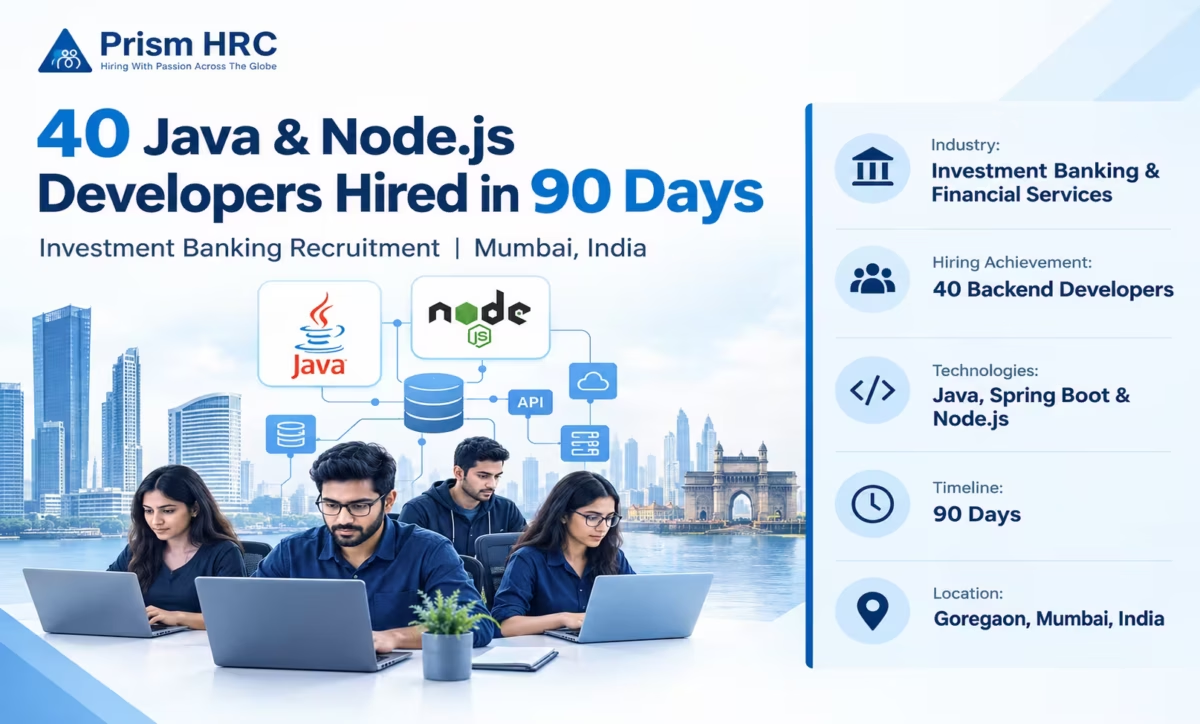
- Industry: Investment Banking & Financial Services
- Client: Leading Investment Banking Company
- Location: Goregaon, Mumbai, India
- Hiring Requirement: 40 Backend Developers
- Technologies: Java, Spring Boot, Node.js, REST APIs, Microservices, SQL, NoSQL
- Hiring Model: Permanent Recruitment
- Project Duration: 3 Months
- Hiring Outcome: 40 Backend Developers Successfully Hired
Client Background
Out of its technology operations in Goregaon, Mumbai, a leading investment banking company was building out its backend engineering team to keep pace with ongoing application development and a broader set of technology initiatives.
Investment banking runs on backend technology. Complex business processes, financial applications, data processing, system integrations, enterprise platforms, all of it depends on backend engineering that holds up under pressure. Which means the developers behind it need more than a programming language on their CV. They need to understand application performance, database management, API integrations, security and how to architect backend systems that scale.
The client wanted a mix of Java developers and Node.js developers to strengthen the team it already had. What they were after were experienced professionals who could genuinely contribute to enterprise application development, backend services, API integrations and the technology projects already in motion.
With a sizable number of positions to fill and a fixed recruitment window, the company needed an IT recruitment partner who could identify the right technical talent, run a large candidate pipeline and keep the hiring process moving efficiently. That’s where Prism HRC came in, engaged to support the recruitment of 40 backend developers across three months.
The Hiring Challenge: Recruiting 40 Backend Developers Within 90 Days
The core challenge was volume and specificity at the same time, a large number of experienced backend developers, all of whom needed to be able to work from the client’s Goregaon office.
Backend hiring isn’t like general software development recruitment. It calls for a proper grasp of programming languages, frameworks, application architecture, database technologies and the kind of project experience that actually translates. And this client’s requirement spanned two distinct technology stacks.
Java and Spring Boot Developers
The company needed Java backend developers with real enterprise application experience. The relevant skills included:
- Core Java and advanced Java concepts
- Spring Boot and the Spring Framework
- Microservices architecture
- RESTful API development
- SQL databases and database integration
- Application performance and optimisation
- Backend system integration
- Enterprise application development
Crucially, candidates needed hands-on development experience rather than theoretical knowledge or passing exposure to Java technologies.
Node.js Backend Developers
The second half of the requirement called for Node.js developers who could build and maintain backend services and applications. Here the screening criteria covered:
- JavaScript and Node.js development
- Express.js and related backend frameworks
- REST API development and integration
- Microservices and asynchronous programming
- SQL and NoSQL databases
- Backend application architecture
- Authentication and authorisation concepts
- Application debugging and performance optimisation
The task for our recruitment team was to separate candidates with genuine backend experience from those whose background was really frontend development or fairly basic JavaScript work.
Key Recruitment Challenges
1. Large-Scale Hiring Within a Fixed Timeline
Forty backend developers in three months meant running a continuous pipeline, with sourcing, screening, interviews, offer discussions and joining coordination all happening at once rather than in sequence.
2. Identifying Technically Relevant Candidates
Not every Java or Node.js developer had the backend depth required. We needed people who’d genuinely worked on APIs, databases, enterprise applications and production-level backend systems.
3. Location-Specific Hiring in Mumbai
The client needed developers who could work from Goregaon. That made location preference, commute feasibility and willingness to work from the office real screening considerations rather than afterthoughts.
4. Salary Expectations and Notice Periods
Experienced backend developers arrive with widely varying compensation expectations and joining timelines. Finding people whose numbers and availability matched was its own filter.
5. Managing Multiple Interviews and Offers
With 40 positions in play, the process demanded constant interview coordination, candidate follow-ups, feedback management and clear communication between the client and everyone shortlisted.
Prism HRC’s Recruitment Strategy
We built a focused approach around the client’s Java and Node.js requirements.
With over 15 years of IT recruitment behind us, our team knew the screening had to go deeper than surface-level matching, looking at relevant technical expertise, actual project responsibilities, availability and hiring expectations together.
So rather than leaning on programming language keywords, the process concentrated on finding backend developers whose experience genuinely lined up with the client’s technology environment.
1. Understanding the Technical Requirements
The first job was working through the requirements properly and getting clear on where the Java and Node.js roles diverged. Our recruiters mapped out the languages, frameworks, backend responsibilities, database technologies and experience levels that each one called for.
Java screening leaned into Spring Boot, enterprise applications, APIs and microservices. Node.js screening shifted toward backend JavaScript, API implementation, databases and application architecture. With that clarity, the team could run two distinct pipelines rather than one blurred pool.
2. Dedicated Candidate Sourcing for Java and Node.js
Specialised IT recruiters went to work, finding backend developers through professional networks, recruitment databases, job portals and existing candidate relationships.
Mumbai and the surrounding area was the primary hunting ground, though candidates elsewhere willing to relocate were considered too. Our recruiters sought out professionals with genuine backend application development behind them, along with API integrations, database work and enterprise technology projects.
And before anyone’s profile moved forward, the team checked employment status, expected compensation, notice period and preferred working arrangements. That discipline is what kept the pipeline honest.
3. Technical CV Screening and Candidate Evaluation
A big part of this project came down to reading CVs properly.
For Java developers, our recruiters looked at experience in Core Java, Spring Boot, REST APIs, microservices and database technologies. For Node.js developers, the focus was JavaScript, Node.js frameworks, API development, asynchronous programming and backend application work.
But we went beyond the skills section. We examined the nature of the projects candidates had handled, what they’d actually been responsible for, and how involved they’d been in application development. A candidate listing Spring Boot, for instance, was evaluated on their genuine project experience rather than shortlisted simply because the framework appeared somewhere on the page. Node.js candidates were similarly screened to establish whether they’d really done backend work or had only brushed against it through full-stack projects.
That extra scrutiny made a noticeable difference to the relevance of what reached the client.
4. Candidate Qualification and Hiring Alignment
Alongside the technical screening, we assessed candidates against the practical realities of the hire:
- Total and relevant backend development experience
- Current compensation and expected CTC
- Notice period and likely joining date
- Current location and willingness to work in Goregaon
- Communication skills and interview availability
- Genuine interest in the position and longer-term career expectations
The point was to find people who were both technically suitable and genuinely keen on the opportunity. Raising these things before submitting a profile is what prevented avoidable mismatches surfacing later at the interview or offer stage.
5. Interview Coordination and Candidate Follow-Ups
With this many positions open simultaneously, interview coordination became a significant piece of work in its own right.
We worked closely with the client’s hiring team to schedule interviews, pass on the details, collect feedback and manage candidate follow-ups. Our recruiters stayed in regular contact with shortlisted candidates to gauge their continued interest, their availability and whether anything had shifted in their employment situation. Anyone moving through the process got updates on subsequent rounds and hiring decisions.
That steady communication is what kept momentum going across the full three months.
6. Offer Management and Joining Coordination
Selection wasn’t the finish line. We supported the conversations around compensation expectations, offer discussions, documentation requirements and joining timelines.
Our recruiters stayed in touch with selected candidates throughout their notice periods and coordinated with the client on expected joining dates. That mattered particularly here, because the project involved multiple hires across two technologies, each candidate with their own availability and notice period. The team kept supporting the process until every required position was filled.
Recruitment Execution Across Three Months
This project needed continuous sourcing and recruitment activity right across the 90 days. Rather than treating the brief as a series of isolated vacancies, we ran it as one coordinated backend developer hiring project.
In the early phase, the focus was on understanding the technical requirements, identifying the relevant talent pools and establishing pipelines for both Java and Node.js. As things progressed, sourcing and CV screening carried on in parallel with client interviews and candidate selection. In the closing stages, the team concentrated on keeping candidates engaged, coordinating the remaining interviews, and supporting offers and joining to hit the overall target.
Running things in parallel like this, rather than waiting for one stage to finish before starting the next, is what made the timeline achievable.
Hiring Outcome: 40 Backend Developers Recruited in 90 Days
40 Backend Developers | Java & Node.js | Goregaon, Mumbai | 3 Months
Prism HRC supported the recruitment of 40 backend developers within three months for the investment banking company, covering a mix of Java and Node.js developers with genuine backend application development experience.
The assignment helped the client expand its backend engineering team and strengthen its technical workforce for the application development work already underway.
Key Outcomes
- 40 backend developers hired within the planned three-month timeline
- Recruitment completed across both Java and Node.js technology stacks
- Hiring delivered for the client’s Goregaon, Mumbai technology operations
- Candidates screened on backend development skills, project experience, salary expectations and availability
- Recruitment activities coordinated across sourcing, interviews, offers and joining
Taken together, the project showed what Prism HRC can do on volume hiring involving specialised backend technologies inside a defined timeline.
Key Learnings from the Backend Developer Hiring Project
Technology-Specific Screening Improves Candidate Relevance
Java and Node.js developers may both build backend applications, but their frameworks, programming approaches and project environments can differ a great deal. Recognising those differences during CV screening is what helps recruiters find candidates whose experience genuinely fits the role.
Recruitment Speed Requires Continuous Candidate Pipelines
When a company needs multiple backend developers in a short window, a small initial shortlist won’t carry you through. Continuous sourcing and screening keep candidates available as interviews, selections and offers move along.
Salary and Notice Period Alignment Matter
Technical suitability alone doesn’t get a hire over the line. Discussing compensation, location and joining timelines early helps identify the candidates most likely to actually make it through the process.
Candidate Engagement Is Important During Bulk Hiring
Backend developers are usually weighing several opportunities at once. Regular communication, prompt interview scheduling and clear expectations are what keep their interest alive through to the end.
Why Companies Choose Prism HRC for Backend Developer Recruitment
Prism HRC supports companies looking to hire backend developers in India across Java, Python, Node.js, .NET, API development and related backend technologies. Over the last two years we’ve recruited 180+ backend developers across a wide range of technology requirements.
Our recruitment capabilities span permanent hiring, contract staffing, contract-to-hire, dedicated developer recruitment, freelance hiring and recruitment process outsourcing. We work with IT services companies, consulting organisations, product-based businesses, startups and Global Capability Centres looking to strengthen their software engineering teams.
What our specialised IT recruiters bring is an understanding of how backend technologies genuinely differ, and a focus on practical project experience, technical relevance and real hiring readiness. Whether you need to hire Java developers in India, hire Node.js developers in India, or build out a larger backend engineering team, we shape the support around your technology requirements and your timelines.
Looking to Hire Backend Developers in India?
Partner with Prism HRC to hire experienced Java, Node.js, Python and .NET developers through permanent, contract or freelance hiring models. With 15+ years of IT recruitment experience and 180+ backend developers hired in the last two years, we’re ready for your next backend engineering requirement.