
Why Data Engineering Roles Stay Vacant Longer Than Any Other Tech Hire
July 30, 2026
Hiring ERP Consultants – SAP S/4HANA Migration: IsYour Company Ready to Find ERP Talent?
August 3, 2026
Data Scientist vs Data Analyst Hiring: What Non-Technical Managers Get Wrong
Somewhere in your company right now, a manager is about to open a role called "Data Scientist." What they actually need is someone to build a sales dashboard and explain why last quarter went sideways. The job will get posted anyway. Six weeks and forty resumes later, everyone will be quietly confused about why the shortlist looks wrong. This is the quiet trap of data scientist vs data analyst hiring: the wrong hire is set in motion long before anyone reads a single CV.
This happens constantly, and it is not a competence problem. It is a vocabulary problem. Two titles that sound like tiers of the same job are actually two different professions, with different training, different daily work and very different price tags. If you are a non-technical hiring manager signing off on the brief, understanding that split is the highest leverage thing you can do before a single resume lands.
The demand context is what makes precision urgent rather than academic. According to NASSCOM, demand for data science and AI professionals in India has doubled over the past three to five years and the country's demand is expected to cross one million professionals by 2026. Roles like data scientist and machine learning engineer already run a demand supply gap in the range of 60 to 73 percent. In a market that tight, every week your brief stays vague is a week spent competing for scarce, expensive talent you may not even need. Which is exactly why getting data scientist vs data analyst hiring right is less a semantic exercise than a budget decision.
Start With the Question, Not the Title
Here is the cleanest way to tell the data analyst vs data scientist roles apart, and you do not need any technical background to use it.
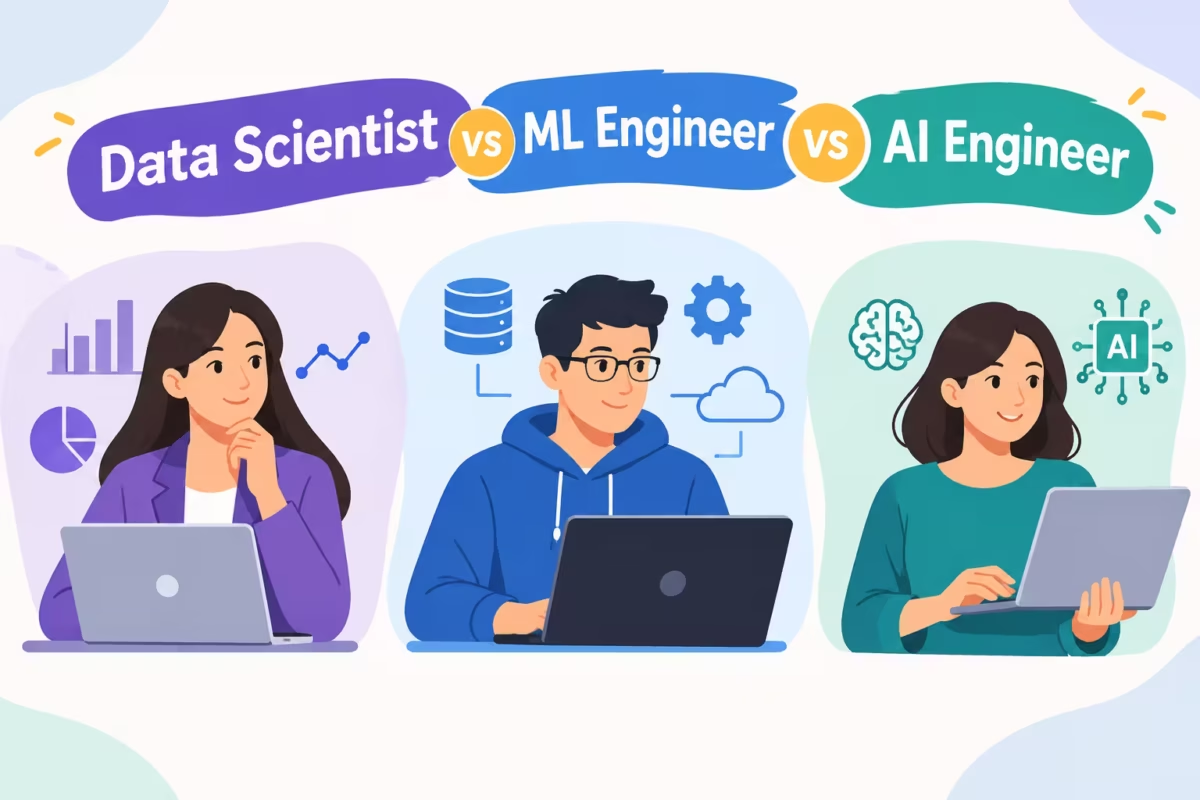
A data analyst answers questions about what already happened. Why did churn spike in March? Which region is underperforming? What does the funnel look like this quarter? They pull the data, clean it, interrogate it and turn it into something a business person can act on. Their output is understanding.
A data scientist answers questions about what will happen, or what to do about it. Which customers are likely to churn next month? What should this user see next? Can we flag a fraudulent transaction before it clears? They build models and systems that make predictions and keep making them without a human in the loop. Their output is a working mechanism.
That is the whole distinction in plain language. Explaining the past versus building something that predicts the future. Everything else, the tools, the degrees, the salary bands, follows from that one difference.
So before writing any brief, answer this: do you need someone to tell you what is going on, or do you need something built that runs on its own? If it is the first, you want an analyst and hiring a data scientist will not get it done faster. It will just cost more.
What Each One Actually Does All Day
The day to day is a useful reality check on the data analyst vs data scientist question, especially if the technical vocabulary is doing your head in.
A data analyst should have:
- SQL, and properly - joins, window functions, CTEs, not just SELECT statements. This is the single most important skill on the analyst side
- Excel at a serious level - pivot tables, lookups, modelling. Still the working language of most business teams
- A BI tool - Power BI, Tableau or Looker, including data modelling inside the tool, not just dragging charts
- Descriptive statistics - averages, distributions, significance, enough to avoid drawing false conclusions
- Light Python or R - pandas for cleaning and manipulation, useful but not always mandatory
- Data storytelling - structuring a finding so a non-technical stakeholder acts on it
- Domain fluency - understanding the business well enough to ask the right question in the first place
A data scientist should have:
- Python at depth - pandas, NumPy, scikit-learn as a baseline, plus PyTorch or TensorFlow for deep learning work
- Applied statistics and mathematics - probability, inference, linear algebra, hypothesis testing. This is what separates a modeller from someone running library functions
- Machine learning fundamentals - regression, classification, clustering, and crucially knowing when a model is overfitting or quietly failing
- Experiment design - A/B testing, causal reasoning, sample sizing
- Feature engineering - turning raw messy data into something a model can learn from, often where most of the real work hides
- Model deployment and MLOps - Docker, APIs, MLflow, cloud platforms like SageMaker or Vertex AI, because a model that never ships is worth nothing
- Model evaluation and monitoring - knowing when a live model has drifted and started making bad calls
- SQL and data wrangling - same foundation as the analyst, just used differently
- Communication - explaining a model's limits to people who will make decisions on its output
The Mistake That Costs the Most
The expensive version of this confusion runs in one direction: over hiring.
Titles carry prestige, so "Data Scientist" gets used to make a role sound more serious, or to compete for attention in a crowded market. The trouble is that when you hire data scientist talent into what is really an analyst job, they spend their days building dashboards, get bored within months and leave. You will have paid a premium, waited longer and still ended up re-hiring. Meanwhile the analyst who would have loved that job and stayed three years never applied, because the title told them they weren't qualified.
The reverse mistake is quieter but just as real. A company hires an analyst, then asks them to build a production recommendation engine. That is not a stretch assignment, it is a different discipline. The person struggles, the project stalls and everyone concludes the hire was weak. The hire was fine. The brief was wrong.
Why the Pool Matters More Than the Title
There is a second angle worth knowing. Because analyst roles are far more numerous and the entry path is shorter, the analyst pool in India is genuinely deep. The data scientist pool is not. Anyone who has run data science recruitment India knows how that plays out: when you write "Data Scientist" on a job an analyst could do, you voluntarily move your search from a deep pool into a shallow, fiercely contested one. Sometimes that is the right call. Often it is just the title someone typed without thinking about which market it drops you into.
How to Get the Brief Right Without Being Technical
You do not need to understand gradient descent to write a good brief. You need to answer four questions honestly.
What decision or product does this role serve? "Leadership needs better visibility" is analyst work. "The app needs to personalise recommendations" is data science.
Does the output need to run automatically? Reports a human produces and presents are analyst work. Systems that decide repeatedly without anyone pressing a button are data science.
Who will this person talk to daily? Business stakeholders point toward analysts. Engineers and product teams point toward data scientists.
Do we have the data infrastructure for this? This gets skipped constantly. Hiring a data scientist before you have clean, accessible data is like hiring a chef for a kitchen with no plumbing. Often the honest first hire is a data engineer, and nobody wants to hear it.
Answer those four and you can write a brief a specialist recruiter can actually work with.
Evaluating Candidates When You Can't Read the Code
The instinct is to defer entirely to a technical interviewer. Bring one in, absolutely, but do not check out, because there are things you can assess better than they can.
Ask the candidate to explain a past project to you, specifically to you, without jargon. If they cannot make you understand what problem they solved and why it mattered, that is a real signal, not a technicality. Both roles live or die on translating work to people who are not in the weeds.
Ask what the business impact was. Strong candidates talk about outcomes and constraints. Weaker ones recite tools. Ask what went wrong, too. Anyone who has genuinely shipped something has a story there; anyone who has only studied will fumble it.
And push for a work sample built on a real problem rather than a whiteboard puzzle. It is the closest thing to a reliable signal this field has.
Where Prism HRC Fits In
At Prism HRC, we see this from the side most hiring managers never do: the point where a vague brief turns into a six month search. The data scientist vs data analyst hiring question is rarely a technical debate. It is a symptom of an organisation that has not been honest yet about the problem it is trying to solve, and no amount of sourcing fixes that after the fact. So we start upstream, pushing on the brief before the search begins, mapping the role to the pool it actually sits in and screening for demonstrated ability rather than title matching off a resume. In a market with a supply gap this wide, the companies that define the role precisely fill it. The ones that pick a title first are still interviewing.
Not sure whether you need a data analyst, a data scientist or something else entirely?
Prism HRC helps companies sharpen the brief before the search starts, then finds people who can actually do the job.
Frequently Asked Questions (FAQs)
Tell Us Your Requirement
Ready To Build Your Dream Team With Prism HRC?
Want to explore our range of recruitment, staffing, payroll, compliance, employee welfare and employee global mobility solutions? Fill out this form and our subject matter experts will get in touch with you within 2 working days to address all your requirements at length.
Note to Candidates: Please DO NOT use this form to career related queries or job applications, as all such requests will be DELETED. For any job/career related queries, please go to career page.