
Hiring Your First Site Reliability Engineer: When You Need One and What the Role Should Own
October 23, 2026
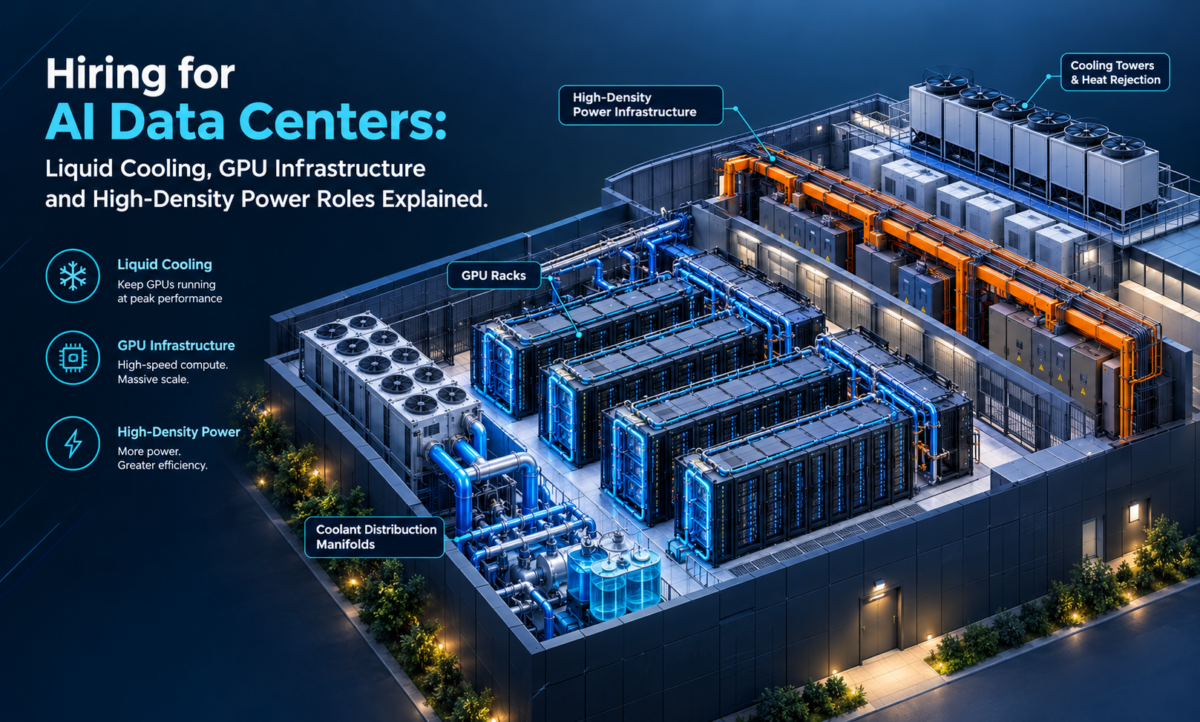
Hiring for AI Data Centers: Liquid Cooling, GPU Infrastructure and High-Density Power Roles Explained
October 29, 2026
Most full stack hiring conversations begin in the wrong place. Someone decides the company needs a MERN developer, the role goes up and only later does anyone work out whether MERN was ever the right fit for what’s being built. The stack gets chosen first, the product requirements get retrofitted around it and six months in there’s a quiet realisation that the architecture is fighting the business problem rather than serving it.
The better order is straightforward. Understand what you’re building. Decide which stack suits it. Then hire someone who genuinely knows that stack, rather than someone who has listed it.
This post covers the main options, the kind of product each one actually fits and what to screen for in each case. It also tackles a question most buyers never think to ask, which is whether hiring a full stack developer is the right answer at all.
MERN: MongoDB, Express, React, Node.js
MERN is the default for good reason. JavaScript runs end to end, which means one language across front and back, a single talent pool to draw from and developers who move between layers without switching mental models. It also has the deepest hiring pool of the three, one 2026 comparison put active MERN roles in India at around 42,000, with notably higher remote and freelance availability than Java.
What it fits: customer-facing web applications, SaaS products, dashboards, marketplaces, anything where you’re iterating quickly on the interface and the data model is still finding its shape. React’s component model suits products where the UI carries most of the complexity.
Where it strains: complex transactional requirements, heavy reporting, regulatory constraints on data integrity. MongoDB’s schema flexibility is a genuine advantage early and can turn into a liability once relationships get properly complicated.
When you hire MERN stack developers, screen for:
- React depth rather than familiarity, hooks, state management, component architecture, performance
- Node.js and Express for API design, middleware, authentication, error handling
- MongoDB schema design, embedding versus referencing, indexing, aggregation
- Asynchronous JavaScript handled properly, including the error cases people skip
- Real deployment experience, not just local development
A question that separates people quickly: “How would you model data for a marketplace where buyers and sellers both leave reviews?” It reveals whether they think about query patterns and relationships, or simply store documents and hope.
MEAN: MongoDB, Express, Angular, Node.js
Swap React for Angular and the character of the stack changes considerably. Angular is opinionated and structured, TypeScript by default, dependency injection built in, a defined architecture rather than an assembled one.
What it fits: larger applications where consistency across a bigger team matters more than flexibility. Internal enterprise tools. Products expected to be maintained for years by developers who didn’t write the original code. Angular’s conventions mean someone joining in year three finds things roughly where they expect them.
Where it strains: small, fast-moving products where the structure becomes overhead and teams without the discipline to use it properly.
Screen for:
- Angular proper, components, services, modules, RxJS, change detection
- TypeScript used genuinely, not JavaScript with occasional annotations
- The same Node.js, Express and MongoDB depth as MERN
- Judgment about when Angular’s conventions help and when they get in the way
Choosing between MERN and MEAN stack options usually comes down to team shape and timeline rather than technical superiority. React gives flexibility and a bigger hiring pool. Angular gives structure and consistency.
Java full stack: enterprise systems with real complexity
Java occupies different territory and the products needing it are usually obvious once you look. A java full stack developer typically pairs Spring Boot on the back end with React or Angular on the front and companies choose this for reasons that have nothing to do with fashion.
It’s also the larger market in India. That same 2026 comparison counted roughly 68,000 active Java full stack roles against MERN’s 42,000, driven by banking, insurance, government and telecom.
What it fits: complex business logic, strict transactional requirements, deep integration with existing enterprise infrastructure, regulatory and audit obligations. Banking, insurance, logistics, healthcare, ERP-adjacent products.
Java’s maturity is the entire point. Decades of tooling for transaction management, security, monitoring and integration. A type system that catches at compile time what JavaScript finds at runtime, which matters enormously when the runtime is a payments system.
Where it strains: small products and early-stage startups. Java carries more ceremony and on a simple CRUD product that ceremony is pure cost.
Screen for:
- Core Java and Spring Boot, including dependency injection, Spring Data, Spring Security
- REST API design and microservices architecture
- Relational database design, SQL depth, transactions, performance tuning
- A genuinely competent front end, usually React or Angular
- Testing discipline, JUnit and integration testing, because enterprise teams expect it
One caution: “Java full stack” sometimes means strong Java with thin front-end exposure. Test both halves separately rather than assuming the balance.
Python full stack: products built close to data
Python with Django or FastAPI, paired with React, suits a specific kind of product, one where the interesting work lives in the data layer rather than the interface.
What it fits: analytics products, internal data tools, anything with ML or AI components, products where the back end does serious computation. The advantage is ecosystem adjacency, your application code sits in the same language as your data science work, removing an entire translation layer between teams. It has become particularly common in fintech and data-heavy applications.
Screen for: Python depth, Django or FastAPI, SQL and data modelling, API design, plus real front-end capability. If AI features are involved, add model integration and the practical realities of serving predictions.
Matching stack to product
| Stack | Best fit | Watch out for |
| MERN | Customer-facing web apps, SaaS, fast iteration, evolving data models | Complex transactions, heavy reporting, strict data integrity |
| MEAN | Larger apps, bigger teams, long maintenance horizons, enterprise internal tools | Small fast-moving products where structure is overhead |
| Java full stack | Complex business logic, transactional systems, enterprise integration, regulated industries | Early-stage products where iteration speed matters most |
| Python full stack | Analytics products, data-heavy tools, AI and ML components | Products where the front end carries most of the complexity |
The question buyers rarely ask: do you need a full stack developer at all?
This is the part most comparison posts skip and it matters more than the stack choice.
Full stack developers genuinely shine in specific conditions. Small teams. Early-stage products. Situations where one person owning a feature end to end beats coordinating two. A startup with four engineers almost certainly wants full stack people and so does a team building internal tools with modest UI requirements.
But there’s a point where it stops being an advantage. Consider separate specialists when:
Your front end has real complexity. Sophisticated interfaces, accessibility requirements, performance budgets, design systems, animation. This is a discipline of its own and someone treating the front end as “the bit after the API” will build something that works and feels wrong.
Your back end carries serious load. Distributed systems, high throughput, intricate data modelling, security-sensitive logic. Depth beats breadth here and a generalist hits their ceiling.
You’re scaling past eight to ten engineers. Beyond roughly that size, specialisation usually produces better outcomes. The coordination cost full stack avoids gets replaced by a quality cost.
The quality bar is non-negotiable. Regulated industries, expensive failure modes, anywhere “good enough” genuinely isn’t.
The honest version is that full stack is often a resourcing decision dressed up as an architectural one. That’s a legitimate reason, worth naming so you make it deliberately rather than by default.
A practical middle path many teams reach: hire full stack developers for feature velocity, then add one specialist on whichever side carries the most complexity. Flexibility without a ceiling where it counts.
What it costs
Published figures vary widely by source and methodology, so treat these as indicative rather than precise. Across the Indian market in 2026, mid-level full stack developers with three to five years’ experience broadly sit in the ₹10–18 LPA range, with freshers starting lower and senior engineers at product companies and GCCs reaching ₹25–45 LPA.
By stack, the pattern is consistent across sources: MERN commands a premium at startups and product companies, while Java full stack tends to pay highest at MNCs and in banking and insurance, where legacy modernisation is driving demand. One 2026 Bangalore comparison put mid-level Spring Boot plus React at ₹20–35 LPA against MERN’s ₹18–30 LPA, though other sources show MERN ahead at product companies specifically.
The more reliable signal underneath all of it: a full stack engineer who can genuinely own architecture end to end, database schema through to cloud deployment, commands ₹25–45 LPA regardless of which stack they work in. Depth outprices stack choice.
Where Prism HRC fits in
Most full stack searches that stall do so for the same reason, the brief named a stack before anyone defined the product. We spend time there first, working out what’s actually being built, whether a full stack developer suits it, or whether one strong specialist on the harder side would serve better. Then we screen for genuine depth across both halves rather than accepting a CV carrying the right acronyms.
For companies looking to hire full stack developers India wide, across MERN, MEAN, Java or Python, we support permanent, contract and dedicated hiring models depending on how long the work runs and who maintains it afterwards.
Not sure which full stack developer your product needs?
Prism HRC can help you define the role and hire the right fit.
Frequently Asked Questions (FAQs)
1Which full stack developer skill set between MERN, MEAN and Java is best suited for my product?
It depends on what you’re building. MERN suits fast-moving customer-facing web apps, MEAN suits larger applications with bigger teams and longer maintenance horizons and Java suits systems with complex business logic, transactional requirements or regulatory obligations.
2Compare MERN, MEAN and Java full stack for enterprise-level applications.
For enterprise systems with intricate rules and strict data integrity, Java full stack usually wins on maturity, type safety and transaction handling, which is why it dominates banking, insurance and government hiring in India. MEAN fits enterprise internal tools where Angular’s structure helps larger teams. MERN is generally better suited to product-facing applications than core enterprise systems.
3What are the advantages of hiring a Java full stack developer over MERN or MEAN?
Compile-time type safety, decades of mature tooling for transactions, security and integration and strong performance on complex processing. It’s the safer choice where a production error is expensive and the talent pool is larger, with roughly 68,000 active Java full stack roles in India against MERN’s 42,000.
4Where can I find top-rated MERN, MEAN, or Java full stack developers in India?
Through specialist technology recruiters who screen for genuine depth across both front and back end rather than keyword matching. Prism HRC supports full stack hiring across MERN, MEAN, Java and Python stacks.
5What are the typical costs of hiring a MERN vs MEAN vs Java full stack developer in India?
Mid-level full stack developers broadly sit in the ₹10–18 LPA range, rising to ₹25–45 LPA for senior engineers at product companies and GCCs. Java tends to pay highest at MNCs and in BFSI, MERN at startups and product companies, though published ranges vary by source. Genuine end-to-end architectural ownership commands a premium regardless of stack.
6How does the performance of a MEAN application compare to a Java full stack application under heavy load?
Node.js handles high volumes of concurrent I/O-bound requests efficiently, while Java typically performs better on CPU-intensive work and complex transactional processing. In practice, real-world performance depends far more on architecture, database design and caching than on the language itself.
Tell Us Your Requirement
Ready To Build Your Dream Team With Prism HRC?
Want to explore our range of recruitment, staffing, payroll, compliance, employee welfare and employee global mobility solutions? Fill out this form and our subject matter experts will get in touch with you within 2 working days to address all your requirements at length.
Note to Candidates: Please DO NOT use this form to career related queries or job applications, as all such requests will be DELETED. For any job/career related queries, please go to career page.