
MERN vs MEAN vs Java Full Stack: Which Full Stack Developer Does Your Product Need?
October 26, 2026
How to Screen SAP Consultants: Verifying Real Implementation Experience Beyond Module Names
November 1, 2026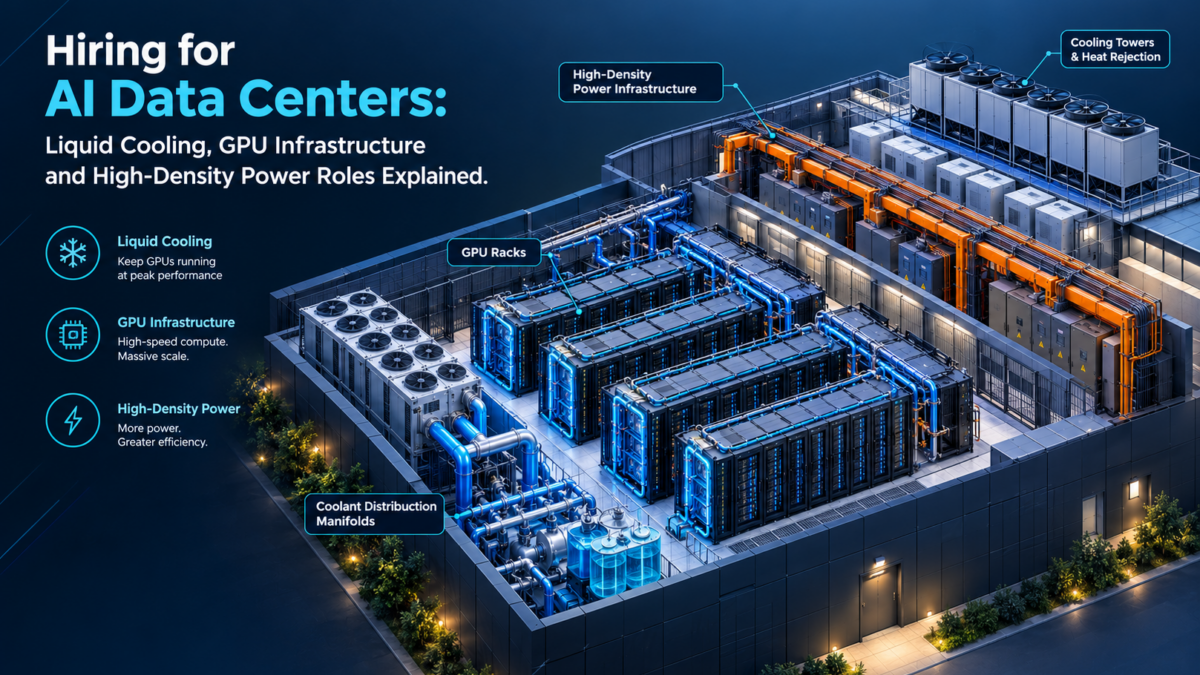
A traditional server rack and an AI training rack look similar from the aisle. What happens inside them is not remotely the same. And that gap is quietly rewriting what a data center team in India needs to look like.
Here are the numbers that explain why. An ordinary server rack drew around 11 kW in 2026, according to the Uptime Institute. A single Nvidia GB300 NVL72 AI rack can pull up to 142 kW. That is more than ten times the heat and power, packed into the same footprint. Air cooling, the default for decades, becomes impractical above roughly 50 kW per rack (Data Center Knowledge). So the moment a facility takes on serious AI workloads, it needs skills most Indian sites simply did not require a few years ago.
This is not a distant trend either. India’s data centre capacity sat at about 1,700 MW at the end of 2025 and is projected to grow around 30% year on year through 2026, per CBRE (IANS). A lot of that new build is AI ready. The talent to run it is not keeping pace.
This piece walks through the three role families AI data centers now depend on, where that talent actually comes from today and how to hire when experienced candidates are thin on the ground.
Role 1: Liquid and immersion cooling specialists
Once a rack crosses that ~50 kW line, fans and chilled air stop being enough. You move to liquid and liquid is a different discipline entirely.
Two approaches dominate. Direct-to-chip cooling pipes coolant straight to a cold plate sitting on the GPU and it handles roughly 100 to 150 kW per rack. Immersion cooling goes further, submerging whole servers in a dielectric fluid. Both bring plumbing, fluid chemistry, leak detection and pressure management into a room that used to care mostly about airflow.
A liquid cooling engineer owns this world. They design and run the coolant loops, manage the coolant distribution units, watch for leaks over live electronics and keep thermals stable while GPUs run flat out for days. It is part mechanical engineering, part facilities, part a genuinely new specialisation. And because the technology is young in India, people who have actually operated it at scale are rare.
Role 2: GPU and HPC infrastructure engineers
Power and cooling get the gear running. Someone still has to make the GPUs actually work as a system and that is its own job.
A gpu infrastructure engineer lives at the seam between hardware and the workloads riding on it. They stand up and maintain GPU clusters, tune the high speed interconnects that let hundreds of GPUs train one model together, manage scheduling and utilisation and chase down the bottlenecks that leave expensive silicon idle. When a training run stalls, they are the ones who understand both the physical fabric and enough of the workload to find out why.
This is where gpu infra overlaps with the high performance computing world. Clustering, fast networking, keeping a fleet of accelerators busy and healthy, these are HPC problems that predate the current AI boom. The context is new. The core skill set has a longer history, which matters a lot when you start looking for candidates.
Role 3: High-density electrical design and capacity planning
Then there is the power itself and this is where the strain is most brutal. Fitting 142 kW into a rack that was designed around 11 is not a tweak. It is a rethink of the electrical backbone.
High-density power engineers handle that rethink. They design power distribution that can actually feed these racks, sort out redundancy so a single fault does not take down a training cluster and plan capacity against a hard ceiling. Because here is the squeeze: grid power in a given location is finite and AI racks are hungry. Capacity planning becomes a real constraint on how much compute a site can ever hold, not a back office spreadsheet exercise. Get the electrical design wrong and you have either stranded expensive capacity or built something that trips under load.
These engineers increasingly shape what a facility can do at all. That makes them one of the most strategically important hires on the list and one of the hardest to find.
Where this talent actually comes from today
Nobody in India has fifteen years of “AI data center” on their CV. The field is not that old. So the realistic question is not where the perfect candidate is, it is which adjacent backgrounds translate.
Three pools stand out. HPC environments, research computing, national labs and a handful of supercomputing centres, have people who have run GPU clusters and fast interconnects for years. The OEM and hardware vendor world, the companies building the cooling systems, power gear and servers, holds engineers who understand this equipment intimately from the manufacturing and deployment side. And adjacent industrial cooling, process industries, specialised thermal management, plants that already handle liquid cooling at scale, has transferable mechanical talent that maps onto data center liquid systems with some retraining.
Spotting these transferable profiles is most of the battle. The candidate who ran immersion cooling in an industrial setting may never have set foot in a data center and a keyword search for “data center” will miss them entirely. That is exactly where generic sourcing fails and specialised data center recruitment india work earns its place.
How to hire when experienced candidates are scarce
Accept the premise first: you will not fill these roles purely with people who have done the exact job before. There are not enough of them. The teams that win treat that as a sourcing strategy, not a dead end.
Cross skill the people you already have. Your critical facilities staff, the electrical and mechanical engineers already keeping the site alive, understand power and cooling fundamentals deeply. Many can move into high density and liquid cooling work with focused training far faster than an outsider learns your facility from scratch. The foundation is already there. Build on it.
Hire for the adjacent profile and the aptitude, not the perfect title. An HPC engineer who has not worked in a commercial data center, or an industrial cooling specialist new to IT, can often grow into the role quickly if the core skills and the willingness to learn are real. Screen for the transferable foundation and the attitude, then invest in the gap.
And move faster than you are comfortable with. This talent is scarce and sought after. A slow, cautious hiring process loses the few strong candidates to someone who moved first. Speed, here, is a competitive advantage, not a corner cut.
How Prism HRC approaches hiring for AI data centers
This is specialised, scarce talent recruitment and it rewards knowing where to look rather than posting a job and waiting. At Prism HRC, our technology recruitment teams understand these next generation data center roles, liquid cooling, GPU infrastructure and high density power and we source against transferable backgrounds, not just literal keyword matches, so the adjacent HPC, OEM and industrial cooling profiles do not slip through.
We also hire at volume when the need is there. Our work with large employers, including a BFSI engagement in Navi Mumbai, has shown we can staff sizable, time bound technology mandates without dropping the quality bar, which is exactly what new facility builds and data center staffing ramps demand. For permanent, contract, project and contract-to-hire requirements, Prism HRC helps you build AI data center teams through the right mix of cross skilled and specialist talent.
Sources
Data Center Knowledge — AI Rack Density’s Real Limits
IANS — India’s data centre capacity to grow 30% in 2026 (CBRE)
Building an AI data center team?
Prism HRC helps you find liquid cooling, GPU infrastructure and high-density power talent, including the right adjacent profiles.
Frequently Asked Questions (FAQs)
Tell Us Your Requirement
Ready To Build Your Dream Team With Prism HRC?
Want to explore our range of recruitment, staffing, payroll, compliance, employee welfare and employee global mobility solutions? Fill out this form and our subject matter experts will get in touch with you within 2 working days to address all your requirements at length.
Note to Candidates: Please DO NOT use this form to career related queries or job applications, as all such requests will be DELETED. For any job/career related queries, please go to career page.