Blockchain Recruitment: How to Screen and Hire Real Blockchain Developers
August 27, 2026
What India’s New Labour Codes Mean for Companies Using Contract IT Talent
September 10, 2026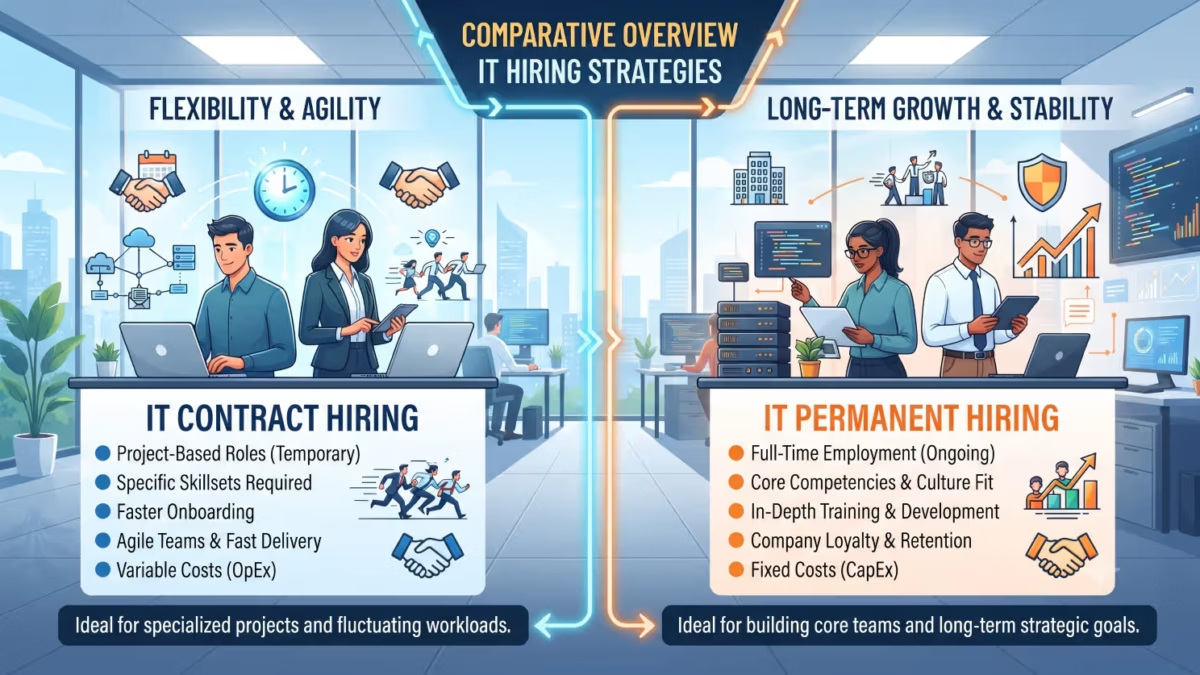
Technology leaders today are expected to deliver more digital transformation while making every hiring decision more carefully. Cloud migration, data platforms, cybersecurity, AI adoption, ERP modernisation and customer facing product work all require specialist talent. At the same time, project scopes can change quickly, budgets may be released in phases and a role that is critical for the next six months may not make sense as a long term addition to the payroll.
That is why the choice between IT contract staffing and permanent IT recruitment has become part of project planning, not just an HR decision. Both models have their place. Permanent employees bring ownership, institutional knowledge and leadership continuity, while contract professionals provide specialist skills, speed and workforce flexibility when project requirements are uncertain.
For many organisations in 2026, a blended workforce can be the most practical approach: keep a strong permanent core and use IT contract staffing to build, speed up or stabilise delivery teams. The right balance depends on the type of work, the skills needed, the project timeline and the level of risk the business is prepared to take.
What is IT contract staffing?
IT contract staffing means engaging technology professionals for a defined assignment, project period or specific business need. They may work on site, remotely or in a hybrid model. The staffing partner typically manages payroll, statutory requirements, timesheets and ongoing employment administration, while the client manages the day to day project work. This gives the organisation access to the specialist capacity it needs without necessarily adding every professional to its permanent headcount.
This model is commonly used for roles such as software developers, cloud engineers, DevOps specialists, data engineers, SAP and Workday consultants, cybersecurity analysts, QA automation engineers, project managers, product specialists and IT support teams. It is especially useful when a company needs a particular skill quickly but is not certain how long that requirement will continue.
Permanent hiring means bringing an employee directly onto the organisation’s payroll for an open ended role. It is generally suited to capabilities that will remain important after a specific programme or project comes to an end.
IT contract staffing vs permanent hiring at a glance
| Factor | IT Contract Staffing | Permanent IT Recruitment |
|---|---|---|
| Speed to deploy | Fast, especially for project-ready skills | Slower due to sourcing, interviews, notice periods and onboarding |
| Cost structure | Variable project-linked monthly cost | Fixed salary, benefits, hiring and long-term employment cost |
| Skills access | Ideal for niche or in-demand expertise | Best for capabilities needed continuously |
| Workforce flexibility | Easy to scale up or down with project demand | Headcount changes take longer and carry more commitment |
| Compliance administration | Managed with support from staffing partner | Managed directly by the employer |
| Knowledge retention | Requires handover discipline | Stronger long-term institutional knowledge |
| Best use case | Time-bound delivery, transformation or uncertain demand | Core products, leadership and stable functions |
1. Cost: fixed employment cost versus flexible project spend
Looking only at the monthly rate does not give the full picture. The cost of a permanent employee can also include recruitment time, benefits, statutory contributions, training, bench risk and the management effort involved if demand falls.
With IT contract staffing, costs are more directly connected to the assignment. The monthly bill may appear higher than one month’s salary, but it often includes payroll administration, statutory compliance and the staffing partner’s employment responsibilities. More importantly, the organisation pays for the capacity when it is needed. Once a project phase is complete, the workforce can be resized instead of carrying a long term cost structure that no longer matches the business requirement.
Contract professionals are not automatically cheaper. Highly specialised cyber, SAP or AI professionals can command premium rates. The value lies in getting access to that expertise during the period when it can have the greatest impact, without making an open ended commitment before the roadmap is fully proven.
Permanent hiring generally makes more sense when the capability is needed year after year. For a core product engineer or long term architect, direct employment can provide better continuity and lower cost over time. The key questions are how long the capability is genuinely needed and what the cost will be if priorities change.
2. Speed: project deadlines rarely wait for a long hiring cycle
Speed is one of the main reasons organisations turn to IT contract staffing. A permanent hiring process can take weeks or months once interviews, negotiations, notice periods and onboarding are taken into account.
Contract staffing can reduce that timeline because the requirement is connected to a specific, clearly defined assignment. A specialist staffing partner typically has networks of active and pre-screened professionals and can present suitable profiles quickly. This can be particularly useful when a security audit has identified urgent gaps, a production release needs additional QA automation, a data migration has a fixed deadline or an enterprise platform rollout needs to go live before a regulatory or commercial milestone.
Moving quickly does not mean the selection process should be rushed. Define the expected outcomes, required tools, seniority, location and duration upfront so the staffing partner can focus on providing fewer, stronger profiles.
3. Skills: use permanent teams for your core and contracts for the edge
Technology stacks change faster than most organisations can rebuild their permanent workforce. In 2026, many teams need skills in AI product engineering, cloud security, data governance, FinOps, platform engineering, ERP transformation and identity security. Some of these requirements may become permanent, while others may be intensive but temporary.
Permanent hiring should protect the capabilities that define the business. Product ownership, enterprise architecture, engineering leadership, customer domain knowledge and critical internal platforms usually benefit from permanent employees. These professionals carry long-term context, make strategic decisions and mentor the wider team.
IT contract staffing works particularly well for project peaks and scarce specialisms. For example, a company moving to SAP S/4HANA may need functional consultants, integration specialists and cutover experts for nine months. A bank strengthening its application security programme may need experienced penetration testing, AppSec and DevSecOps professionals while it develops a longer term internal team. A GCC starting a new data function may initially need contract data engineers and cloud specialists while the operating model takes shape.
Avoid hiring permanently for every temporary surge, but also avoid treating contractors as isolated resources. They need project governance, appropriate system access, clear acceptance criteria and a knowledge transfer plan.
4. Compliance: the model must be structured correctly
Compliance is not a reason to avoid contract staffing. It is a reason to choose a credible partner and structure the engagement properly. In India and across international assignments, employers need to consider payroll, taxes, statutory benefits, labour requirements, confidentiality, data access, background verification, IP ownership and local employment rules.
An experienced IT contract staffing partner can help manage the employment and payroll framework, statutory documentation, timesheets, invoices and the replacement process. This reduces the administrative workload for the client and brings greater discipline to contingent workforce management. The client should still make sure its contracts clearly define the scope, reporting relationships, information security obligations, access controls, data handling and intellectual property rights.
With permanent hiring, these obligations sit directly with the employer throughout the employment lifecycle. For a short term project, that can create additional administrative work. Do not choose a staffing partner based on rate alone: check its payroll capability, compliance processes, background checks, replacement terms and relevant experience.
5. Risk: in 2026, flexibility is a strategic advantage
The technology environment offers plenty of opportunity, but it is also unpredictable. AI investments are growing, while many companies are still testing what can scale. Cybersecurity, cloud optimisation, ERP and digital transformation programmes can speed up, pause or change direction as budgets and leadership priorities shift.
In this environment, hiring permanently for every project position can create headcount risk. If a programme is delayed or a client reduces its scope, the organisation may be left with a cost base built around a delivery plan that no longer exists. Later reductions can affect morale, slow future hiring and take up management attention.
IT contract staffing can turn some of that fixed risk into a planned variable cost. You can start with a focused team, scale up when milestones are approved and gradually reduce the team after deployment or handover. This gives the organisation more room to respond to changing priorities without compromising delivery quality.
Contract staffing has its own risks as well. Knowledge can leave when an assignment ends and weak onboarding can lead to quality or security issues. These risks can be managed through named permanent owners, ongoing documentation and a planned handover.
When IT contract staffing is the better fit
Choose IT contract staffing when your project has one or more of these characteristics:
- A fixed delivery window, such as a cloud migration, ERP rollout or product release.
- Urgent demand for skills that are difficult to hire permanently, including cybersecurity, AI, data, DevOps, SAP or Workday.
- A temporary spike in workload for engineering, testing, support or implementation.
- Budget approval that is tied to project milestones rather than permanent headcount.
- A new capability that the business wants to validate before building a large internal team.
- Expansion into a new city, market or GCC where the long-term workforce plan is still being developed.
For these situations, contract staffing gives the project leader a practical way to begin delivery now instead of waiting until every internal headcount decision has been finalized.
When permanent hiring is the better fit
Choose permanent hiring when the role is central, enduring and closely connected to internal business knowledge. This includes technical leadership, product management for a strategic platform, enterprise architecture, core engineering ownership, long term customer support leadership and roles where succession planning matters.
Permanent employees build relationships, retain business context and create a stable core around which external specialists can contribute.
The 2026 recommendation: build a blended technology workforce
The most resilient model for 2026 is neither “all contract” nor “all permanent.” It is a blended workforce strategy.
Keep permanent hiring focused on your strategic core: leadership, architecture, product ownership and the skills that will be needed after today’s projects are completed. Use IT contract staffing for acceleration: programme launches, specialist requirements, capacity spikes, recovery projects and emerging technology experiments. Review the mix at every major project milestone instead of treating the original headcount plan as fixed.
This gives technology leaders more control without slowing delivery, keeps costs aligned with approved work and preserves the ability to adapt.
How Prism HRC supports IT contract staffing
Prism HRC helps organisations build technology teams for urgent and business critical projects across software engineering, cloud, data and AI, ERP and HRIS, cybersecurity, telecom, GCC and project staffing requirements. With more than 15 years of recruitment experience, we support permanent hiring and IT contract staffing across India and international markets.
Whether you need one specialist or an entire project team, Prism HRC provides relevant, screened talent with a model that fits the timeline and workforce plan. In 2026, the focus is on choosing the right mix at the right stage of delivery.
Planning a technology project or need specialist IT professionals quickly? Contact Prism HRC to discuss an IT contract staffing model that fits your requirement.
Whether you need one specialist or a full project team, Prism HRC provides screened IT talent on a model that fits your timeline and workforce plan, across contract staffing and permanent hiring.
Hire IT talent with Prism HRC
Frequently Asked Questions (FAQs)
Tell Us Your Requirement
Ready To Build Your Dream Team With Prism HRC?
Want to explore our range of recruitment, staffing, payroll, compliance, employee welfare and employee global mobility solutions? Fill out this form and our subject matter experts will get in touch with you within 2 working days to address all your requirements at length.
Note to Candidates: Please DO NOT use this form to career related queries or job applications, as all such requests will be DELETED. For any job/career related queries, please go to career page.