IT Infrastructure Hiring: Sourcing Cloud, Networking, and DevOps Talent That’s Hard to Find
August 18, 2026
How to Hire a Product Manager: Matching the Right PM to Your Company Stage
August 24, 2026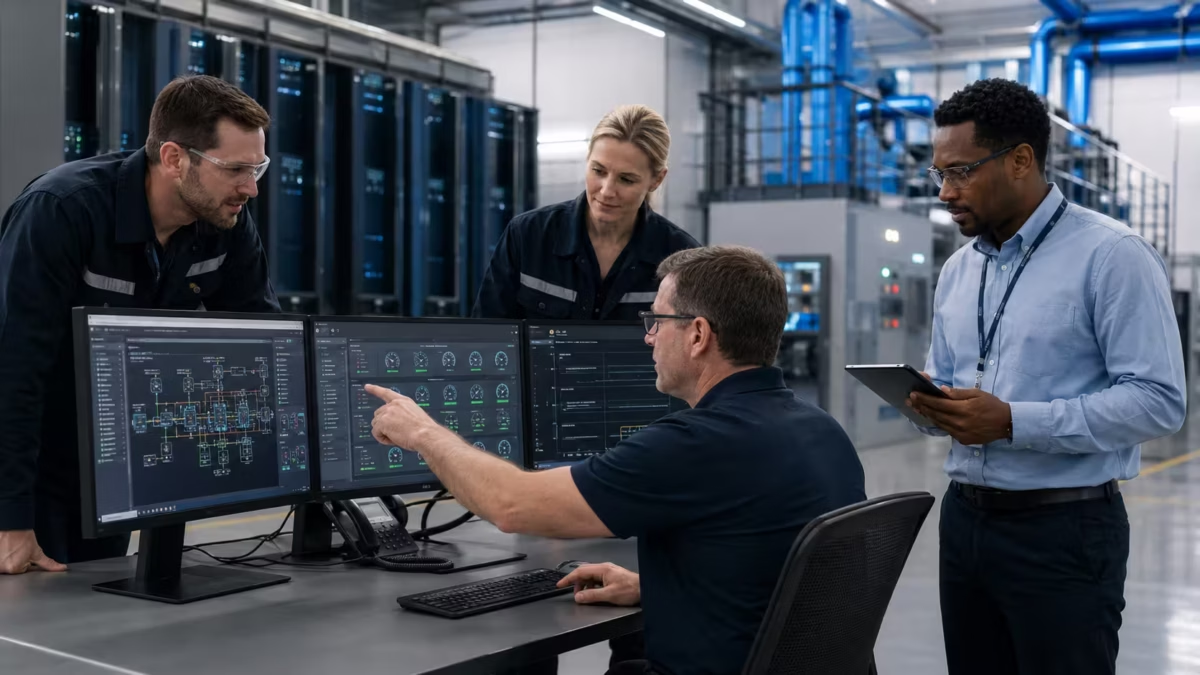
There is a number that keeps data center operators awake at night, and it is not revenue. It is uptime. A facility promising 99.99% availability has budgeted itself roughly 52 minutes of downtime a year, total, across power, cooling, network and everything else. Blow past that and the penalties, the reputational damage and the frantic customer calls follow fast. What stands between a facility and that cliff is not just redundant hardware. It is people, the specialists who design, run and defend the environment around the clock, and who can tell the difference between a routine alarm and the early sign of a cascade failure.
That is what makes hiring for these facilities so unforgiving. The infrastructure can be world class, but a data center is only as reliable as the team keeping it alive at 3am when something no one anticipated starts to go wrong. And the people who can do that well are scarce, in fierce demand and rarely browsing job boards. This piece walks through the specialist roles that actually protect uptime, the skills to screen for in each and how to fill them in a market where everyone is chasing the same short list of qualified engineers.
Why This Hiring Is Different
Most technical hiring can absorb a mediocre hire for a while. Someone underperforms, you notice over a quarter, you correct course. Data center recruitment does not offer that grace. A weak hire in a critical facilities role is not a slow burn problem; it is a single bad decision during an incident away from an outage that costs more than the person's salary many times over. The stakes compress the margin for error to almost nothing, which is exactly why data center recruitment has to be treated as its own discipline rather than a subset of general engineering hiring.
The talent pool makes it harder. These are hybrid roles, part electrical or mechanical engineering, part IT, part operations under pressure and the people who combine all three are genuinely rare. India's rapid build out of hyperscale and colocation capacity has only sharpened the squeeze: new facilities are coming online faster than the country is producing engineers with real mission-critical experience, so the same experienced professionals are being courted by every operator at once. Add the requirement for people who can work rotating shifts in a high-stakes environment, and the addressable pool narrows further still.
The Roles That Protect Uptime
A data center's reliability rests on a stack of specialist roles, each guarding a different failure point. Not every facility needs all of them, and titles vary between operators, but the core functions are consistent. Here are the ones that matter most, and what separates a strong hire from a resume in each.
Critical Facilities Engineer / Electrical Engineer - owns the power chain, the single most common source of catastrophic failure.
- HT/LT systems, UPS, generators and switchgear
- Power distribution and redundancy design (N+1, 2N)
- Testing and commissioning experience
- Ability to troubleshoot live electrical faults under pressure
- Understanding of single points of failure across the power path
Mechanical / HVAC & Cooling Engineer - keeps the environment within the tight thermal envelope servers demand.
- Chiller plants, CRAC/CRAH units and cooling towers
- Airflow management (hot/cold aisle containment)
- Emerging cooling methods like liquid and immersion cooling
- Preventive maintenance discipline
- Reasoning about thermal failure and its knock-on effects
BMS / EPMS / Controls Engineer - the eyes and nervous system of the facility, monitoring everything in real time.
- Building Management Systems and Electrical Power Monitoring Systems
- SCADA and DCIM platforms
- Alarm management and root-cause diagnosis
- Instrumentation and controls integration
- Turning a wall of alerts into a clear picture of what's actually wrong
Data Center Operations Engineer / Shift Engineer - the frontline of 24×7 uptime, the person on the floor when something breaks.
- Real-time monitoring across power, cooling and environment
- Incident response and escalation under pressure
- Standard operating procedures and change management
- Comfort working rotating shifts in a high-stakes setting
- Calm, methodical judgment during an unfolding incident
Network / DC Network Engineer - keeps connectivity and data flow alive alongside the physical plant.
- Routing, switching and structured cabling
- Fiber connectivity and network redundancy
- Network monitoring and fault isolation
- Understanding of how physical and network layers interact
Critical Facilities Manager / Operations Head - the person accountable for the whole environment and the team running it.
- Deep mission-critical operations background
- Vendor, maintenance and compliance oversight
- Uptime governance and risk management
- The leadership to hold standards when pressure is highest
Across all of these, the common thread is that experience in a genuine mission-critical environment matters more than a long resume of general engineering. Someone who has lived through real incidents and learned from them, is worth far more than a candidate who understands the theory but has never felt the pressure of a live facility.
Screening for the Judgment That Actually Matters
The hardest thing to test for is also the most important: how someone behaves when things go wrong. A candidate can list every system in a facility and still freeze, or make a panicked call, during an actual incident. So the most reliable data center staffing assessments go beyond checking certifications and technical knowledge. They probe real situations, ask a candidate to walk through an incident they handled, what failed, what they did first, what they would do differently and listen for methodical reasoning rather than rehearsed answers.
Certifications have their place as a baseline filter, but they are not the verdict. What predicts performance is demonstrated exposure: has this person actually worked in a live, uptime critical facility, recently and at real scale? Someone who monitored a lab is not the same as someone who has held the floor during a power event. Recency counts too, because cooling technology, monitoring platforms and best practices have all shifted and knowledge from a facility someone left five years ago may already be dated.
Winning Talent in a Tight Market
Because the strongest candidates are employed and content, the effective data center operations roles rarely get filled by posting an ad and waiting. They get filled by reaching people directly, mapping which facilities run the kind of infrastructure your role demands, identifying who sits where and making a credible approach that speaks to the scope, the technology and the growth on offer rather than salary alone. Passive candidates would not come to you; they have to be found and engaged.
Speed and pay then decide the outcome. Strong mission critical engineers hold multiple offers, so a slow interview loop simply hands them to a faster competitor and benchmarking compensation to last year's numbers, in a market where these skills have climbed sharply, is a quiet way to keep losing the shortlist. This is where a specialist partner like Prism HRC tends to earn its place, mapping the mission critical talent market, reaching the engineers who are not looking and screening for the incident tested judgment that protects uptime, so a critical seat does not sit open while a half staffed facility inches toward its deadline.
The Bottom Line
A data center is a promise of reliability and that promise is only ever as strong as the people keeping it. The redundant power, the precision cooling, the monitoring systems, all of it depends on specialists who can run it flawlessly on an ordinary day and think clearly on the worst one. Filling those roles well means treating the hire as the mission critical decision it is: defining each role by the failure point it guards, screening for real incident tested capability rather than certifications alone, reaching the scarce people who are not applying and moving fast enough to close them. Operators who get this right have facilities that quietly hit their uptime targets year after year. The ones who treat it as ordinary hiring find out the hard way, usually at 3am, that the weakest link was never the hardware.
Uptime rests on the people keeping the facility alive at 3am.
Prism HRC finds the incident-tested specialists who protect it and reaches the ones who aren't applying.
Fill Mission-Critical Roles With Prism HRC
Frequently Asked Questions (FAQs)
Tell Us Your Requirement
Ready To Build Your Dream Team With Prism HRC?
Want to explore our range of recruitment, staffing, payroll, compliance, employee welfare and employee global mobility solutions? Fill out this form and our subject matter experts will get in touch with you within 2 working days to address all your requirements at length.
Note to Candidates: Please DO NOT use this form to career related queries or job applications, as all such requests will be DELETED. For any job/career related queries, please go to career page.