IT Recruitment Agency in India: How the Right Partner Fixes a Broken Tech Hiring Process
August 15, 2026
Data Center Recruitment: The Specialist Roles Behind Uptime and How to Fill Them
August 21, 2026
When an infrastructure hire goes wrong, you usually find out at the worst possible moment, mid-migration, during an outage, or when a system nobody fully understands finally buckles. Cloud, networking and DevOps roles carry outsized weight because everything else runs on top of them, which is exactly why IT infrastructure hiring is so unforgiving. A weak hire here doesn't just underperform; it puts the reliability of everything above it at risk.
And yet these are some of the toughest roles in tech to fill well. The genuinely capable engineers are scarce, already employed, and rarely on the market, while the applications you do get are full of resumes that list the right tools without the depth to back them. Sourcing and assessing this talent takes a sharper approach than ordinary hiring. This guide walks through how to find it, screen it properly, and close it before someone else does.
Why These Roles Are So Hard to Fill
Infrastructure talent sits at an awkward intersection. The work is deeply technical, it changes fast, and it's invisible until it breaks, which means the people who are good at it are quietly indispensable to their current employers and rarely on the market. Every serious company is modernising its infrastructure at once, moving to cloud, adopting containers, automating everything, so the same finite pool of experienced engineers is being fished by everyone simultaneously. That's the supply side of the problem.
The demand side makes it worse. The scope of these roles has ballooned. A "network engineer" ten years ago configured switches and routers; today the same title might be expected to handle cloud networking, security, automation and infrastructure-as-code. Job descriptions lag behind how fast the work has changed, so companies write briefs for a role that no longer exists and screen for skills that no longer matter, then wonder why the shortlist feels off. The gap between what's on the job ad and what the work actually demands is where most of these searches quietly go wrong.
Screen for Capability, Not Keywords
The single biggest mistake in IT infrastructure hiring is trusting the resume. Anyone can list AWS, Kubernetes and Terraform. Far fewer can reason about why a deployment fails under load, design a network that degrades gracefully when a link drops, or debug a problem that spans three systems at once. The words on the page stop correlating with ability at exactly the seniority where ability matters most.
The reliable alternative is a scenario built on a real problem. Instead of asking "do you know Terraform," hand the candidate a messy, realistic situation, an environment that needs to span two clouds, a pipeline that keeps breaking, a network that has to survive a data-centre failover, and watch how they reason through it. It surfaces genuine capability regardless of pedigree, and it rescues strong candidates from tier 2 backgrounds who'd otherwise be filtered out by a resume screen hunting for the right logos. Two other things are worth checking that most screens miss: recency, because a skill someone last used two years ago may already be stale in a field this fast, and scale, because running something in a lab is a world away from running it in production under real traffic.
Match the Skills to the Role You're Filling
"Infrastructure" isn't one job, it's several, and each needs a different test. Before screening anyone, be clear about which role you're actually filling, because the signals of a strong hire shift completely depending on the answer.
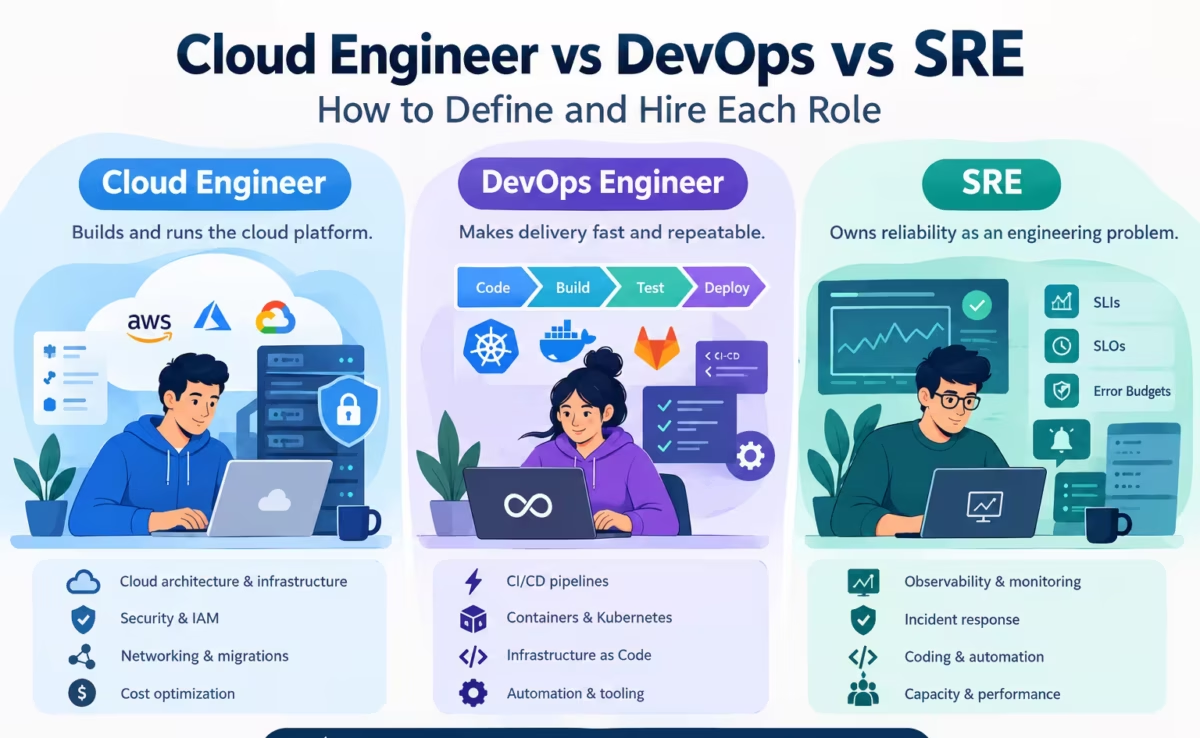
Cloud Architect / Engineer designs and runs your cloud environment, increasingly across more than one provider. Effective cloud engineer recruitment means testing for real depth, not passing familiarity.
- Multi-cloud fluency across AWS, Azure or GCP
- Compute, storage and networking services within each platform
- Infrastructure-as-code with Terraform, CloudFormation or Pulumi
- Containerisation and orchestration with Docker and Kubernetes
- Identity and access management
- Cost-aware architecture and failure-mode thinking
- Landing zones, multi-account governance, on-prem to cloud migration
Network Engineer / Architect the backbone role, and one whose scope has widened dramatically.
- Routing and switching fundamentals (BGP, OSPF, VLANs, subnetting)
- Firewalls and load balancing
- VPN and SD-WAN
- Cloud networking (VPCs, transit gateways, DNS, CDN)
- Network security
- Automation with Ansible or Python
- Designing for resilience and failover, not just connectivity
DevOps Engineer the connective tissue between development and operations. Serious DevOps hiring weights automation and reliability as core, not nice-to-have.
- CI/CD pipeline design (Jenkins, GitLab CI, GitHub Actions)
- Container orchestration with Docker and Kubernetes
- Infrastructure-as-code
- Configuration management
- Scripting in Python, Bash or Go
- Version control discipline with Git
- GitOps and secrets management
Site Reliability Engineer (SRE) owns uptime, incident response and the hard engineering behind reliability.
- Observability and monitoring (Prometheus, Grafana, ELK, Datadog)
- SLIs, SLOs and error budgets
- Strong coding ability, not just scripting
- On-call and incident-response experience
- Reasoning about failure modes, blast radius and graceful degradation
- Chaos engineering and capacity planning
Security / Cloud Security Engineer increasingly non-negotiable as infrastructure moves to the cloud.
- IAM and governance at scale
- Cloud-native security tooling
- Network and application security fundamentals
- Vulnerability management
- Encryption and secrets handling
- Compliance frameworks (SOC 2, ISO 27001)
- DevSecOps, embedding security into the pipeline
Platform Engineer builds the internal tooling and self-service platforms other engineers depend on.
- Strong software-engineering fundamentals applied to infrastructure
- Deep Kubernetes knowledge
- Internal developer platform (IDP) experience
- API design
- Infrastructure-as-code
- Product sense to build tools people actually want to use
Shared fundamentals worth confirming in any infrastructure hire, regardless of title:
- Linux administration
- Networking basics
- At least one scripting language
- Version control
- A genuine understanding of security
The thread running through all of it is depth over breadth. The market is punishing generalists and rewarding people who go genuinely deep on the parts that break in production, so the skills you screen for should follow the specific role, not a generic infrastructure wishlist.
Reaching People Who Aren't Looking
Here's the practical reality that trips most companies up: the strongest infrastructure engineers are employed, comfortable, and not browsing job boards. Posting a role and waiting reaches only the small slice of the market that's actively searching, which for scarce roles is a shallow, heavily contested pool. The candidates who'd genuinely move the needle have to be reached directly.
That means knowing which organisations run the kind of infrastructure your role demands, mapping who sits where, and making a credible approach that speaks to the scope and the problem rather than just the salary. It's slower and more deliberate than posting and praying, but it's the only way to reach passive talent, and passive talent is where the quality is. This is the part where a specialist partner like Prism HRC tends to earn its place, mapping the market, reaching the people who aren't applying, and screening for real capability rather than keyword matches, so a critical seat doesn't sit open for two quarters while the search stalls.
Speed and Money Decide the Rest
Two more factors quietly determine whether you win the candidates you want. The first is speed. Strong infrastructure engineers hold multiple offers and stay on the market for days, not weeks, so a slow, multi-round process isn't rigorous, it's a way to lose people to whoever moves faster. Tightening the loop to the interviews that genuinely predict performance, and deciding quickly once you've seen enough, wins candidates that a drawn-out process loses.
The second is compensation, and it moves fast in this space. Pay for scarce infrastructure skills, multi-cloud, Kubernetes, security, has climbed as demand outstrips supply, and companies benchmarking against last year's numbers routinely come in under market without realising why their offers keep getting declined. Getting the band right for the specific skill and city, rather than anchoring to a generic engineering average, is often the difference between an accepted offer and a shortlist that evaporates at the final step.
The Bottom Line
Infrastructure roles are hard to fill because the work is scarce, fast-moving and largely invisible, and because the best people are almost never the ones applying. Winning them takes a different approach than ordinary hiring: define the role by what the work actually demands rather than an outdated template, screen for demonstrated capability instead of listed keywords, reach passive candidates directly, benchmark pay to the real market, and move fast enough to close. None of that is complicated, but all of it is deliberate. The companies that treat infrastructure hiring as a specialist discipline rather than a generic req end up with teams that keep everything running. The ones that don't are still re-posting the same role, wondering where the good candidates went.
Struggling to find cloud, networking, and DevOps professionals with the depth to handle production environments?
Prism HRC helps you reach experienced infrastructure talent, assess real technical capability, and fill critical roles faster.
Frequently Asked Questions (FAQs)
Tell Us Your Requirement
Ready To Build Your Dream Team With Prism HRC?
Want to explore our range of recruitment, staffing, payroll, compliance, employee welfare and employee global mobility solutions? Fill out this form and our subject matter experts will get in touch with you within 2 working days to address all your requirements at length.
Note to Candidates: Please DO NOT use this form to career related queries or job applications, as all such requests will be DELETED. For any job/career related queries, please go to career page.