
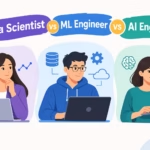
Data Scientist vs ML Engineer vs AI Engineer: Which Role Does Your Project Need?
October 5, 2026
Something has shifted in how global companies think about their India centres. For years, the GCC was where back-office work went, reliable, cost-effective, but rarely where the interesting problems got solved. That's no longer the case. Today, a growing number of global capability centres in India own genuine AI and data science work end to end: building the models, running the platforms, and in many cases setting the direction for the parent organisation.
That shift creates a hiring challenge most companies underestimate. Building a data science and AI team isn't the same as scaling a support function. The roles are specialised, the talent is scarce, the market is fiercely competitive, and the order in which you hire matters enormously. Plenty of centres have learned the hard way that hiring an excellent data scientist into an organisation with no clean data and no path to production just produces an expensive, frustrated employee who leaves within a year.
This piece covers how GCCs in India are actually structuring these teams, which roles to hire and in what sequence, how to attract scarce talent in a crowded market, and the challenges that tend to derail things along the way.
Why GCCs are the ones building these teams now
It's worth understanding why this is happening at India centres specifically, because it explains a lot about the hiring dynamics.
India offers a genuine depth of engineering and analytical talent, combined with a cost structure that lets a global company build a substantial team rather than a token one. But the bigger driver is capability. The AI and data work sitting in Indian GCCs today isn't peripheral. It includes production machine learning, GenAI applications, data platform engineering and analytics that feed real business decisions in markets around the world.
That in turn changes the kind of people these centres need. They're no longer hiring for execution alone. They're hiring people who can own problems, shape solutions and work directly with business stakeholders sitting several time zones away. Which is a very different hiring brief, and one that a lot of GCC recruitment processes haven't caught up with.
Getting the data science team structure right
The most common mistake in building these teams is starting with the most glamorous role rather than the most necessary one. A sensible data science team structure recognises that AI work rests on layers, and the layers have to be built in a reasonable order.
Here's how the roles typically break down.
Data Engineers
The foundation, and the role most frequently underinvested in. Before any model can do anything useful, the data underneath it has to be reliable, accessible and clean. Data engineers build and maintain the pipelines that make that possible. Screen them for pipeline design, orchestration tooling, SQL and Python depth, and real reasoning about why a data job fails at scale.
Data Scientists
The role most people picture first, though rarely the one to hire first. Strong data scientists frame ambiguous business problems and build models that answer them. Screen for applied statistics, experiment design, feature engineering, and the judgment to recognise when a model is quietly failing rather than performing.
Machine Learning Engineers
The people who take a model out of a notebook and make it run in production, reliably and at a sensible cost. Without this role, promising work never ships. Screen for MLOps tooling, containerisation with Docker and Kubernetes, deployment experience, and an instinct for building systems that fail gracefully.
AI / GenAI Engineers
As generative AI moves into real products, this role integrates LLM capabilities into systems people actually use. Screen for hands-on work with RAG pipelines, vector databases, professional-level prompt engineering, and the critical eye to know when model output can't be trusted.
MLOps / Platform Engineers
The role that determines whether your AI still works six months after launch. Screen for cloud platforms, deployment on SageMaker, Vertex AI or Azure ML, monitoring and drift detection, cost awareness and production security.
Analytics and BI Specialists
Often overlooked in AI conversations, but these are the people who turn outputs into something business teams can act on. Screen for SQL depth, visualisation skill and genuine business understanding.
Data Science / AI Leadership
As the team grows past a handful of people, you need someone who can set technical direction, manage stakeholders across geographies and hire well. This is usually the hardest role to fill and the most consequential to get right.
The sequence matters as much as the list. For most GCCs, the honest order is foundation first, data engineering before data science, deployment capability close behind, and specialised GenAI roles once there's something stable to build on. Build the floor before you furnish the room.
Attracting AI talent when everyone is hiring
Here's the uncomfortable reality of AI talent for GCCs: you're not just competing with other GCCs. You're competing with product companies, AI startups, consulting firms and global employers hiring remotely. The people you want are almost always employed and reasonably content.
Which means the old approach, post a role and wait, reaches only the small slice of the market that's actively looking. That pool is shallow and heavily picked over. The candidates who'd genuinely transform your team have to be reached directly.
But reaching them is only half the problem. Once you have their attention, what actually moves strong AI people is rarely the salary alone. In our experience, the things that land are:
Real ownership
Will they own a problem end to end, or execute someone else's specification? This is the single most common reason strong candidates decline GCC offers, they fear becoming an offshore delivery arm for decisions made elsewhere.
Genuine technical challenge
What problems will they actually work on, and at what scale? Specialists want interesting work more than they want perks.
A credible AI roadmap
Is the company serious about this, or running a pilot that might get cancelled? Candidates can smell uncertainty, and it costs you offers.
Access to global stakeholders
The chance to work directly with the parent organisation's business and product leaders is a genuine differentiator, and GCCs that offer it convert far better than those that don't.
Learning and progression
In a field that reinvents itself every eighteen months, people want to know they'll stay current.
Get those right and your employer brand does a lot of the recruiting for you. Get them wrong and you'll keep losing candidates at the offer stage while blaming compensation.
Integrating ML engineers into existing IT teams
One challenge that catches GCCs off guard is what happens after the hire. Machine learning engineers dropped into a traditional IT organisation frequently struggle, not because they lack ability, but because the surrounding structures weren't built for how they work.
A few practices make integration far smoother.
Give them clear ownership rather than fragmenting their work across multiple teams' backlogs. Make sure they have proper access to data and environments from day one, since nothing kills momentum faster than waiting three weeks for permissions. Pair them with data engineers early, because the two roles are deeply interdependent. And set expectations realistically with existing IT leadership, ML work is experimental by nature, and measuring it against traditional software delivery metrics creates friction on both sides.
It also helps enormously to have at least one senior person who has done this before, someone who can translate between the ML team and the wider IT organisation. Without that bridge, both sides tend to conclude the other is being unreasonable.
Making collaboration with business units actually work
The value of a data science team lives or dies on whether it's connected to real business problems. A technically brilliant team producing models nobody uses is a very expensive way to learn that lesson.
GCCs that handle this well tend to do a few things deliberately. They embed data scientists with business units rather than keeping them entirely centralised, so the team hears the problems directly rather than through a translation layer. They invest in an intermediary role, often an AI product manager or analytics translator, who can speak both languages and challenge vague requirements before work begins.
They also insist on defining success upfront. What decision will this improve, and how will we know it worked? That question, asked before a project starts, prevents more wasted effort than any amount of technical rigour afterwards.
And they manage the time-zone reality honestly. When business stakeholders sit in another hemisphere, collaboration needs structure: fixed overlap hours, strong written communication, clear documentation and regular touchpoints. Left to chance, the distance quietly erodes the relationship.
The challenges that derail AI scaling
A few problems come up repeatedly when GCCs scale these teams, and they're worth naming plainly.
Scarcity of production-ready talent
Plenty of candidates have AI exposure. Far fewer have shipped something into production and kept it alive. That gap is where most hiring frustration originates.
Hiring out of sequence
Bringing in data scientists before the data foundation exists is the classic error, and it produces attrition rather than output.
Attrition
AI talent is heavily poached. Retention has to be planned from day one through interesting work, progression and market-aligned pay, not addressed reactively after someone resigns.
Slow decision-making
Strong candidates hold multiple offers and stay available for days, not weeks. Multi-layer approval chains between the GCC and headquarters lose people routinely.
Compensation drift
Pay for scarce AI skills moves fast. Benchmarking against last year's numbers means coming in under market without realising why offers keep getting declined.
Unclear mandate
If the parent organisation hasn't decided whether the GCC owns AI work or merely supports it, candidates sense the ambiguity and choose elsewhere.
None of these are unsolvable, but they do need addressing deliberately rather than hoping they resolve themselves as the team grows.
Where Prism HRC fits in
As a GCC recruitment agency, we see GCC hiring in India from the side that rarely shows up in a workforce plan: the searches that stall, and why. Rarely is it one dramatic failure. It's usually a role defined too vaguely, a screen that tested keywords instead of production capability, an approval chain that moved too slowly, and a shortlist built from whoever happened to be actively looking.
So we work the front of the search instead. We help clients define which roles they actually need and in what order, rather than hiring the most senior title first and discovering the foundation is missing. We screen for demonstrated depth in pipelines, deployment and production reliability rather than a resume full of the right words. And we reach the engineers and scientists doing strong work somewhere else who would never respond to a job post.
Alongside that, we keep our compensation benchmarks current and we move at the pace this market genuinely demands. For global capability centre recruitment, particularly in AI and data, the difference between a team built in four months and a search still running after nine is usually process, not market conditions.
The AI talent shortage is real and it isn't easing. But the GCCs building strong teams aren't the ones seeing the most resumes. They're the ones who defined the roles clearly, sequenced the hiring sensibly, offered genuine ownership, and decided quickly when the right person appeared.
The GCCs that build strong AI teams define roles clearly, sequence hiring well, and move fast.
Prism HRC helps you do all three, from role definition to production-level screening.
Hire AI Talent with Prism HRC
Frequently Asked Questions (FAQs)
Tell Us Your Requirement
Ready To Build Your Dream Team With Prism HRC?
Want to explore our range of recruitment, staffing, payroll, compliance, employee welfare and employee global mobility solutions? Fill out this form and our subject matter experts will get in touch with you within 2 working days to address all your requirements at length.
Note to Candidates: Please DO NOT use this form to career related queries or job applications, as all such requests will be DELETED. For any job/career related queries, please go to career page.