How to Hire ML Ops and AI Infrastructure Engineers
October 1, 2026
How GCCs in India Are Building Their Data Science and AI Teams
October 8, 2026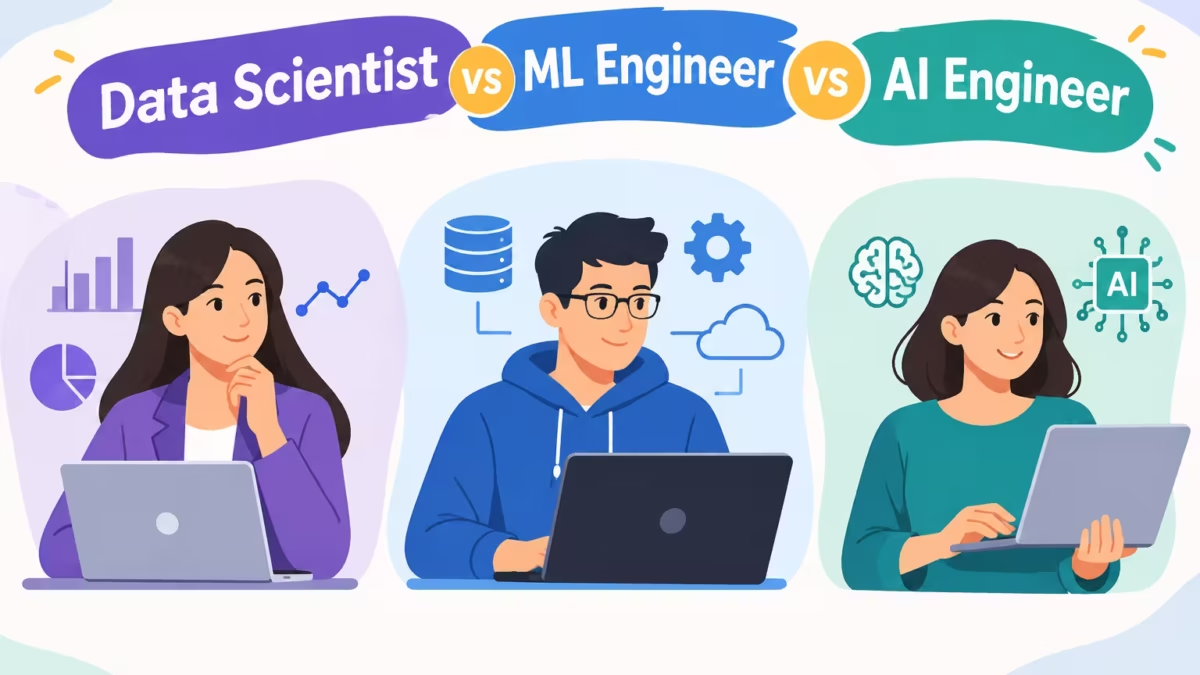
Here's a mistake that plays out in companies every week. A team wants to "do AI," so they hire a data scientist. Six months later the models are brilliant in notebooks and nowhere near production because what they actually needed was an ML engineer. Or the reverse: they hire engineers to build pipelines when the real gap was someone to figure out what the data was even saying.
These three roles get treated as interchangeable and they absolutely are not. Data scientist, ML engineer, AI engineer, they solve different problems, need different skills and sit at different points in the lifecycle of an AI project. Get the match wrong and you burn months plus a serious salary. This guide sorts out the data scientist vs machine learning engineer confusion, adds the AI engineer into the picture and helps you work out which role your project genuinely needs before you start hiring.
The short version, before we go deep
If you want the quick mental model: a data scientist figures out what to build and whether it is worth building. An ML engineer takes a promising model and makes it work reliably in the real world. An AI engineer builds applications on top of AI capabilities, increasingly using existing models rather than training from scratch.
One explores. One productionises. One integrates. That is the spine of it. Now the detail, because the overlap is where people get tripped up.
What a data scientist actually does
A data scientist is fundamentally about insight and experimentation. They live in the question "what can this data tell us and can we model it?"
Their work runs through exploring and cleaning messy data, finding patterns, building and testing models and critically, translating all of it into something a business can act on. Strong statistics. Comfort with ambiguity. The ability to look at a vague business problem and reframe it as something measurable. A good data scientist often spends more time understanding the problem and the data than building the model itself and that's exactly as it should be.
What they are generally not built for is production engineering. A model that scores beautifully in a Jupyter notebook is a data scientist's deliverable. Making that model serve millions of requests reliably, with monitoring and retraining, usually is not their strength and expecting it to be is where a lot of AI projects quietly stall.
What an ML engineer actually does
This is where the data scientist vs machine learning engineer line gets sharp. An ML engineer is an engineer first. Their job is to take models and make them real, robust, scalable, deployable, maintainable.
They build the pipelines that train and serve models. They handle deployment, versioning, monitoring and the infrastructure underneath. They optimize for latency, cost and reliability, the things that matter once real users hit the system. Where a data scientist asks "does this model work?", an ML engineer asks "will this model still work at 3am on a Sunday under ten times the load?"
Strong software engineering is the foundation here: clean code, testing, systems design, plus familiarity with the ML lifecycle and tools for deployment and orchestration. If your models are stuck in the lab and never reaching users, a dedicated ML engineer is very often the missing piece.
What an AI engineer actually does
The AI ML engineer landscape shifted with the rise of large pre-trained models and the AI engineer role grew out of that shift. Instead of training models from the ground up, an AI engineer builds products and features on top of existing AI capabilities.
Think working with foundation models and APIs, prompt engineering, retrieval systems, embeddings and wiring AI into real applications that users actually touch. The emphasis leans toward software engineering and product sense, with enough ML understanding to use these systems well, rather than the deep statistical modelling a data scientist brings.
This is a newer, fast evolving role and titles blur in the market. So when you compare AI engineer vs data scientist, the cleanest distinction is this: the data scientist is more likely to build a custom model from your data, while the AI engineer is more likely to build a smart application around an existing model. Different tools, different mindsets, both valuable, rarely the same person.
So which one does your project actually need?
Instead of matching titles, match your project's real stage and problem. That is what prevents the expensive mis-hire.
If your problem is "we have data and don't know what it's telling us," or "we need to know whether ML can even solve this," you need a data scientist. This is the exploration and feasibility stage and skipping it means engineers may end up building something that should not have been built at all.
If your problem is "we have a model that works but it's stuck and never reaches users," you need an ML engineer. This is the productionisation stage. The insight already exists; what is missing is reliable, scalable engineering to ship it.
If your problem is "we want to build a product using AI capabilities that already exist," you need an AI engineer. Here you are not inventing new models, you are integrating and applying them well, fast.
And the honest truth for many teams: a real AI initiative needs more than one of these, in sequence. A data scientist proves it is possible, an ML engineer makes it production ready and an AI engineer or ML engineer keeps it running and integrated. Trying to force one person to do all three is how projects lose momentum because almost nobody is genuinely excellent across all of it.
What this means for data scientist hiring
Getting data scientist hiring right starts with being honest about which role you are actually after, regardless of the title you plan to post. Plenty of "data scientist" job ads are really describing an ML engineer and vice versa, which is why so many hires disappoint on both sides.
When you are hiring a data scientist, evaluate for statistical depth, problem framing and communication. Can they take a fuzzy business question and turn it into something measurable? Can they explain a result to a non technical stakeholder? Watch how they reason about a messy, ambiguous dataset, not just whether they know the algorithms.
When you're hiring an ML engineer, evaluate for software engineering and systems thinking. Give them a deployment or scaling scenario and shift the constraints. Ask about a production system they built and what broke. The tell is whether they think like a builder or only like an analyst.
When you are hiring an AI engineer, evaluate for practical building with existing AI tools, product sense and speed. Have they shipped something real on top of foundation models? Can they reason about trade offs in a retrieval or prompt based system?
For teams looking to hire data scientists in India, the market is deep but noisy. Titles are inconsistent and a lot of profiles claim all three skill sets at once. That makes precise, role specific evaluation more important than ever, because the label on the CV tells you very little about which of these three people you're actually talking to.
The freelance vs full-time question
For short, well defined pieces of work, a freelance specialist can make sense: a one off model, a proof of concept, a specific integration. You get focused expertise without a long term commitment and speed when the scope is clear.
But for anything ongoing, models that need maintenance, systems that must stay reliable, knowledge that should stay in house, full time hires almost always win. AI systems aren't build-once-and-leave; they drift, they break, they need people who understand them over time. Freelance is a scalpel for a defined cut. Full-time is what you want when you're building something that has to live and evolve.
How Prism HRC helps you hire the right AI talent
At Prism HRC, we help clients cut through exactly this confusion. Because titles in the AI and data space are so inconsistent, our technology recruitment teams focus on what a candidate can actually do, not what their CV calls them, so you get a data scientist when you need insight, an ML engineer when you need production and an AI engineer when you need to build on existing models.
We maintain vetted pipelines across data science, ML engineering and AI engineering, with technical screening that goes well past keyword matching. For permanent, contract, project and contract-to-hire requirements, Prism HRC helps you match the right role to the right stage of your project, so you don't spend months and a big salary discovering you hired the wrong one. To discuss a hiring requirement, visit www.prismhrc.com
Hiring the wrong AI role costs you months and a big salary.
Prism HRC matches vetted data scientists, ML engineers, and AI engineers to the right stage of your project.
Find the Right AI Talent with Prism HRC
Frequently Asked Questions (FAQs)
Tell Us Your Requirement
Ready To Build Your Dream Team With Prism HRC?
Want to explore our range of recruitment, staffing, payroll, compliance, employee welfare and employee global mobility solutions? Fill out this form and our subject matter experts will get in touch with you within 2 working days to address all your requirements at length.
Note to Candidates: Please DO NOT use this form to career related queries or job applications, as all such requests will be DELETED. For any job/career related queries, please go to career page.