How to Hire AI Engineers in India: Skills, Salaries and a Hiring Process That Works
September 15, 2026
Proxy Interviews and Deepfake Candidates: How to Protect Your IT Hiring
September 21, 2026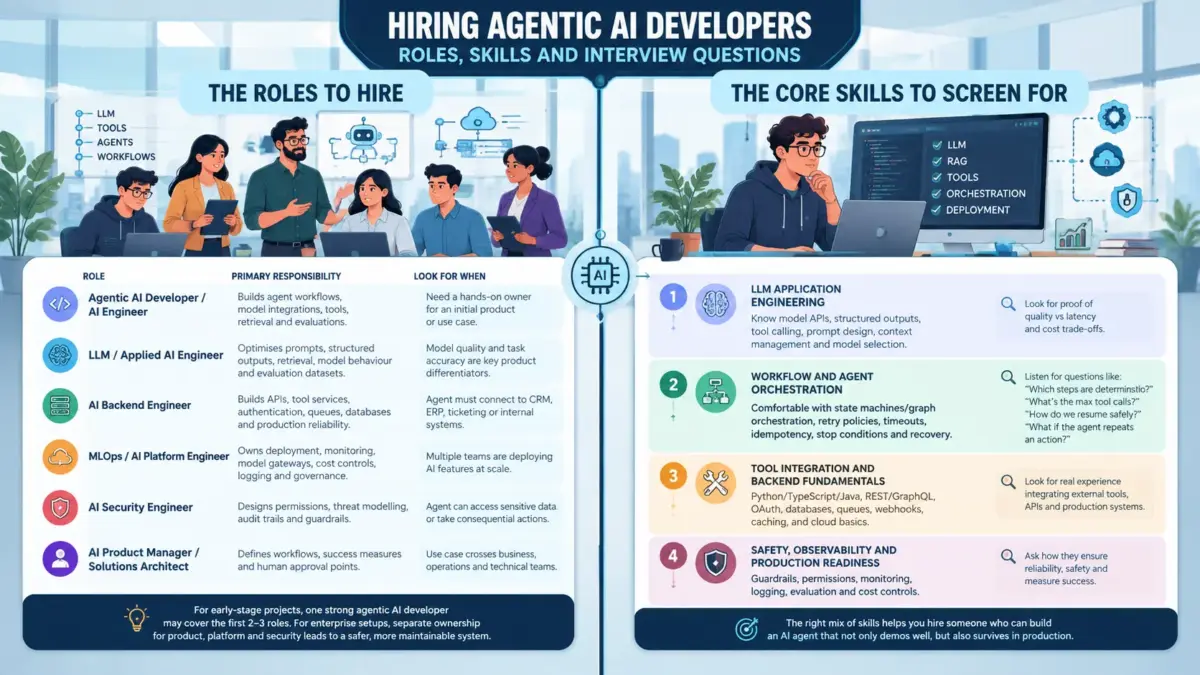
Agentic AI has moved well past the chat window. Businesses are now building systems that can read a goal, pick up approved tools, go and fetch information, take actions inside business software, and stop for a human decision whenever the stakes get high. That shift changes the hiring brief entirely.
A brilliant traditional machine-learning engineer might be excellent at data pipelines, model training and prediction quality. An agentic AI developer has to do all that and design reliable multi-step workflows around foundation models: tool contracts, state and memory, retrieval, permissions, testing, observability and safeguards. The job sits right where AI engineering, backend development, product thinking and security overlap.
This guide covers the roles worth considering, the skills that genuinely matter, and the interview questions that reveal whether someone can build an AI agent that survives production, rather than one that simply demos well.
What does an agentic AI developer do?
An agentic AI developer builds applications where a language model can reason through a task, choose from a controlled set of tools, and keep iterating until it reaches a defined stopping point. You'll see this in customer-support resolution, research assistants, sales operations, document workflows, developer copilots and internal knowledge assistants.
One thing worth getting straight: "agentic" shouldn't be shorthand for "an LLM with a prompt." A real production agent needs a clear objective, a constrained action space, dependable tool integrations, some way to hold onto or retrieve relevant context, and success criteria you can actually measure. That's why modern orchestration platforms put so much weight on durable execution, persistence, human-in-the-loop controls and tracing, rather than just model calls.
Roles to hire for an agentic AI team
|
Role |
Primary responsibility |
Look for when |
|
Agentic AI Developer / AI Engineer |
Builds agent workflows, model integrations, tools, retrieval and evaluations |
You need a hands-on owner for an initial product or use case |
|
LLM / Applied AI Engineer |
Optimises prompts, structured outputs, retrieval, model behaviour and evaluation datasets |
Model quality and task accuracy are the main product differentiators |
|
AI Backend Engineer |
Builds APIs, tool services, authentication, queues, databases and production reliability |
The agent must connect to CRM, ERP, ticketing or internal systems |
|
MLOps / AI Platform Engineer |
Owns deployment, monitoring, model gateways, cost controls, logging and governance |
Multiple teams are deploying AI features at scale |
|
AI Security Engineer |
Designs permissions, threat modelling, audit trails and guardrails |
The agent can access sensitive data or take consequential actions |
|
AI Product Manager / Solutions Architect |
Defines workflows, success measures and human approval points |
The use case crosses business, operations and technical teams |
For an early-stage implementation, one strong agentic AI developer with solid backend chops may well cover the first two or three roles on their own. For enterprise deployments, splitting product, platform and security ownership usually leads to something safer and easier to maintain.
Core skills to screen for
1. LLM application engineering
Candidates should know their way around model APIs, structured outputs, tool or function calling, prompt design, context management and model selection. Look for proof that they've actually weighed quality against latency and cost, rather than picking a model purely on its benchmark reputation.
2. Workflow and agent orchestration
Good developers know when an open-ended agent loop is right and when a deterministic workflow will serve better. They should be comfortable with state machines or graph-style orchestration, retry policies, timeouts, idempotency, stop conditions and recovering after a step fails.
Listen out for phrases like: "Which steps are deterministic?", "What's the maximum number of tool calls?", "How do we resume safely after a pause?" and "What happens if the agent repeats an action?" Those questions are a strong signal of production thinking.
3. Tool integration and backend fundamentals
Agents create value by using tools, so screen for Python, TypeScript or Java; REST/GraphQL APIs; OAuth and service accounts; databases; queues; webhooks; caching and asynchronous processing. A good candidate can take a vague business action, something like "update the customer's renewal status", and turn it into a narrow, validated API operation.
4. Retrieval, memory and data design
Retrieval-augmented generation (RAG) earns its place when the agent has to work from company knowledge. The candidate should understand document ingestion, chunking, metadata, retrieval quality, citations, access controls and how to evaluate the context being retrieved.
They should also draw a clear line between short-term workflow state and durable user or organisational memory. That distinction matters: persistence can help an agent resume work or remember approved preferences, but it has to be scoped, secured and auditable.
5. Evaluation and observability
"It looks good in testing" isn't a production metric. Hire AI agent developers who build task-specific test sets and measure completion rate, accuracy, tool-call correctness, policy violations, latency, cost and fallback rate. They should trace every step of a run, so a failure can be reproduced and debugged rather than shrugged at.
Ask whether they've done offline evaluation before release and production monitoring afterwards. You want both, because model behaviour, source data and tool dependencies all drift over time.
6. Security, guardrails and human approval
An agent that can call systems carries a far bigger risk surface than a chatbot. Prompt injection, sensitive-information disclosure, improper output handling and excessive agency are all serious risks for LLM applications.
Your candidate should be able to talk through least-privilege tool permissions, input and output validation, secrets handling, data boundaries, audit logs and confirmation flows for high-impact actions. A sound design usually lets read-only discovery run autonomously while demanding human approval before payments, data deletion, customer commitments or changes to sensitive records.
Skills checklist for hiring managers
Use this as a practical scorecard when you're shortlisting:
- Hands-on experience shipping LLM applications, not just ML notebooks or research projects
- Python or TypeScript, plus solid API and database development
- Tool/function calling and structured output schemas
- Agent orchestration, state management, retries and safe stop conditions
- RAG, vector search and enterprise data-access patterns
- Evaluation design, tracing, debugging and monitoring
- Authentication, authorisation, secrets and auditability
- Prompt-injection awareness and guardrail design
- Cloud deployment, CI/CD and containerisation
- The ability to turn a business workflow into a bounded technical system
Framework experience, whether that's OpenAI Agents SDK, LangGraph, Semantic Kernel, CrewAI or a cloud AI platform, is useful. Just don't make it your main filter. Someone who genuinely understands systems design, security and evaluation will adapt as the tooling keeps shifting.
Interview questions for an agentic AI developer
Architecture and product thinking
Design an agent that answers HR policy questions and can raise a leave request. What components would you build?
Look for: retrieval with access controls, a leave-management tool, validation, confirmation before submission, and run logs.
When would you use a deterministic workflow instead of an autonomous agent?
Look for: deterministic steps for regulated, high-risk or repeatable processes; agents for ambiguity, triage or research.
How would you stop an agent from taking the same action twice after a retry?
Look for: idempotency keys, persisted state, tool-level checks and explicit success criteria.
Tool use and integrations
Show how you would define a tool for updating a CRM record. What would the input schema and permission checks look like?
Look for: narrow parameters, strict validation, authentication, role-based access, audit events and confirmation for material changes.
An agent chooses the wrong tool repeatedly. How would you diagnose and fix it?
Look for: traces, clearer tool descriptions, fewer overlapping tools, constrained tool choice, evaluation examples and a fallback path.
How would you handle a third-party API timeout during an agent run?
Look for: retry/backoff, timeouts, graceful user messaging, workflow checkpointing and no duplicate writes.
Retrieval, quality and evaluation
How would you evaluate a knowledge agent before release?
Look for: representative questions, grounded-answer checks, retrieval relevance, citation accuracy, refusal behaviour and regression testing.
What metrics would you monitor after launch?
Look for: task completion, human escalation, invalid tool calls, latency, token/API cost, error categories and user feedback.
A model gives a plausible but incorrect answer. What layers would you add?
Look for: source grounding, structured responses, confidence or verification steps, clear uncertainty, human escalation and targeted evaluations.
Security and governance
A retrieved document contains hidden instructions telling the agent to export customer data. What can go wrong and how would you reduce the risk?
Look for: awareness of indirect prompt injection, separation of data from instructions, tool permissions, trusted sources, output checks and human approval.
Which actions should always require human approval?
Look for: a risk-based answer covering financial transactions, irreversible changes, external commitments, sensitive-data access and policy exceptions.
How would you keep customer data out of logs while retaining enough information to debug failures?
Look for: redaction, structured telemetry, role-based log access, retention policies and secure trace storage.
A practical hiring exercise
Don't ask candidates to build a sprawling multi-agent system during an interview. Give them a 60–90 minute design-and-build exercise instead.
Scenario: create a support triage agent that reads a ticket, retrieves policy information, proposes a response, and either drafts an update or sends it only once approved.
Ask them to describe or implement:
- The agent state and success criteria
- The tools and their input schemas
- Where retrieval is needed and how they'd evaluate it
- The approval checkpoint before any external action
- Error handling, monitoring and tests
- The security controls that stop over-broad data access
This sorts a prompt-only prototype from an engineer who can genuinely design safe, observable agentic AI development services, and it does it fast.
Common hiring mistakes
Don't hire on the sheer number of agent frameworks listed on a CV. And don't assume a strong general backend engineer is automatically ready for the role without checking their grasp of LLM behaviour, evaluation and AI security.
The other frequent mistake is hiring against a broad "AI agent" brief with no actual use case behind it. Nail down the business outcome, the systems available, the allowed actions, the approval requirements, the data sensitivity and the success metric before you start sourcing. A precise brief pulls in stronger candidates and makes your technical interviews far more meaningful.
How Prism HRC helps hire agentic AI developers
Prism HRC helps organisations hire for AI product development across agentic AI, generative AI, data engineering, MLOps, cloud and backend engineering. Our dedicated AI recruitment team works on specialised technology hiring, and we understand that agentic AI roles need assessing well beyond model keywords: workflow design, tool integrations, security, evaluation and genuine delivery capability.
We support companies looking to hire AI agent developers for permanent, contract, contract-to-hire and project staffing needs. Whether you want one senior agentic AI developer to build an initial use case or a full team spanning AI engineering, platform and product roles, Prism HRC helps define the brief, reach relevant talent quickly, and keep the process moving before strong candidates are lost to slower decisions.
To discuss your requirement, visit Prism HRC
References
Prism HRC assesses agentic AI roles well beyond model keywords, across workflow design, tool integration, security, and evaluation, so you get real delivery capability, fast.
Build your AI team with Prism HRC
Frequently Asked Questions (FAQs)
Tell Us Your Requirement
Ready To Build Your Dream Team With Prism HRC?
Want to explore our range of recruitment, staffing, payroll, compliance, employee welfare and employee global mobility solutions? Fill out this form and our subject matter experts will get in touch with you within 2 working days to address all your requirements at length.
Note to Candidates: Please DO NOT use this form to career related queries or job applications, as all such requests will be DELETED. For any job/career related queries, please go to career page.