
In-House, Dedicated or Freelance: Choosing the Right Model to Hire AI Developers in India
October 11, 2026
AI Product Manager vs Product Manager: What Changes in the Role and How to Hire for It
October 17, 2026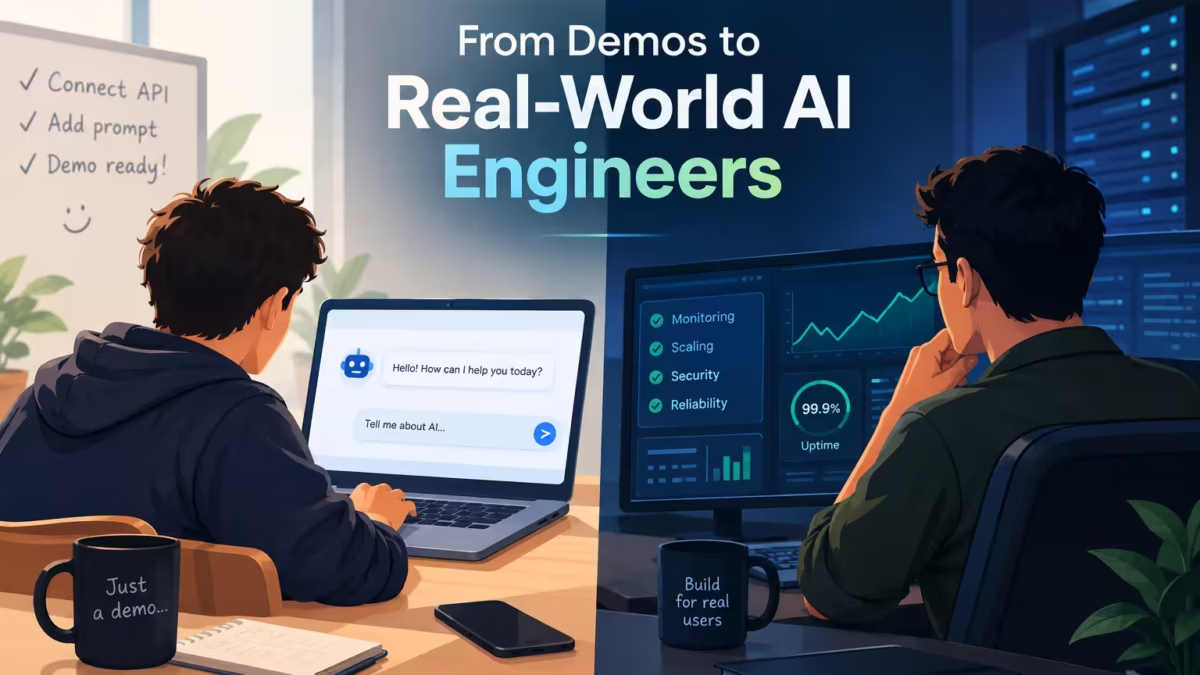
Here’s an uncomfortable reality for anyone hiring in this space. Connecting an LLM API to a chatbot and demoing it by Sunday night is something a huge number of people can now do. It looks impressive. It proves almost nothing about whether the person can build something real users lean on every single day, and most generative AI engineer hiring interview questions aren’t designed to tell the difference.
That is the gap hiring teams keep falling into. The demo and the production system share a surface and from across a table they can look identical. Underneath, they are worlds apart. The trouble is, catching the difference isn’t one person’s job, it’s two. The recruiter screens first, often without deep technical knowledge and decides who’s even worth a panel’s time. The technical panel then goes deep. When either stage asks the wrong things, demo builders slip through.
So this post splits the questions by who’s asking. First, what a recruiter should probe for in the early screen. Then, what the technical panel needs to dig into. We’re staying on LLM application engineering throughout, building features on top of models, rather than autonomous agent design.
Part 1: The Recruiter’s Screen
A recruiter isn’t expected to debug a RAG pipeline. That’s not the job. The recruiter’s job is to filter out the obvious demo builders before they eat up a panel’s afternoon, and that can be done without writing a line of code. The trick is asking smart proxy questions, ones a non-technical person can score by listening for the right signals.
“Tell me about an LLM feature you built. Did real users actually use it, and how often?”
This is the sharpest filter a recruiter has. A demo builder describes something they made that worked once, for a demo. A production engineer talks about something real people used daily, with all the mess that brings.
Listen for: scale and continuity. “Thousands of users, every day, for over a year” is a very different answer from “I built a prototype that showed how it could work.” You don’t need to understand the tech to hear which one is which.
“What broke in production and who fixed it?”
Demos don’t break in interesting ways. Production systems break constantly. Someone who’s shipped for real has war stories and they tell them naturally.
Listen for: specifics and ownership. A strong candidate describes an actual failure and their part in fixing it. A weak one stays vague, or admits nothing ever really broke, usually because nothing ever ran long enough to break.
“How did your team know the feature was working well, not just running?”
The recruiter doesn’t need to grasp evaluation methods. They just need to hear whether the candidate has a method at all.
Listen for: the difference between “we tested some prompts and it looked good” and “we had a system for measuring quality.” The second answer, even half-understood, signals production experience. The first signals a demo.
“Was there any sensitive or real user data involved? How was that handled?”
Again, no technical depth required to score this. You’re checking whether the candidate even thinks about it unprompted.
Listen for: awareness versus a blank. A production engineer mentions privacy and data handling without being pushed. A demo builder treats the question as an afterthought, because their project ran on dummy data.
Availability, scarcity and the practical stuff
The recruiter also owns the unglamorous but decisive details. Generative AI talent is scarce and in demand, so notice periods, competing offers, compensation expectations and genuine interest in the role all need surfacing early. A brilliant production engineer who’s three offers are deep and 90 days from being free is a different planning problem from one who can start in two weeks. Getting this on the table upfront saves everyone a wasted loop.
The recruiter’s output isn’t a verdict on technical skill. It’s a filtered shortlist of people who sound like they’ve actually shipped, handed to the panel to verify properly.
Part 2: The Technical Panel’s Deep Dive
Now the panel takes over and here the questions get specific. These are the areas where demos and production genuinely part ways, five of them. For each, here’s what a weak answer sounds like and what a strong one contains.
A fair opener before the hard stuff: ask the candidate to explain, in their own words, what is generative AI and where it breaks. Weak candidates recite a definition. Strong ones go straight to limitations, hallucination, non-determinism, cost, because they’ve been burned in the wild.
1. Retrieval quality in RAG systems
Nearly every serious LLM feature leans on retrieval. Building a basic RAG pipeline is easy; making retrieval actually good is where people struggle.
A weak answer stops at the recipe: chunk, embed, store in a vector DB, retrieve top-k, done. Ask what happens when the retrieved chunks are irrelevant and they stall.
A strong answer obsesses over retrieval quality. They discuss chunking strategy, re-ranking results, handling queries that match nothing useful and measuring whether retrieval surfaces the right context. They know bad retrieval, not a bad model, is behind most disappointing RAG systems.
2. Evaluation and hallucination testing
The single sharpest divide. In a demo you eyeball a few outputs. In production, “it looked fine when I tried it” isn’t a strategy.
A weak answer runs on vibes, they try some prompts and read the responses. Pushed on catching hallucinations at scale, they have no method beyond more manual checking.
A strong answer treats evaluation as its own engineering problem: eval sets, automated scoring, testing against known-good outputs, measuring hallucination rates, catching regressions when prompts or models change. They know you can’t improve what you can’t measure. These are the LLM interview questions that expose production experience fastest.
3. Latency and token cost control
In a demo, nobody cares about an eight-second, few-cents response. At scale, both become real problems.
A weak answer hasn’t thought about it, biggest model every time, full context every call, no idea what it costs.
A strong answer is like someone who’s owned a budget and an SLA: right-sizing the model, trimming context, caching, streaming to improve perceived latency, monitoring cost per request.
4. Prompt and model versioning
Prompts are code, even if they don’t look at them. An untracked prompt change can silently break a feature for thousands of users.
A weak answer edits prompts in place, no versioning, no testing before shipping. They’ve never had a prompt tweak cause an incident, usually because nothing ran long enough to.
A strong answer brings engineering discipline to the non-code parts: versioned prompts, tested changes and planning for providers updating or deprecating models underneath them.
4. Guardrails around data privacy
The one that can become a genuine incident. A demo runs on dummy data; production often handles real, sensitive data.
A weak answer hasn’t considered it, or assumes the provider handles everything.
A strong answer treats the LLM as an untrusted boundary: what should and shouldn’t be sent, handling PII, prompt injection risks, validating outputs before they reach users and the compliance realities of the domain.
Pulling it together
Notice what unites both stages. None of it is transformer trivia or a brain-teaser. The best artificial intelligence interview questions for this role surface whether someone has felt the specific pains production inflicts. The recruiter catches the obvious demo builders with proxy questions anyone can score. The panel confirms the real thing with depth. That two-layer filter is the whole art of how to evaluate generative AI developers for work that has to survive real users.
How Prism HRC screens before you ever interview
Running this consistently, recruiter screen and technical depth, for every candidate takes time most hiring teams don’t have. That’s the part we take on.
At Prism HRC, we handle that first technical filter for you. Before we shortlist anyone, our screening tests for exactly this production readiness, not just whether a candidate can wire up an API, but whether they’ve genuinely shipped and maintained LLM features users depend on. So when you want to hire generative AI engineers, the profiles you see are already separated from the demo builders.
For permanent, contract, project and contract-to-hire requirements, Prism HRC helps you reach production-ready generative AI talent faster.
Need generative AI engineers who’ve shipped real products?
Prism HRC screens for production experience before you interview.
Frequently Asked Questions (FAQs)
Tell Us Your Requirement
Ready To Build Your Dream Team With Prism HRC?
Want to explore our range of recruitment, staffing, payroll, compliance, employee welfare and employee global mobility solutions? Fill out this form and our subject matter experts will get in touch with you within 2 working days to address all your requirements at length.
Note to Candidates: Please DO NOT use this form to career related queries or job applications, as all such requests will be DELETED. For any job/career related queries, please go to career page.