
How GCCs in India Are Building Their Data Science and AI Teams
October 8, 2026
Generative AI Engineer Interview Questions: Telling Demo Builders Apart from Production Engineers
October 14, 2026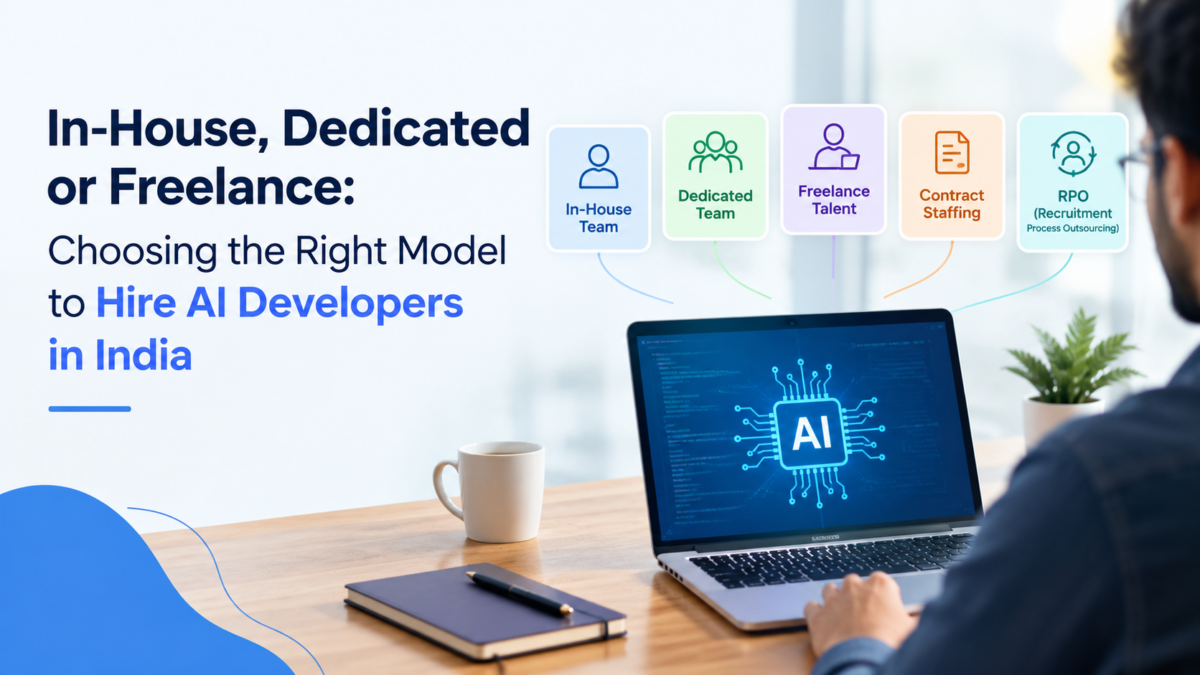
Before you get anywhere near a technology stack, there’s a more basic question to settle: what kind of engagement do you actually need? One company wants a single AI engineer to prove out an idea. Another needs a cross-functional team to build a product properly. A third just wants specialists to bolt generative AI features onto a platform that already exists. Three very different situations, three very different hiring models.
And when you set out to hire AI developers in India, your options stretch well beyond “permanent employee or freelancer.” You could build an in-house team, bring in contract staffing, engage a dedicated AI team, hire freelancers for clearly defined work, or use recruitment process outsourcing to scale your hiring. Which one fits comes down to how long the work will run, how sensitive your data and IP are, who’s going to maintain the thing after launch, and frankly, how much of your managers’ time you can realistically spare.
This guide walks through the main models so you can pick an arrangement that suits the actual work, rather than the job title.
Start with the project, not the candidate
An AI project is rarely just model development. Get a production application running and you’re suddenly dealing with data engineering, application and API development, cloud infrastructure, model evaluation, security, monitoring and ongoing maintenance. One “AI developer” isn’t going to cover all of that.
So before you open a role, write down the expected outcome, the delivery timeline, the team skills needed, data access, who holds decision-making authority and who owns it post-launch. A short proof of concept might need a senior AI engineer and a backend developer for a few months. A customer-facing product will need something more stable across AI, software engineering, data, product and platform operations.
That brief does double duty: it helps you write a genuinely useful AI developer job description, and it tells you whether to hire employees, bring in contract talent, build a dedicated team or go external.
1. Permanent, in-house AI developers
Permanent hiring makes sense when AI is part of your ongoing product or business strategy. Employees accumulate knowledge of your systems, your customers, your data and your internal processes, the sort of context that can’t be handed over in a brief. They work closely with product, engineering, legal and security, and they carry responsibility well past the initial release.
In-house teams prove especially valuable when a product needs continuous improvement, which most AI products do. Models shift, prompts get refined, retrieval sources change, evaluation methods evolve and user needs move. Internal ownership makes it far easier to investigate problems, prioritise fixes and keep the technical knowledge in the building.
The trade-off is planning. You’ve got to define roles, interview, agree compensation, then provide onboarding, equipment, management and career development. And the real cost goes beyond salary, there’s benefits, recruitment, infrastructure, training, plus the hours your existing people spend supporting new hires. Build a full team before validating the use case and you may be left with capacity you can’t easily redeploy.
Choose permanent hiring when: AI is a long-term capability, the work ties closely to your core product or proprietary systems, and you have leaders who can genuinely manage and develop a team.
2. Contract staffing for defined delivery needs
Contract staffing gives you professionals for a set project period or delivery phase. It works when you’ve got a clear requirement, a budget and a near-term milestone, but no desire to convert every role into a permanent seat. It’s also a sensible way to plug a specialist skill gap while your existing team keeps ownership of the product.
Say you need an LLM application engineer to build a RAG feature, an ML engineer to sharpen a model pipeline, or an MLOps professional to get deployment and monitoring established. Contract staffing brings those skills in for precisely the window where they matter most.
That said, this model still needs a capable owner on your side. Your team sets priorities, reviews work, grants access and makes decisions on time. Before anyone starts, nail down the scope, deliverables, reporting line, access rules, confidentiality obligations, IP terms and handover expectations. And talk through extension or transition options early, project timelines have a habit of moving.
Choose contract staffing when: the work has a defined duration, you need specialist capacity quickly, and an internal manager can direct it while keeping project ownership.
3. Dedicated AI teams
A dedicated AI team is a group assigned to your work for an agreed period. Depending on what you’re building, that might include AI or generative AI developers, data engineers, backend developers, QA or evaluation specialists and a technical lead. They operate as an extension of your organisation while you keep hold of the roadmap and priorities.
This suits companies needing several complementary skills at once but with no appetite for recruiting each person individually. It also helps when delivery has to move faster than a string of separate hires would allow. You might set one up for a product build, for a pilot heading toward production, or for a sustained roadmap where workloads keep shifting.
It works best, though, when responsibilities are spelled out. Agree upfront who owns architecture, code review, security approvals, product decisions, performance management and knowledge transfer. Clarify whether team members are exclusive to your project, how continuity gets managed, and what happens if a key person walks. A team described as “dedicated” still needs regular access to your product stakeholders and a clear definition of done.
Choose a dedicated team when: the project needs multiple skills, delivery will run for several months or more, and you want a stable team without building every capability through individual permanent hires.
4. Freelance AI developers
Freelancers earn their place on focused, time-bound tasks. Reviewing an architecture, building a prototype, writing an evaluation script, integrating a public API, troubleshooting a contained technical problem, all of these are good fits. It’s a practical way to test an idea or reach a specialist without signing up for a longer engagement.
What a freelancer isn’t, though, is an automatic substitute for a product team. AI work leans heavily on context that’s hard to transfer in a short brief: undocumented data pipelines, business rules, system permissions, model limitations, operational requirements. If nobody internally can review and maintain the output, a quick prototype can quietly turn into a production dependency with no owner.
Risks to manage in production AI work
IP ownership: Get it in writing, who owns the code, the prompts, the evaluation sets, configuration, documentation and project-specific materials. Review that agreement before you share proprietary data or any work starts.
Model and system handover: Ask for a handover plan covering model and provider choices, versions, parameters, dependencies, credentials ownership, deployment steps and rollback procedures. Accounts and keys should sit with your organisation, not theirs.
Missing documentation: Insist on a maintained repository, setup instructions, architecture notes, tests, known limitations and operating guidance. Documentation is part of the delivery, not a nice extra tacked on at the end.
Data and security exposure: Give the minimum access needed. Set clear rules on production data, third-party tools, logging, storage, retention and deletion, and make sure the developer both understands your security requirements and works in an approved environment.
No maintenance after launch: Decide who monitors quality, cost, latency, errors and model changes. If a freelancer is building a production component, identify the internal owner or follow-on team before you launch, not after.
Choose freelancers when: the task is bounded, acceptance criteria are clear, and someone on your side can review the work and own it afterwards.
5. RPO for sustained AI hiring
Recruitment process outsourcing comes into its own when you need to hire several AI professionals over time and your internal recruiting team is stretched. An RPO partner can take on part or all of the process, from defining roles and sourcing talent through to screening coordination, interview scheduling and offer follow-up.
Be clear on what it is, though. RPO is a hiring delivery model, it won’t replace technical management or build your AI product. Your hiring managers still define the roles, assess technical capability and make the calls. Where it earns its keep is when hiring volume is high, roles are specialised, or several teams need talent across AI, data, cloud and software engineering at once.
Choose RPO when: you have a repeatable or multi-role hiring plan and need a structured recruiting team working alongside your organisation.
Compare the models on the factors that matter
Four practical questions tend to settle it.
How long will the work run? A permanent product roadmap may justify employees. A defined implementation may suit contract staffing. A multi-skill delivery phase may call for a dedicated team. A discrete task may suit a freelancer.
How sensitive are the data and IP? Sensitive systems need clear access controls, contractual protections, code ownership and auditability whichever model you pick. A stable internal team makes long-term governance easier; external models demand deliberate controls and documented handover.
Who maintains the system after launch? If the AI feature is staying in production, work out who’s responsible for monitoring, evaluation, updates and incidents before development starts. Don’t leave ownership implicit, it never resolves itself.
How much management time can you provide? Freelancers and contract specialists need a client-side owner. A dedicated team offers more delivery structure but still needs product direction. RPO lightens your recruiting workload, not your product management.
Use the job description to support the model
A strong AI developer job description describes the outcome and the operating context rather than listing whatever tools are fashionable this quarter. Say whether the role is building a proof of concept or production software, which data sources and systems it touches, how model quality will be evaluated, and who owns deployment and maintenance.
Then list skills that actually match the work. A generative AI role might need LLM APIs, prompt and context design, RAG, vector databases, evaluation and API integration. A machine learning role might lean toward data preparation, model selection, experimentation and deployment. Production roles often add cloud, security, observability, cost management and solid software engineering practice.
However you assess candidates, look for evidence of delivery: what they built, how it was tested, what limitations they ran into, how they handled sensitive data, and how the system was maintained afterwards. That holds whether you’re hiring generative AI developers permanently or bringing in external specialists for a few weeks.
A practical example: choose the model around the delivery plan
A US SaaS success story featured on the Prism HRC AI hiring service page works well as a reference point here. Look at how the requirement, team structure and delivery objective line up in that case, then hold your own project against it. The lesson worth taking is to tie the hiring model to the work and the outcome you expect, rather than picking one based on the label “AI developer.”
For your own project, map out the stages: discovery, prototype, production build, ongoing support. Plenty of companies use different models at different points, a contract specialist to validate the use case, say, followed by permanent hires or a dedicated team to build and maintain the real thing. Read the service page case study alongside your own timeline, security requirements and internal capacity before you commit.
Decision table: which AI hiring model should you choose?
| Your situation | Model to consider | Why it may fit | Main point to manage |
| AI is a core, ongoing product capability | Permanent in-house team | Retains product knowledge and supports continuous improvement | Longer hiring and onboarding; ongoing employment costs |
| A defined project needs one or more specialists | Contract staffing | Adds skills for a planned delivery period | Internal direction, scope and handover |
| Several complementary roles are needed for sustained delivery | Dedicated AI team | Provides a coordinated group with a clearer delivery structure | Governance, team continuity and integration with your product team |
| A prototype or contained technical task needs specialist input | Freelance developer | Flexible access for a bounded piece of work | IP, security, documentation and post-project ownership |
| Multiple AI roles need to be filled over time | RPO | Adds structured recruiting capacity alongside your internal team | Your managers still define roles and assess technical capability |
Final thoughts
There’s no single best AI developer hiring model, and anyone insisting otherwise is selling something. What fits depends on how long the work runs, how sensitive your systems are, what maintenance it’ll need after launch, and how much management capacity you can genuinely offer.
Build permanent capability when AI sits at the centre of your long-term roadmap. Use contract staffing for defined skill gaps and delivery phases. Consider a dedicated AI team when several roles need to work together over time. Bring in freelancers for carefully scoped tasks with clear ownership. And turn to RPO when your real challenge is sustained recruitment volume.
If you’re planning to hire AI developers in India, Prism HRC supports permanent hiring, contract staffing, dedicated recruitment and RPO requirements across AI, generative AI, data and software roles. Share your project timeline, team needs and hiring priorities, and we can talk through a model that actually fits your delivery plan.
Planning to hire AI developers in India?
Prism HRC can help you choose the right hiring model and build your team.
Frequently Asked Questions (FAQs)
Tell Us Your Requirement
Ready To Build Your Dream Team With Prism HRC?
Want to explore our range of recruitment, staffing, payroll, compliance, employee welfare and employee global mobility solutions? Fill out this form and our subject matter experts will get in touch with you within 2 working days to address all your requirements at length.
Note to Candidates: Please DO NOT use this form to career related queries or job applications, as all such requests will be DELETED. For any job/career related queries, please go to career page.