Cloud Engineer vs DevOps vs SRE: How to Define and Hire Each Role
September 28, 2026
Data Scientist vs ML Engineer vs AI Engineer: Which Role Does Your Project Need?
October 5, 2026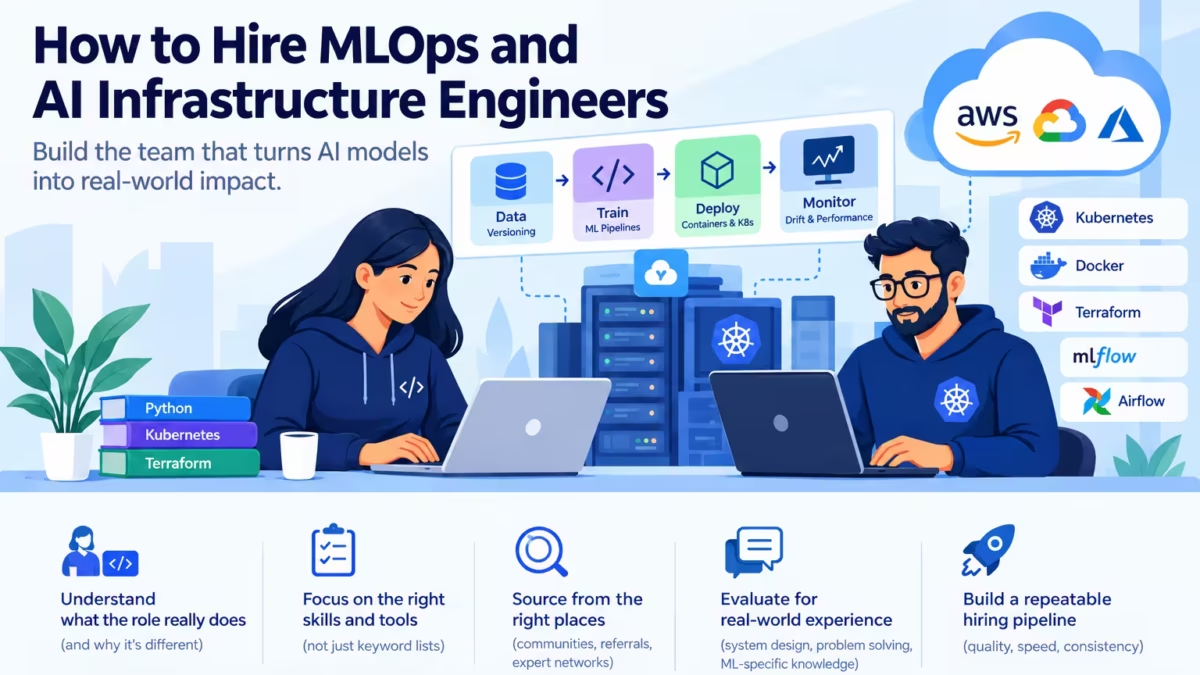
Every company wants to do AI right now. Far fewer can actually run it in production. That gap has a name, and it is largely a talent gap. The model your data science team built in a notebook is worth very little until someone can deploy it, scale it, monitor it and keep it from falling over at 2am. That someone is an MLOps or AI infrastructure engineer and they have become one of the hardest roles in tech to fill.
The trouble is that most hiring teams aren't quite sure what they're looking for. MLOps sits in an awkward middle ground, part software engineering, part DevOps, part machine learning and a job description that leans too far in any one direction attracts the wrong people. This guide breaks down what these engineers actually do, the MLOps engineer skills that matter, how to evaluate them properly and how to hire MLOps engineers without your pipeline dragging for months.
What an MLOps engineer actually does (and why the role confuses people)
Before you can hire well, you need a clear picture of the role, because plenty of companies get this wrong from the first line of the JD.
An MLOps engineer builds and runs the machinery that takes machine learning models from experiment to reliable, production grade service. They own the pipelines that train, deploy and retrain models. They handle versioning of data and models, not just code. They set up monitoring so a model quietly degrading in production gets caught early. When something breaks, they are the ones who understand both the infrastructure and enough of the ML to diagnose it.
An AI infrastructure engineer often sits close by, focused more on the GPUs, orchestration, cluster efficiency and cost, the foundation everything else runs on. The two roles overlap heavily and in smaller teams one person wears both hats. The key point: this is not a data scientist and it is not a plain DevOps engineer either. Treat it as either one and you will mis-hire.
The MLOps engineer skills that genuinely matter
Job descriptions for these roles tend to become keyword soup, twenty tools listed, no sense of priority. Cut through it by separating the fundamentals from the nice-to-haves.
The core software foundation comes first. Strong coding ability, usually Python, plus solid engineering habits: version control, testing, clean and maintainable code. Without this, everything else is shaky.
Then the infrastructure layer. Containerisation with Docker, orchestration with Kubernetes and real fluency in at least one major cloud, AWS, GCP or Azure. Infrastructure-as-code tools like Terraform. CI/CD pipelines, adapted for the quirks of shipping models rather than just applications.
On top of that, the ML specific layer, which is what separates an MLOps engineer from a generalist. Familiarity with the ML lifecycle. Model deployment patterns. Pipeline and workflow tools such as MLflow, Kubeflow or Airflow. Data and model versioning. And crucially, monitoring for things that are unique to ML, like data drift and model decay, problems that do not exist in ordinary software.
Finally, the softer but decisive traits. These engineers work between teams, translating for data scientists on one side and platform or product teams on the other. Communication and a systems thinking mindset matter as much as any single tool. The best ones can reason about a whole pipeline, not just the piece in front of them.
How to hire MLOps engineers for machine learning deployment quickly
Now the practical question everyone actually cares about: how to hire MLOps engineers for machine learning deployment quickly, without settling for whoever's available. Speed and quality aren't opposites here. A sharp process delivers both.
Step 1: Scope the role honestly
Decide what you truly need before posting. Are you building ML infrastructure from scratch, or maintaining and scaling something that exists? Do you need deep Kubernetes expertise, or is cloud-managed ML enough? A precise scope filters your pipeline before it fills with mismatches and mismatches are where weeks quietly vanish.
Step 2: Write a JD that speaks to engineers
Skip the twenty tool wishlist. Name the three or four things that are genuinely non-negotiable, describe the actual problems the person will solve and be honest about scale and stack. Strong candidates read a bloated JD as a sign the company doesn't know what it wants and they self select out.
Step 3: Source where these engineers actually are
They're rarely refreshing job boards. They're in open source projects, technical communities, past colleagues' referral networks, or already placed by a recruiter who specialises in this niche. Targeted sourcing beats volume every single time for a role this specific.
Step 4: Screen for reasoning, not recall.
More on evaluation below, but the principle for speed is: a well structured technical conversation early on saves you three wasted interview rounds later. Filter accurately at the front and the rest of the process moves fast because only real candidates remain.
How to evaluate MLOps and AI infrastructure expertise
This is where most hiring processes stumble, because MLOps skill is hard to judge from a CV full of tool names. Anyone can list Kubernetes. Far fewer can explain how they debugged a failing deployment under pressure.
Lead with system design. Ask the candidate to design a deployment pipeline for a model, then keep changing the constraints. What if traffic spikes ten fold? What if the model needs retraining weekly? What if predictions start drifting? Their answers reveal whether they've genuinely lived this or only read about it.
Dig into real experience. Ask them to walk through a production ML system they built or maintained. What broke? How did they catch it? What would they do differently now? Genuine practitioners have battle scars and talk about them naturally. The pretenders stay vague or drift into pure theory the moment you ask what actually went wrong.
Test the ML-awareness specifically. A strong DevOps engineer might nail the infrastructure questions but freeze on data drift or model versioning. That gap is exactly what tells you whether you've got a true MLOps engineer or a general infra person hoping to pivot. Both can be valuable, but you should know which one you're hiring.
Keep it hands on but respectful of their time. A focused, live problem solving session, or a short scenario walk through, beats a sprawling take-home assignment that top candidates simply won't do. Rotate a standard set of scenarios and score them consistently, so you're comparing candidates fairly rather than on interviewer mood.
How to hire an AI infrastructure engineer specifically
When you need to hire AI infrastructure engineer talent rather than a generalist MLOps profile, shift the emphasis. Here the weight moves toward compute and scale: GPU scheduling and utilisation, distributed training, cluster orchestration, cost optimisation and squeezing performance out of expensive hardware.
Probe for efficient thinking. These engineers save companies serious money by using resources well, so ask how they'd cut GPU costs on a large training workload, or handle scheduling across contended resources. The candidates who've done it at scale answer with specifics and trade-offs. The ones who haven't speak only in generalities.
Building a repeatable hiring pipeline for these roles
If you hire for MLOps or AI infrastructure once a year, an ad-hoc process is fine. If you're scaling an AI function, you need a pipeline that produces good hires reliably, not a scramble every time a role opens.
Build a talent pool continuously, not reactively. Stay in touch with strong engineers even when you're not hiring, so you start warm instead of from zero. Standardise your evaluation, the same scenarios, the same scorecard, so quality doesn't swing with whoever's interviewing. Keep candidates engaged with fast, transparent communication, because engineers this in-demand won't wait around through a silent, sluggish process. And feed learnings back in: every hire and every miss should sharpen the next round.
For many companies, the honest answer is that building this pipeline in-house is slow and expensive, especially for a niche this specialised. That's where a partner who already lives in this talent market changes the maths.
How Prism HRC helps you hire MLOps and AI infrastructure engineers
At Prism HRC, we specialise in exactly this kind of niche, high-demand technology hiring. We help clients hire MLOps engineers and AI infrastructure engineers through a pre-built pipeline of vetted candidates, technical screening that goes well beyond CV keywords and a process tuned to move quickly without dropping the quality bar.
Our technology recruitment teams understand what genuinely separates a strong MLOps engineer from a general infrastructure profile, so the shortlists you receive are already filtered for real capability. For permanent, contract, project and contract-to-hire requirements, Prism HRC helps you build AI teams that can actually ship models to production. To discuss a hiring requirement, visit www.prismhrc.com
Prism HRC helps you hire MLOps and AI infrastructure engineers through a pre-built pipeline of vetted candidates and screening that goes well beyond CV keywords, so you get real capability, fast.
Hire MLOps talent with Prism HRC
Frequently Asked Questions (FAQs)
Tell Us Your Requirement
Ready To Build Your Dream Team With Prism HRC?
Want to explore our range of recruitment, staffing, payroll, compliance, employee welfare and employee global mobility solutions? Fill out this form and our subject matter experts will get in touch with you within 2 working days to address all your requirements at length.
Note to Candidates: Please DO NOT use this form to career related queries or job applications, as all such requests will be DELETED. For any job/career related queries, please go to career page.