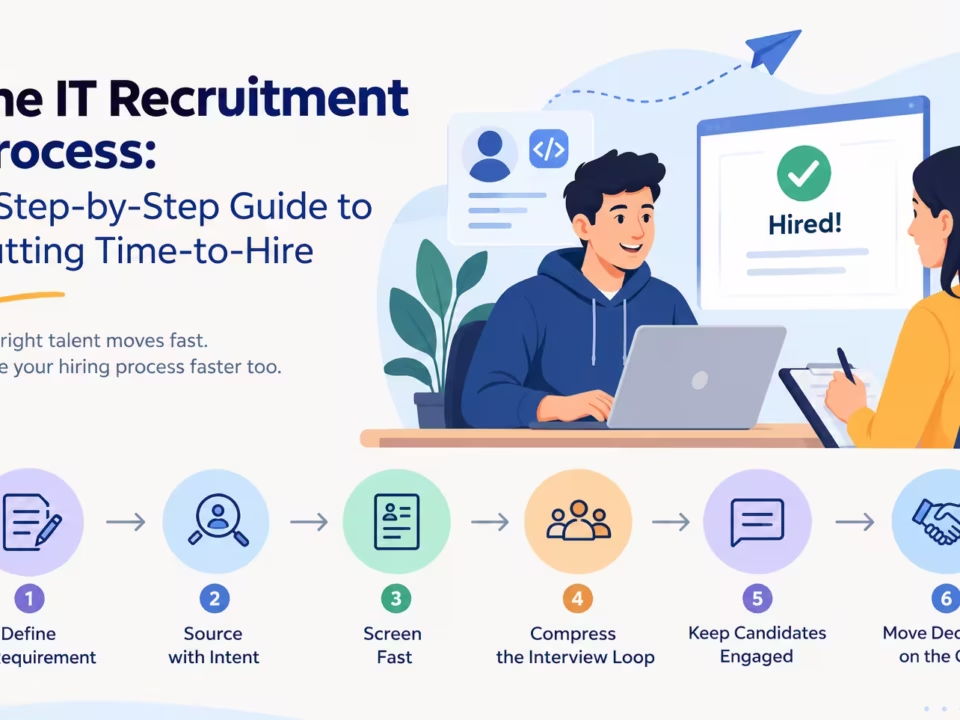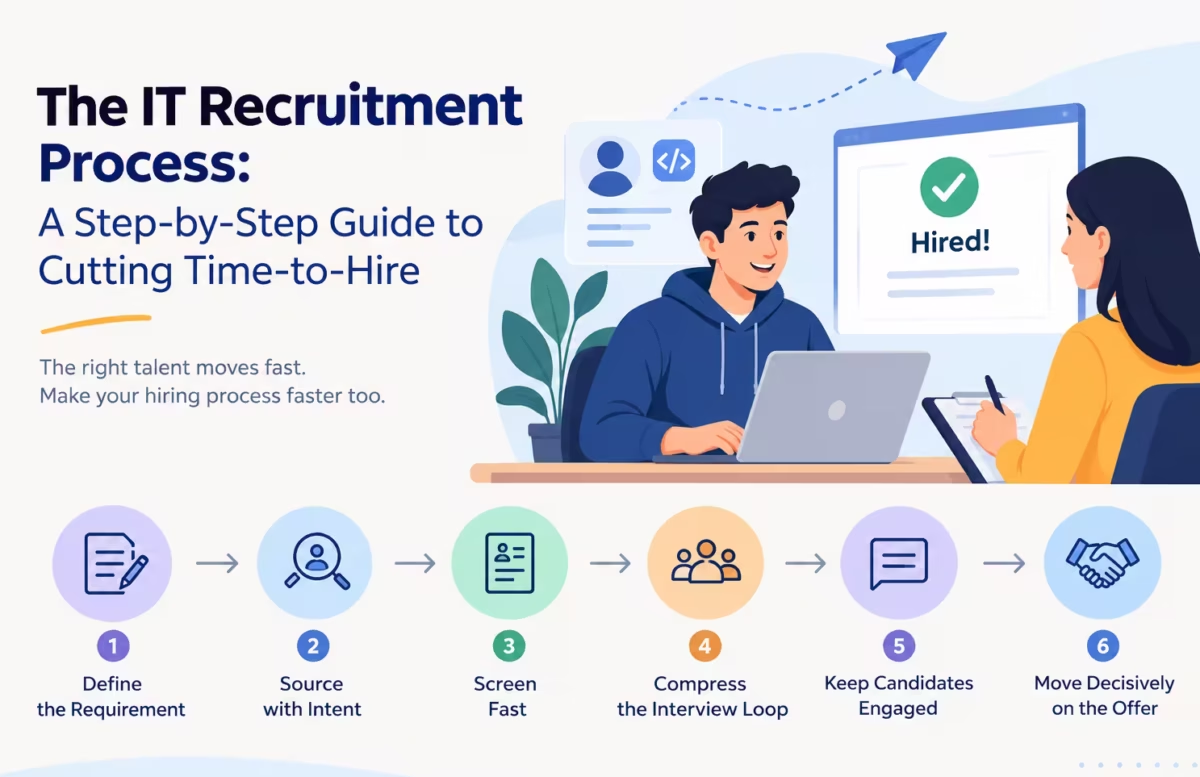
The IT Recruitment Process: A Step-by-Step Guide to Cutting Time-to-Hire
September 25, 2026
How to Hire ML Ops and AI Infrastructure Engineers
October 1, 2026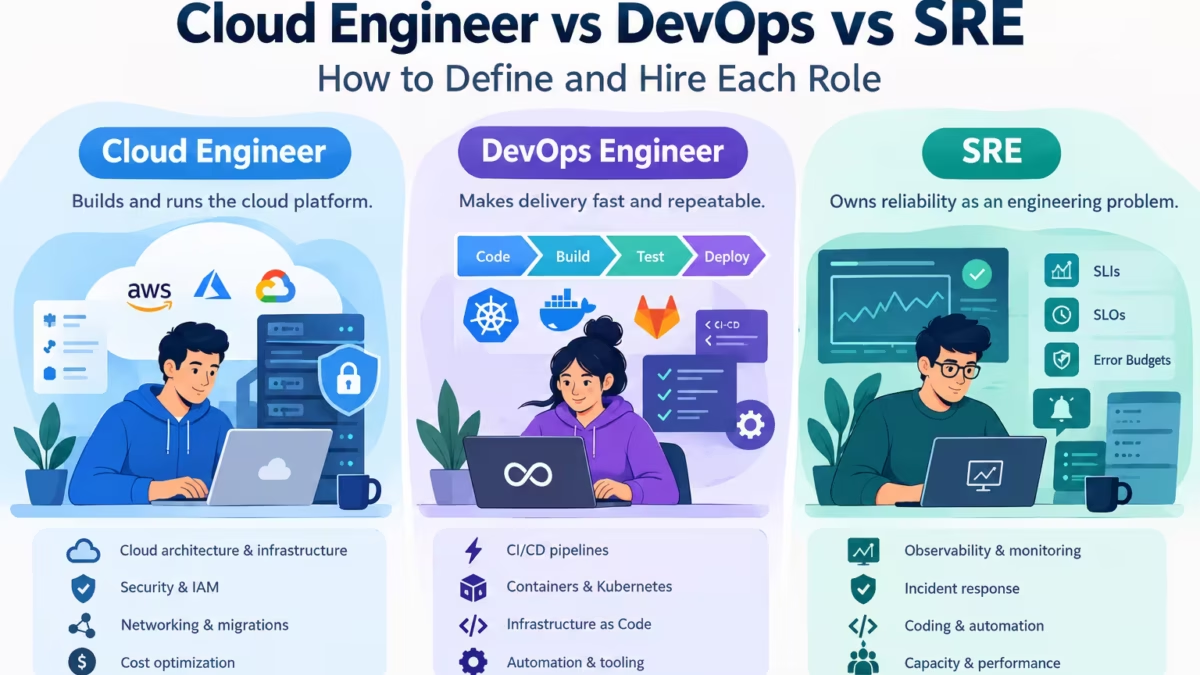
Open ten job descriptions for these three roles and you'll notice something odd. Half of them read almost identically. The same tools appear in each, Kubernetes, Terraform, AWS, CI/CD pipelines, and the responsibilities blur into one another until you can't tell what the company actually wants. Then the interviews start, the shortlists fall apart, and six months later someone is quietly wondering why the hire isn't working out.
This is one of the most common problems in IT infrastructure staffing, and it isn't really a sourcing problem. It's a definition problem. Cloud Engineer, DevOps Engineer and Site Reliability Engineer do overlap, they share a toolchain, and people move between them over a career. But they solve different problems, they're measured differently, and the person who thrives in one can genuinely struggle in another.
If you get the definition right before you post the role, everything downstream gets easier: sourcing, screening, interviewing, compensation and onboarding. Get it wrong, and you'll spend months interviewing people who were never quite right for what you actually needed. Here's how to tell these roles apart and hire each one properly.
Start with the problem, not the title
Before writing a job description, answer one question honestly: what problem are you hiring this person to solve?
If the answer is "we're moving to the cloud and need someone to design and run our infrastructure there," you want a Cloud Engineer. If it's "our releases are slow, manual and painful, and we need to ship faster and more safely," you want a DevOps Engineer. And if it's "our systems keep breaking, we're firefighting constantly, and we need someone to own reliability," you want an SRE.
Those are three different problems. They produce three different job descriptions, three different interview loops and three different kinds of successful hire. The moment you skip this step and write a generic "cloud/DevOps" requirement, you've guaranteed a muddled shortlist.
The Cloud Engineer: building and running the platform
A Cloud Engineer owns the cloud environment itself. They design it, build it, secure it and keep it running efficiently. Their world is infrastructure, how it's architected, how it scales, how much it costs and how safely it's configured.
Typical responsibilities include designing cloud architecture on AWS, Azure or GCP, building infrastructure as code, managing networking and identity, handling migrations from on-premise environments, and keeping a close eye on cloud spend. In many organisations they're also the people who set the guardrails other teams build within.
Skills to test for:
- Genuine depth in at least one cloud platform, covering compute, storage, networking and identity, rather than surface familiarity across three
- Infrastructure as code with Terraform, CloudFormation or Pulumi
- Cloud networking: VPCs, subnets, routing, load balancing, DNS
- IAM and access management at scale
- Cost awareness, someone who thinks about the monthly bill, not just whether it works
- Migration experience, if you're moving workloads from on-prem
- Security fundamentals in a cloud context
A good screening question: "Walk me through how you'd design a multi-account cloud environment for a company with three product teams." Strong candidates talk about account separation, shared services, network design, IAM boundaries, cost allocation and governance. Weaker ones list services without explaining how they fit together.
The DevOps Engineer: making delivery fast and repeatable
DevOps sits between development and operations, and the clue is in the name. A DevOps Engineer's job is to make shipping software fast, repeatable and low-drama. They build the pipelines, the automation and the internal tooling that let developers get code into production without a week of manual steps and crossed fingers.
Where a Cloud Engineer is focused on the platform, a DevOps Engineer is focused on the flow of work across it. Their success looks like shorter lead times, fewer failed deployments, less manual intervention and developers who can self-serve rather than raising a ticket for everything.
Skills to test for:
- CI/CD pipeline design with Jenkins, GitLab CI, GitHub Actions or similar
- Container orchestration, Docker and Kubernetes especially
- Infrastructure as code and configuration management
- Scripting depth in Python, Bash or Go
- Strong Git discipline and branching strategy
- Secrets management and pipeline security
- An instinct for automating whatever is currently done by hand
A good screening question: "Our deployment takes four hours and involves eleven manual steps. Where would you start?" The answer tells you a great deal. Strong candidates ask questions first, what breaks most often, what's riskiest, what's reversible, before proposing anything. Weaker ones jump straight to naming a tool.
The Site Reliability Engineer: owning reliability as an engineering problem
SRE is where the confusion peaks, because on paper it can look like DevOps with a different label. The distinction that matters is this: a site reliability engineer treats reliability itself as an engineering problem, with measurable targets attached.
SREs define what "reliable enough" means using SLIs, SLOs and error budgets, then engineer toward those numbers. They own observability, incident response, capacity planning and the hard question of when to stop shipping features and go fix stability instead. They also tend to write more software than people expect, building tooling that removes toil rather than absorbing it manually.
Skills to test for:
- Observability and monitoring with Prometheus, Grafana, ELK, Datadog or similar
- A working grasp of SLIs, SLOs and error budgets, not just the vocabulary
Genuine coding ability, not just scripting - Real on-call and incident-response experience
- Reasoning about failure modes, blast radius and graceful degradation
- Capacity planning and performance work
- Postmortem culture, and the ability to run one without blame
A good screening question: "Tell me about the worst production incident you've been part of. What happened, what did you do, and what changed afterwards?" This is the single most revealing question in an SRE interview. People who've genuinely been in the trenches describe the messiness honestly, the false leads, the pressure, the fix that didn't work. People who haven't give you a tidy story with no rough edges.
SRE vs DevOps: the distinction worth holding onto
Since this is where most confusion lives, it's worth stating plainly. The clearest way to separate SRE vs DevOps is by what each optimises for.
DevOps optimises for velocity, getting changes into production quickly, safely and repeatedly. SRE optimises for reliability, keeping the system available and performant within defined targets, even as it changes.
They're complementary rather than opposed, and healthy organisations need both tensions in the room. A DevOps Engineer wants the pipeline to move faster. An SRE wants to know the error budget can absorb it. That productive friction is a feature, not a problem.
In smaller companies, one person often wears both hats, and that's fine early on. As you scale, separating them usually produces better outcomes, because the priorities genuinely pull in different directions and someone has to own each one.
Why these roles are hard to fill
Three things make this market difficult.
First, the scope of every one of these roles has expanded enormously. A "cloud engineer" ten years ago provisioned servers. Today they're expected to handle security, cost, networking and automation as well. Job descriptions rarely keep pace with that shift, so companies end up screening for skills that no longer reflect the actual work.
Second, the strongest candidates aren't looking. Good infrastructure people are quietly indispensable where they are, which means they're not browsing job boards. If you're only reaching active applicants, you're fishing in a shallow, heavily contested pool.
Third, resumes have stopped correlating well with ability. Anyone can list Kubernetes and Terraform. Far fewer can reason about why a deployment fails under load or design a system that degrades gracefully when a dependency disappears. The words on the page no longer tell you what you need to know, which means your screening has to do more work.
How to screen properly: scenarios beat trivia
The single biggest improvement most companies can make is to stop asking tool questions and start asking scenario questions.
"Do you know Terraform?" tells you almost nothing. "Here's an environment that needs to span two clouds with shared identity, walk me through how you'd structure it, where it breaks, and what it costs" tells you everything. Real capability shows up in how someone reasons through a messy, constrained problem, not in whether they can recall a command.
Two other things are worth checking that most interviews skip. Recency, because a skill last used two years ago may already be stale in a field moving this fast. And scale, because running something in a lab is a completely different discipline from running it in production under real traffic with real users complaining.
Speed and pay close the deal
Even a perfect process loses candidates if it drags. Strong infrastructure engineers hold multiple offers and stay available for days rather than weeks. A drawn-out, six-round loop isn't rigorous, it's a slow way to hand your shortlist to a competitor who decided faster. Cut the loop to the rounds that genuinely predict performance, and decide once you've seen enough.
Compensation matters just as much. Pay for scarce infrastructure skills has climbed steadily as demand has outrun supply, and companies benchmarking against last year's numbers routinely come in under market without understanding why their offers keep getting declined. Benchmark to the specific skill and city, not a generic engineering band.
Getting cloud engineer recruitment right
Effective cloud engineer recruitment, and infrastructure hiring more broadly, comes down to a handful of disciplines practised consistently.
Define the role by the problem you're solving, not by a template. Write a job description that reflects the work as it actually is today. Screen for reasoning through realistic scenarios rather than tool recall. Reach passive candidates directly instead of waiting for applications. Benchmark pay to the real market. And move decisively once you've found the right person.
None of that is complicated. All of it is deliberate, and that's precisely why so few companies do it consistently.
Where Prism HRC fits in
At Prism HRC, we see these searches from the side that rarely makes it into a job description: the point where a vague brief turns into a six-month vacancy. More often than not, the problem isn't a shortage of candidates. It's that "cloud/DevOps/SRE" was never properly defined, the screen tested tools instead of judgment, and the strongest people were never reached because they weren't applying anywhere.
So we work the front of the search. We help clients pin down which of these three roles they actually need before anything gets posted, screen for demonstrated depth in architecture, automation and production reliability rather than keyword matches, and reach the engineers doing good work somewhere else who'd never respond to a job ad. We keep our compensation benchmarks current and we move at the pace this market demands, because in infrastructure hiring, a clear and fast process closes candidates that a slow, well-funded one loses.
For companies looking to hire DevOps engineers in India, or to build out a full platform team across cloud, DevOps and SRE, that clarity at the start is what turns a stalled search into a working team.
Prism HRC helps you pin down which role you actually need, screen for real depth in architecture, automation and reliability, and reach the strong engineers who are not applying anywhere.
Build your platform team with Prism HRC
Frequently Asked Questions (FAQs)
Tell Us Your Requirement
Ready To Build Your Dream Team With Prism HRC?
Want to explore our range of recruitment, staffing, payroll, compliance, employee welfare and employee global mobility solutions? Fill out this form and our subject matter experts will get in touch with you within 2 working days to address all your requirements at length.
Note to Candidates: Please DO NOT use this form to career related queries or job applications, as all such requests will be DELETED. For any job/career related queries, please go to career page.