What India’s New Labour Codes Mean for Companies Using Contract IT Talent
September 10, 2026
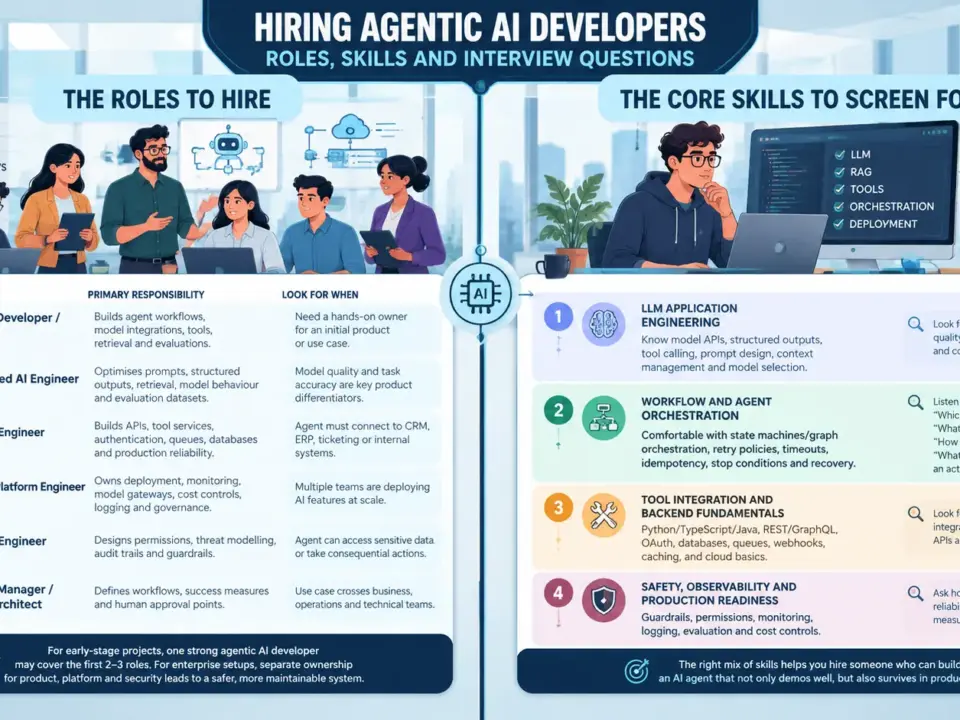
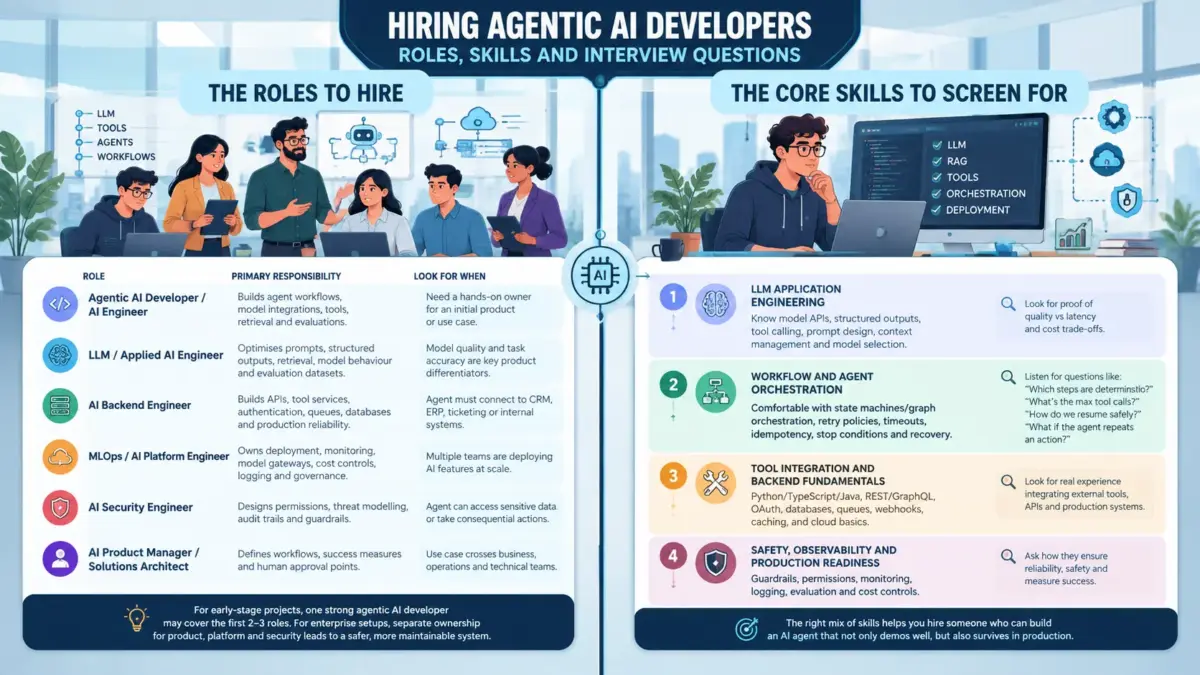
Hiring Agentic AI Developers: Roles, Skills and Interview Questions
September 18, 2026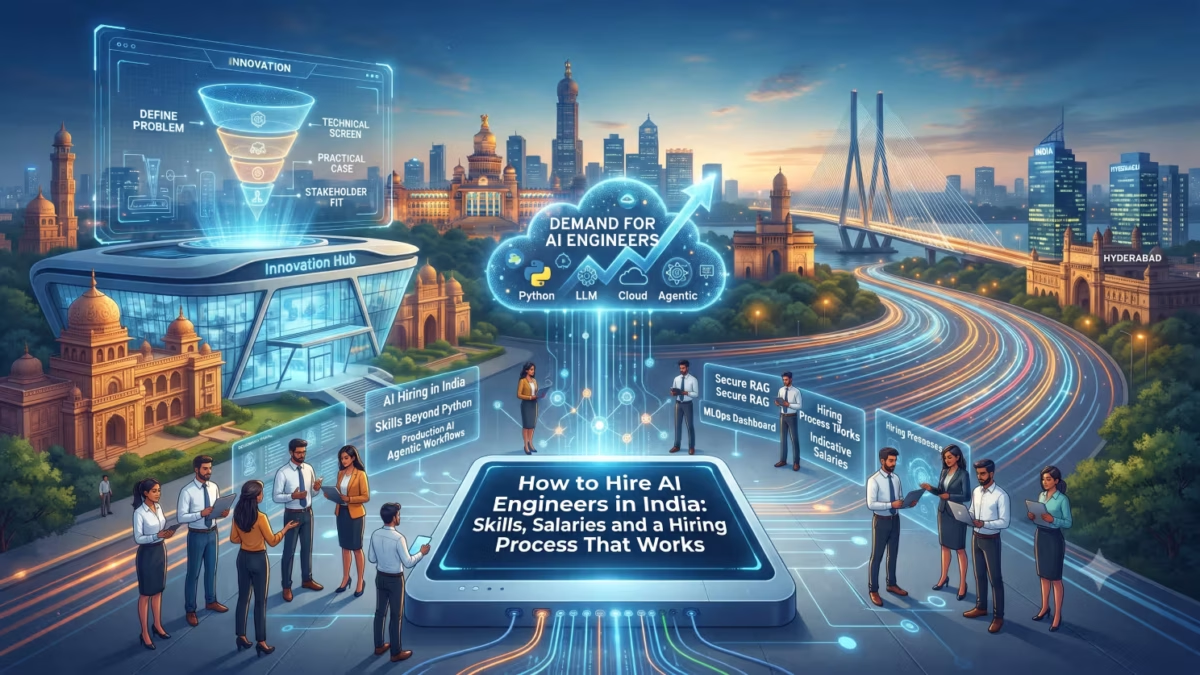
Artificial intelligence hiring in India has moved well past looking for someone who knows Python or has finished a machine-learning course. What companies need now are engineers who can turn AI ideas into reliable products: systems that work with trusted company data, plug into existing software, stay secure, get measured in production and actually deliver a business outcome.
That's exactly why hiring has become so hard. Plenty of profiles now carry titles like AI Engineer, GenAI Developer, LLM Engineer or Agentic AI Engineer, but the depth of real delivery experience behind them varies enormously. One candidate may have built a chatbot demo yet never deployed a secure Retrieval-Augmented Generation (RAG) application. Another may know their way around model APIs but lack the engineering discipline to handle authentication, permissions, testing, monitoring and production failures.
For companies looking to hire AI engineers in India, the fix is not piling more keywords into a job description. It's defining the business problem, testing the AI engineer skills that genuinely matter, and running a hiring process that tells real product builders apart from tool users.
India's AI hiring market: why the right profile is hard to find
AI demand is climbing across product companies, Global Capability Centres (GCCs), banks, consulting firms, SaaS companies, e-commerce businesses and IT services providers. The sharpest demand is for professionals who pair AI knowledge with software engineering, cloud and data-platform capability.
The market is particularly tough for hiring AI engineers with hands-on experience in:
- Generative AI and LLM application development
- RAG systems and enterprise search
- Agentic AI and workflow automation
- MLOps and model deployment
- AI security, governance and evaluation
- Data engineering for AI applications
- Cloud architecture and AI API integration
Companies that hire AI engineers in India are not just up against other startups, either. They're competing with well-funded AI companies, large GCCs, global product firms and consulting organisations. Which means speed, role clarity and a strong interview experience count for just as much as compensation.
Start with the business problem, not the job title
The first mistake is putting out a broad requirement for an "AI engineer" before you've decided what the person actually needs to build. AI is not one role.
A predictive-demand model, an internal HR knowledge assistant, a customer-support chatbot, a fraud-detection platform and an autonomous finance workflow all call for different skill combinations.
Before you start hiring, answer these six questions:
- What process or decision should the AI solution improve?
- Who will use it: employees, customers, recruiters, finance teams or developers?
- What data will the solution need to access?
- Does the project need machine learning, generative AI, AI agents or a combination?
- Is it a proof of concept, pilot or production implementation?
- What measurable result should it achieve in three or six months?
Take "We need an AI engineer", it's vague. A stronger brief would be:
We need a generative AI engineer to build a secure internal assistant that retrieves HR policies and recruitment-process information from approved documents, cites sources, tracks feedback and integrates with Microsoft Teams.
A brief like that tells candidates, recruiters and interviewers exactly what success looks like. It also makes salary benchmarking far more accurate.
Which AI role should you hire?
AI engineer
An AI engineer blends software engineering with AI or machine-learning capability. They build applications that draw on models, data pipelines, APIs, cloud services and business workflows.
Typical skills include Python, SQL, APIs, cloud platforms, model integration, testing, deployment and monitoring. It's the broadest role, and it works well when a company needs someone who can build AI-enabled products end to end.
Generative AI engineer
A generative AI engineer builds applications using large language models, multimodal models or image-generation models. Their work might include RAG systems, LLM integrations, prompt and context design, structured outputs, model evaluation, guardrails and enterprise-system integration.
When you hire generative AI engineers, do not assess them on prompt-writing ability alone. They should understand retrieval quality, hallucination reduction, latency, token cost, data security, model fallback and user experience.
Agentic AI engineer
Companies looking to hire agentic AI engineers need a specialised profile. Agentic AI systems do more than answer questions, they use tools, follow workflows, make controlled decisions, hold state where needed and complete approved actions in business systems.
An agent could, for instance, read a support ticket, retrieve customer data, classify the request, draft a response, create a follow-up task and route the case to the right team.
That takes more than LLM knowledge. An agentic AI engineer needs strong software engineering, API integration, workflow orchestration, observability, identity and access management, approval controls and safety design.
The strongest candidates also know that a fully autonomous agent is not always the best answer. In many enterprise workflows, a deterministic process with AI used for classification, extraction or drafting is safer, cheaper and easier to audit.
Machine-learning engineer
A machine-learning engineer is usually stronger at training, deploying and maintaining predictive models. This is the right profile for forecasting, recommendations, fraud detection, classification, computer vision, optimisation or risk scoring.
If the core requirement is statistical performance and model training rather than an LLM-based interface, hire a machine-learning engineer instead of forcing a generative AI profile into the role.
AI consultant
An AI consultant salary in India varies a lot, mostly because the title covers several kinds of work. Some consultants focus on AI strategy, use-case prioritisation and governance. Others are hands-on solution architects who design data flows, security controls, integrations and implementation roadmaps.
For an early-stage AI programme, a strong consultant can help a company steer clear of spending on low-value experiments. But a consultant should not stand in for the engineering team you need to build, deploy and run the final product.
The AI engineer skills that matter most
A good hiring process tests practical engineering judgment, not just familiarity with the latest AI framework.
1. Software engineering fundamentals
AI applications are still software products. Test Python proficiency, API design, version control, debugging, testing, data structures and system design.
Ask candidates how they'd release an AI feature into an existing product. A strong answer should cover authentication, error handling, logs, user permissions, CI/CD, rollback plans and monitoring.
A candidate who only ever works in notebooks may struggle once the solution has to support thousands of users or reach sensitive company information.
2. Data and retrieval capability
For enterprise AI, data quality often matters more than the model you pick. Test whether the candidate understands document ingestion, chunking, metadata, embeddings, vector search, reranking, source citations and permission-aware retrieval.
A useful interview question: "How would you build an internal policy assistant using approved company documents?"
A strong candidate should talk through:
- Document-quality checks before indexing
- Metadata and document-version control
- Role-based access to sensitive information
- Retrieval evaluation datasets
- Source citations in the final answer
- User-feedback loops to improve quality
3. LLM application engineering
For generative AI roles, assess model selection, context management, structured outputs, function calling, prompt-injection risk, fallback logic and cost control.
Ask: "How would you reduce hallucinations in a customer-facing AI assistant?"
A high-quality answer should take in grounded retrieval, constrained outputs, input validation, confidence thresholds, tool permissions, human escalation and continuous evaluation. A thin answer like "improve the prompt" is not enough.
4. Agentic workflow design
For agentic AI roles, test how a candidate handles planning, tool use, retries, approvals, memory, state and failure scenarios.
Give them a live case: design an agent that reads a customer request, checks an internal system, drafts a response and sends it only after human approval.
Look at whether the candidate:
- Defines approved tools and permissions
- Limits what the agent can do
- Designs an audit trail
- Handles incorrect or incomplete information
- Includes human approval for sensitive actions
- Measures task success, latency, cost and failure rate
5. MLOps, deployment and observability
Production AI systems need monitoring. Candidates should understand cloud deployment, containers, CI/CD, secrets management, model versioning, tracing, logging and incident response.
The metrics they should be able to discuss include response quality, retrieval relevance, task-success rate, latency, error rates, token usage, cost per interaction, user feedback and security events.
6. Security and responsible AI
AI engineers working with company data have to understand authentication, authorisation, privacy, prompt injection, data leakage, malicious-file ingestion, model-provider risk and audit trails.
Security cannot be left wholly to another team. The engineer should know how to restrict tool permissions, design safe defaults, redact sensitive data and route high-risk actions to a human.
7. Business communication
The best AI engineers can talk clearly with product, operations, legal and security teams. They can push back on vague requirements, explain trade-offs and turn an AI idea into a measurable workflow.
That's essential, because AI projects fail when teams build impressive technology that is not connected to a real business process.
AI engineer salary in India: what should companies expect?
AI engineer salaries in India hinge on location, experience, company type, engineering depth, cloud expertise and production delivery experience. Bengaluru, Hyderabad, Pune, Gurugram, Mumbai and Chennai remain the major AI talent hubs, though remote and hybrid hiring have widened access.
The ranges below are realistic annual fixed-CTC guidance for 2026. Actual offers can shift based on bonus, ESOPs, joining incentives, notice-period buyouts, city, employer brand and niche skills.
| Role and experience | Indicative salary range in India |
|---|---|
| Junior AI or ML engineer, 0–2 years | ₹8–15 LPA |
| AI engineer, 2–4 years, with production exposure | ₹15–28 LPA |
| Generative AI engineer, 3–6 years | ₹20–35 LPA |
| Senior AI or ML engineer, 5–8 years | ₹30–50 LPA |
| Senior generative AI or agentic AI engineer | ₹35–70 LPA |
| AI architect, principal engineer or specialised lead | ₹60 LPA and above |
| AI consultant salary in India | ₹12–25 LPA for junior-to-mid roles; ₹25–50 LPA or more for experienced hands-on consultants and solution architects |
The premium runs highest for candidates who can show all four capabilities: production AI delivery, strong backend engineering, cloud deployment and security awareness. An engineer who's deployed a secure RAG application, integrated it with enterprise systems, measured answer quality and controlled cloud cost will usually command a higher offer than a general ML profile with similar years behind them.
A hiring process that works
Step 1: Build a role-specific scorecard
Create the scorecard before you review any CVs. For a generative AI engineer, weight Python, RAG, LLM integration, evaluation, cloud deployment, security and stakeholder communication.
For an agentic AI engineer, add workflow orchestration, API integration, tool permissions, observability and human-in-the-loop design.
Do not write a job description that demands every possible AI skill. It filters out practical specialists and pulls in keyword-heavy profiles.
Step 2: Source from the right backgrounds
Do not search only for the title "AI Engineer." The right candidates may go by Applied AI Engineer, ML Engineer, LLM Engineer, Generative AI Developer, MLOps Engineer, Data Scientist, AI Solutions Architect or Backend Engineer with RAG experience.
Look at project descriptions, GitHub, technical portfolios, open-source work, conference talks and blogs where you can find them. A portfolio does not replace a technical interview, but it can reveal genuine interest and depth.
Step 3: Conduct a 45-minute technical screen
The first technical conversation should dig into one real project. Ask:
- What business problem did the system solve?
- What data did it use?
- Why was that model or architecture chosen?
- How was quality measured?
- What failed during implementation?
- How were security, privacy and cost managed?
- What changed after users started using it?
A candidate who genuinely owned the work can walk you through the trade-offs, not just the final architecture diagram.
Step 4: Use a 60- to 90-minute practical case
Skip the long unpaid take-home assignments. Use a live case study instead.
For a generative AI engineer, ask the candidate to design an employee-policy assistant. For an agentic AI engineer, ask them to design a workflow that reads a request, retrieves data from approved systems and sends an external action only after human approval.
Score them on architecture, assumptions, data security, evaluation plan, failure handling and clarity of communication.
Step 5: Include business and product stakeholders
A final round with a product manager, business owner or operations leader matters. Test whether the candidate asks useful questions, challenges unclear goals and explains technical risk in plain language.
Step 6: Check delivery ownership
Reference checks should centre on outcomes. Ask whether the candidate shipped production systems, worked well across teams, documented their work and handled ambiguity or production failures responsibly.
A representative agentic AI hiring case
A mid-sized services company wanted to cut the turnaround time on internal employee queries. The first request was to "build an AI chatbot." After discovery, the requirement was sharpened into a controlled workflow: retrieve answers only from approved policy documents, cite the source, create an HR ticket when confidence is low, and keep a human approver for sensitive actions.
So the role was redesigned from a generic "AI Developer" into an Agentic AI Engineer requirement with five core priorities:
- Python and backend API development
- RAG and document-retrieval design
- Workflow orchestration and tool integration
- Security, permissions and audit logs
- Evaluation and production monitoring
That narrower brief produced better interviews. Rather than picking the candidate with the most AI buzzwords, the company chose an engineer who'd built enterprise integrations, handled access controls, and could explain how to test the system before release.
This is the approach Prism HRC recommends when supporting agentic AI hiring: first clarify the workflow, user, data and approval model; then assess the candidate against the engineering and governance skills the product genuinely needs.
How Prism HRC helps companies hire AI engineers in India
Prism HRC supports companies hiring AI talent across AI engineering, generative AI, agentic AI, data engineering, MLOps, cloud and product-development roles. We have a specialised team of around 20 AI recruiters who work only on technology and AI hiring requirements.
We take an aggressive, fast-moving approach, because strong AI candidates are so often lost when interview feedback, approvals or offer decisions drag on. Our recruiters know the difference between generic AI exposure and real experience in RAG, LLM applications, agentic workflows, MLOps, cloud deployment and enterprise AI integrations.
Having worked with large IT organisations and consulting companies, Prism HRC understands the need for quality profiles, fast turnaround and a well-managed candidate experience. Whether you need to hire generative AI engineers for a RAG platform, hire agentic AI engineers for workflow automation, or build a complete AI product team, we help define the requirement, move candidates through the process quickly and support you in closing the right talent before the market does.
References
- NITI Aayog: Roadmap for Job Creation in the AI Economy
- Stanford HAI: AI Index Report 2026
- PwC: AI Jobs Barometer 2026
- AI engineer salary guide for India, 2026
Salary figures are indicative market ranges for hiring planning. They are not a compensation guarantee and should be validated against role scope, location, seniority, company type and total-reward structure.
Prism HRC's specialist AI recruiters help you define the role, test what actually matters, and close the right talent fast, before the market does.
Start hiring with Prism HRC
Frequently Asked Questions (FAQs)
Tell Us Your Requirement
Ready To Build Your Dream Team With Prism HRC?
Want to explore our range of recruitment, staffing, payroll, compliance, employee welfare and employee global mobility solutions? Fill out this form and our subject matter experts will get in touch with you within 2 working days to address all your requirements at length.
Note to Candidates: Please DO NOT use this form to career related queries or job applications, as all such requests will be DELETED. For any job/career related queries, please go to career page.