Hiring Agentic AI Developers: Roles, Skills and Interview Questions
September 18, 2026
The IT Recruitment Process: A Step-by-Step Guide to Cutting Time-to-Hire
September 25, 2026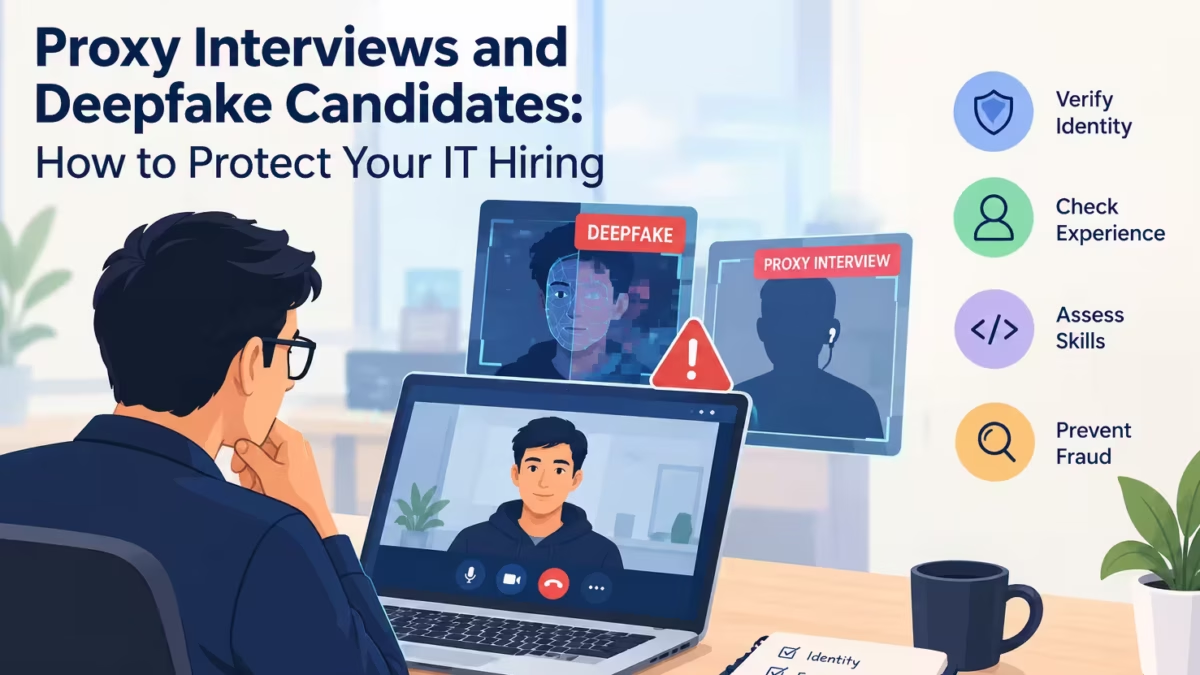
Remote hiring has made it easier for Indian companies, GCCs, IT services firms and startups to access talent across cities. It has also created a serious verification problem: can the person who interviews, completes the assessment and joins the project actually be trusted to be the same person?
Proxy interviews, fabricated work histories and deepfake video calls are no longer theoretical risks for India Inc. Indian business reporting has noted growing employment fraud involving false work histories, fake educational credentials, dual employment and deepfakes during online interviews. For recruiters, the lesson is clear: identity, capability and employment history must be verified before a candidate reaches the client or receives sensitive access.t
For in-house recruiters and IT recruitment agencies, the objective is not to become an investigator or reject candidates based on instinct. It is to run a consistent, documented process that identifies mismatches early, treats candidates fairly and prevents questionable profiles from reaching the client interview stage.
What is a proxy interview?
A proxy interview happens when the person appearing for an interview is not the person who will ultimately join the organisation. Sometimes a more experienced person answers technical questions off camera or through an earpiece. In more serious cases, an entirely different individual gives the interview and the hired candidate cannot perform the work after onboarding.
In IT hiring, proxy interview risk is especially high where roles are remote, technical assessments are unsupervised and the recruitment process moves quickly. The consequences can include a failed joining, loss of client trust, project delays, unauthorised system access and a costly replacement cycle.
What are deepfake candidates and deepfake job interviews?
A deepfake candidate uses synthetic or manipulated media to make an interviewer believe they are speaking to a genuine person. This can range from a modified profile photo to a real time video or voice impersonation during a deepfake job interview. Not every video glitch indicates fraud but a pattern of unexplained visual or behavioural inconsistencies should trigger a verification step.
The risk is recognised in India’s AI and cybersecurity discussions. The Government of India has stated that CERT-In issued an advisory on deepfake threats and protective measures, while MeitY has also cautioned that AI models can be used for misinformation and deepfakes. For recruiters, that makes layered human verification more important than relying only on a video call.
Warning signs recruiters should not ignore
One signal alone is not proof. Recruiters should look for a pattern and give the candidate a clear, reasonable opportunity to verify their identity and experience.
- The candidate repeatedly refuses a live camera on conversation or claims recurring technical issues only when verification is requested.
- There is a mismatch between lip movement and speech, unusual face edges, inconsistent lighting, unnatural blinking or frequent image distortion.
- Technical answers are unusually delayed, generic or inconsistent with the CV, GitHub work, prior projects or the role sought.
- A different person appears to take over during a coding round, screen share session or follow up call.
- LinkedIn, resume, email address, phone number and work history details do not align.
- Employment dates, designation, client names or project claims change across recruiter, technical and HR rounds.
- The candidate pressures the team to skip verification, requests equipment or credentials before standard onboarding is complete, or uses a third party for salary arrangements.
A recruiter’s process to stop fake candidates before client interviews
1. Verify the profile before submission
Compare the resume, LinkedIn profile, contact details, location, work history and project descriptions. Ask concise, role relevant questions: What did you personally build? Which API did you own? What production issue did you resolve? What was the deployment process? A genuine candidate may not remember every detail, but should be able to explain their own work naturally and consistently.
For niche skills, use a short live screening with a recruiter trained technical panel. This helps prevent fake candidates in tech hiring from reaching client interviews solely because their CV contains the right keywords.
2. Use a live identity check at appropriate stages
For sensitive, senior, remote or client-critical roles, schedule at least one live camera-on call before final submission or before an offer. Explain in advance that it is a standard identity and interview-integrity check.
Ask the candidate to join from a stable connection, show their face clearly and complete a short, role related interaction. The aim is to establish continuity between the profile, the conversation and the person who will attend the technical interview.
3. Make technical assessment hard to outsource
Use live problem-solving rather than only take home assignments. During a coding discussion, ask the candidate to explain design choices, change one requirement, debug a small issue or talk through a recent project. Rotate questions by role and use a standard scorecard.
The best check is not a trick question. It is a structured conversation that tests whether the candidate can reason through their claimed experience in real time. For higher risk roles, add a supervised coding exercise and a second technical round with a different interviewer.
4. Verify employment, but do it lawfully and fairly
PF or UAN history can be one useful supporting document for employment verification when the candidate provides informed consent. However, the absence of PF is not proof of fraud: startups, small firms, contract roles, overseas work, self employment and non covered employers may not create the same PF trail.
Do not make “no PF” an automatic rejection rule. Instead, investigate material gaps or inconsistencies through consent based documents such as offer letters, relieving letters, salary slips, official employment references and project evidence. PF should be a verification aid, not a universal eligibility filter.
5. Be cautious with education claim - verify through official channels
Recruiters should apply additional verification when an institution, college affiliation, course or degree format is unfamiliar, difficult to validate, or does not align with the candidate’s claimed timeline. In the market, some colleges, training centres or placement networks may develop recurring and credible fraud concerns. Where a company has documented evidence - such as an official regulatory notice, verified prior cases or repeated failed certificate verifications - the institution or network should be marked as high risk in its internal verification policy.
For high risk cases, do not submit the candidate to a client or progress the application until independent verification is complete. Verify the specific degree, college affiliation, course, year of passing and certificate through the issuing university or an authorised background verification partner. For India, check recognition and official fake university notices through the UGC; UGC also states that degree verification is the responsibility of the concerned university. Avoid informal or rumour based blacklists: only verified, documented findings should determine the outcome.
6. Run a pre-joining and day-one continuity check
The person who accepts the offer should be the person who joins. Before onboarding, reconfirm contact details, bank account ownership and identity documents through approved HR processes. On day one, conduct a short manager or HR video call before access to sensitive systems is issued.
For critical roles, IT teams should apply least privilege access and avoid providing production credentials until identity, device and onboarding checks are complete.
A simple recruiter escalation checklist
When a concern arises, do not accuse the candidate immediately. Record the specific inconsistency and follow a defined escalation process: ask for a live clarification or relevant document, re-check technical capability with a different interviewer, obtain written consent before verification and share only verified role relevant findings with the client.
Do not submit the candidate until the inconsistency is resolved or transparently disclosed. This protects the recruiter’s credibility as well as the client’s hiring process.
Common mistakes to avoid
Do not rely solely on automated deepfake detection tools. They can generate false positives and should support - not replace human review and documented verification. Do not make decisions based on accent, appearance, disability, location, university reputation, PF status or an isolated video quality issue.
Also avoid asking for excessive personal data during sourcing. Use proportionate checks based on role risk, obtain consent and restrict sensitive data to authorised personnel.
How Prism HRC supports secure IT hiring in India
At Prism HRC, we help clients reduce hiring risk through structured recruiter screening, role relevant technical evaluation, interview coordination and verification focused candidate management. Our technology recruitment teams assess capability beyond CV keywords and help clients maintain a fast process without compromising due diligence.
For permanent, contract, project and contract to hire requirements, Prism HRC can support disciplined pre submission checks, technical interview panels and joining risk follow up so clients receive better vetted IT candidates and recruiters protect the credibility of every shortlisted profile.
References
Prism HRC helps you hire faster while keeping fraud out, with structured screening, technical panels, and verification-focused candidate management.
Hire safely with Prism HRC
Frequently Asked Questions (FAQs)
Tell Us Your Requirement
Ready To Build Your Dream Team With Prism HRC?
Want to explore our range of recruitment, staffing, payroll, compliance, employee welfare and employee global mobility solutions? Fill out this form and our subject matter experts will get in touch with you within 2 working days to address all your requirements at length.
Note to Candidates: Please DO NOT use this form to career related queries or job applications, as all such requests will be DELETED. For any job/career related queries, please go to career page.