Building an AI-Ready Workforce: The Roles Every Company Needs to Hire Next
August 9, 2026
IT Recruitment Agency in India: How the Right Partner Fixes a Broken Tech Hiring Process
August 15, 2026
Every company faces the same question the moment a new piece of work lands: do we hire someone permanent, or bring in a contractor? Most reach for permanent almost by reflex, it's the familiar option, the one that feels safe. But that reflex quietly costs businesses more than they realise, in salaries carried long after a project ends, in roles filled slowly when speed was the whole point, in long-term commitments made to work that was only ever short-term.
The truth is that there is no one IT staffing model better than the other. What matters is fit, matching the hiring approach to the actual shape of the work, the budget, the timeline and the skills you need. Choose well and you hire faster, spend smarter, and keep the freedom to change direction. Choose badly in either direction, over-committing to permanent or leaning too hard on contract, and you pay for it, either in wasted salary or in a team with no continuity. This piece breaks down how the two models really differ, when each one wins, and how to read your own situation clearly enough to make the right call.
What the Two IT Staffing Models Actually Are
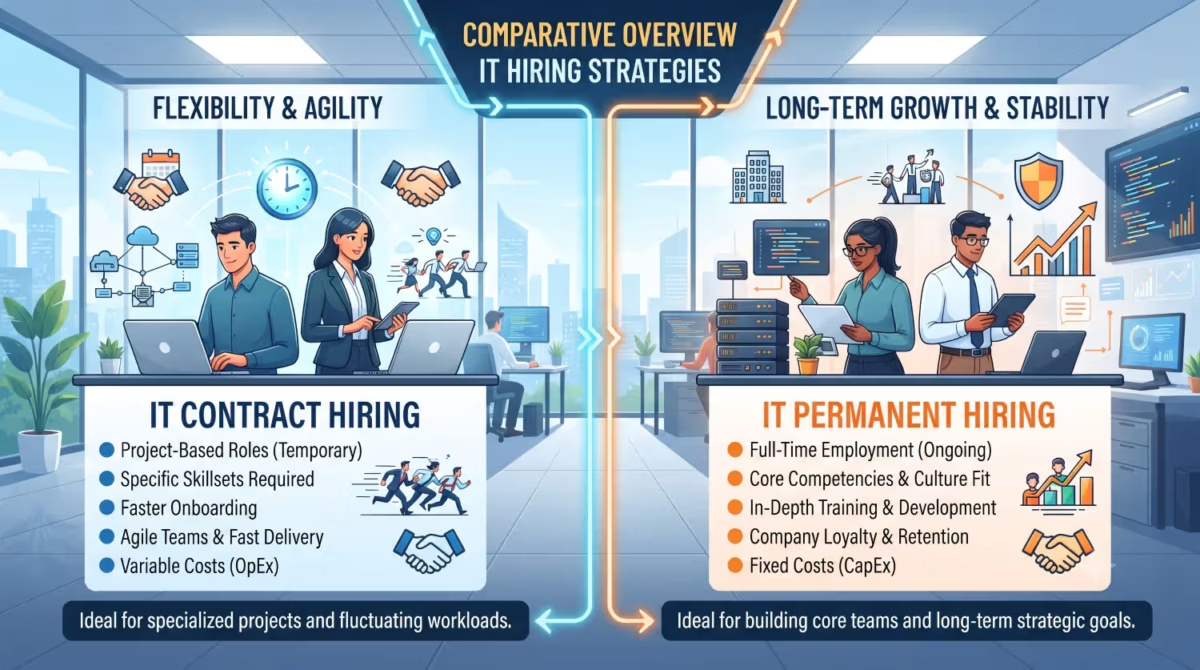
At its simplest, permanent hiring brings someone onto your payroll indefinitely, with a salary, benefits, and the expectation that they'll grow with the company over years. Contract IT staffing engages a tech personnel for a defined scope or period, often through a staffing partner, to do a specific job and then move on. Both fill a seat. What differs is everything around that seat, cost structure, commitment, speed, and what you're really buying.
The mistake is treating this as a binary loyalty test, permanent for the people you value, contract for the ones you don't. That framing leads to bad decisions. A far more useful lens is to ask what the work needs. Is this an ongoing responsibility that will still exist in three years, or a burst of demand tied to a specific project or deadline? The honest answer to that question points you toward the right model far more reliably than instinct does. This is the heart of choosing between IT staffing models, and it's less about people than about the nature of the work itself.
When Permanent Makes Sense
Permanent hiring earns its cost when the work is continuous, core to the business, and dependent on institutional knowledge that compounds over time. The engineer who owns your core platform, understands why a decision was made two years ago, and mentors the people around them is worth the long-term commitment precisely because their value grows the longer they stay.
There's a cultural dimension too. Permanent employees build the continuity, the shared context and the deep familiarity with your systems that a rotating cast of contractors can't replicate. For roles at the centre of your product and your team, that continuity isn't a nice-to-have, it's the whole point. The trade-off is commitment and cost. A permanent hire carries salary, benefits and notice obligations whether this quarter is busy or quiet, and unwinding the decision later is slow and often uncomfortable. That's a price worth paying for genuinely core roles, and a waste for work that won't outlast the year.
When Contract Wins
Contract IT staffing comes into its own exactly where permanent struggles: work that is temporary, specialised, or urgent. A migration with a hard deadline, a skill you need for one project but not forever, a sudden spike in demand during a product launch, these are situations where committing to permanent headcount is the expensive mistake, not the safe choice.
Speed is a major part of the appeal. A good staffing partner can put a qualified contractor to work in a fraction of the time a full permanent search takes, which matters when the alternative is a project sitting idle waiting for a hire. So is access to niche skills, you can bring in deep expertise for the weeks you need it without carrying that specialist salary once the work is done. And there's flexibility, when the project ends, the engagement ends cleanly, without the difficult conversations and costs that come with reducing permanent headcount. The trade-off is continuity, contractors move on, taking their familiarity with them, so relying on them for core, long-lived work leaves you exposed. Used for the right work, though, contract staffing is often the smarter and cheaper path.
IT Staffing Models Also Come With Challenges
Neither model is frictionless, and it's worth being honest about what each one costs beyond the obvious. On the permanent side, the biggest risk is committing to the wrong bet, hiring for a need that changes, and being left with fixed costs you can't easily redeploy. Permanent hiring also moves slowly, which is a genuine problem when strong candidates hold multiple offers and a drawn-out process loses them to whoever decided faster. And a bad permanent hire is expensive to unwind, both in exit cost and in the months of underperformance before anyone admits the mistake.
Contract staffing carries its own drag. Continuity is the obvious one, knowledge walks out the door when the contract ends, so anything a contractor builds needs to be documented and handed over deliberately, or you inherit a system nobody left behind understands. There's an integration challenge too: contractors dropped into a team without proper onboarding often take longer to become productive than expected, eating into the speed advantage that justified the model. And leaning too heavily on contract talent for core work can leave you structurally dependent on people who, by definition, aren't staying. The point isn't that one model is riskier than the other. It's that each has a failure mode, and choosing well means knowing which risk you can better absorb.
Match the Model to the Role and Its Skills
Knowing the difference between temporary vs permanent employees is crucial because the right choice often comes down to the specific role and the skills it demands. Some capabilities are worth owning permanently; others are exactly what you'd bring in on contract. Here's how that tends to break down, and what to screen for in each.
- Core Platform / Backend Engineer (usually permanent). The people who own your central systems and accumulate irreplaceable context. Look for: deep language and architecture expertise, system-design judgment, and the ability to mentor and set standards others follow.
- DevOps / Infrastructure Engineer (permanent or contract). Ongoing if you're running production systems continuously; contract if you're standing up infrastructure for a defined build. Look for: CI/CD, cloud platforms, Infrastructure as Code, and comfort reasoning about reliability and cost.
- Specialist for a Defined Project (contract). Skills you need for one initiative but not forever, a data migration lead, a security specialist for an audit, a Kubernetes expert for a containerisation push. Look for: proven, recent, hands-on delivery of that exact task, not general familiarity with the area.
- Surge Capacity During a Launch or Peak (contract). Extra hands to hit a deadline without permanently inflating headcount. Look for: the ability to onboard fast and ship inside a short window, rather than long-term culture fit.
- Product / Engineering Lead (permanent). Roles that shape direction and carry institutional memory. Look for: leadership track record, architectural depth, and the judgment to make trade-offs the business will live with for years.
The pattern is straightforward once you see it: the more a role depends on continuity and accumulated context, the stronger the case for permanent. The more it's tied to a specific, time-bound need, the stronger the case for contract.
The Cost Picture Isn't What It Looks Like
On paper, a contractor's day rate often looks higher than the equivalent salaried cost, and that comparison fools a lot of decision-makers. It leaves out too much. A permanent hire carries benefits, paid leave, statutory contributions, equipment, onboarding, and the ongoing cost of the role even during quiet stretches. A contractor's rate, higher though it looks per day, buys flexibility and carries none of the long tail.
The real comparison isn't day rate versus salary. It's total cost over the actual duration of the need. For continuous work, permanent almost always wins on cost over time, because you're not paying a premium indefinitely. For finite work, a contract usually wins, because you stop paying the moment the work ends rather than carrying a salary you no longer need. The expensive errors happen when the model and the timeline are mismatched, permanent people kept on for work that finished months ago, or contractors retained so long they'd have been cheaper as employees.
A Blended Model Is Often the Real Answer
In practice, the smartest approach for most growing companies isn't choosing one model wholesale, it's blending them deliberately. A permanent core team holds the institutional knowledge and owns the systems that matter, while contract talent flexes around them to handle surges, specialised projects and time-bound needs. That structure gives you stability where you need it and flexibility where you don't, without overpaying for either.
Getting the blend right, and finding genuinely capable people for the contract side quickly, is where a specialist staffing partner tends to earn its place. Prism HRC works with companies on exactly this, helping them decide which roles belong on permanent headcount and which are better served by contract talent, then sourcing for both. The value isn't just filling seats, it's getting the model right before the seat is even filled, so you're not carrying a salary you don't need or scrambling for a specialist you should have lined up weeks ago.
Choosing Well
The decision between temporary vs permanent employees comes down to a few honest questions. Will this work still exist in a few years, or is it tied to a project with an end date? Do you need continuity and deep context, or speed and a specific skill? Are you optimising for long-term ownership, or short-term delivery? Answer those clearly and the right model usually announces itself.
What doesn't work is defaulting, reaching for permanent out of habit, or leaning on contract to dodge commitment you actually need. The companies that hire well treat this as a real decision made fresh for each role, matched to the work in front of them rather than to what they've always done. Do that consistently and you end up with a team that's both stable and flexible, built at the right cost, ready to move when the work demands it.
The right hire depends on the work, not habit.
Prism HRC helps you pick the model that fits and sources strong talent for both contract and permanent roles.
Get the Right IT Staffing Model With Prism HRC
Frequently Asked Questions (FAQs)
Tell Us Your Requirement
Ready To Build Your Dream Team With Prism HRC?
Want to explore our range of recruitment, staffing, payroll, compliance, employee welfare and employee global mobility solutions? Fill out this form and our subject matter experts will get in touch with you within 2 working days to address all your requirements at length.
Note to Candidates: Please DO NOT use this form to career related queries or job applications, as all such requests will be DELETED. For any job/career related queries, please go to career page.