How to Hire AI Talent: What to Look for Beyond a Machine Learning Degree
August 6, 2026
Contract vs Permanent IT Staffing: How to Choose the Right Hiring Model
August 12, 2026
Most companies approaching AI make the same quiet mistake. They treat it as a tooling decision, buy the platform, license the model, run a pilot and assume the people question sorts itself out later. Then the pilot works, leadership wants to scale it and everything grinds to a halt because there's nobody in the building who can take a promising demo and turn it into something that runs reliably, safely and at cost. Technology was never the bottleneck. The team was.
Getting AI to actually deliver is far less about the models you license and far more about the people you hire around them. A capable model in the hands of a team that cannot deploy, monitor, govern or apply it is an expensive science experiment. The companies pulling real value out of AI are the ones that worked out early which roles they'd need, in what order, and started building that bench before the pressure hit. This piece walks through the roles that matter, the skills to screen for in each, and how to figure out what your own organisation is missing.
Start With the Gap, Not the Hire
Before you write a single job description, it's worth being honest about where you actually are. A sensible AI workforce strategy begins with a plain audit of what your people can do today versus what your AI ambitions will demand of them tomorrow. Most companies discover the gap isn't where they assumed. They think they need more data scientists when what they're really missing is someone who can put a model into production, or someone who can keep the data clean enough for a model to trust in the first place.
The honest version of this exercise asks three questions. What is the AI actually meant to do for the business, automate a workflow, surface insight, power a product feature? What does that require underneath it, in data, infrastructure, and oversight? And which of those capabilities already exist in-house, even informally, versus which have to be hired? Answer those and the shape of the team you need stops being a guess. Skip them, and you end up hiring impressive people who don't fit together, which is slower and far more expensive than hiring deliberately.
The Roles That Build the Foundation
Not every company needs every role, and the sequence matters as much as the list. But across organisations getting this right, a recognisable core keeps appearing. Here are the positions worth planning for, and what genuinely separates a strong hire from a resume in each.
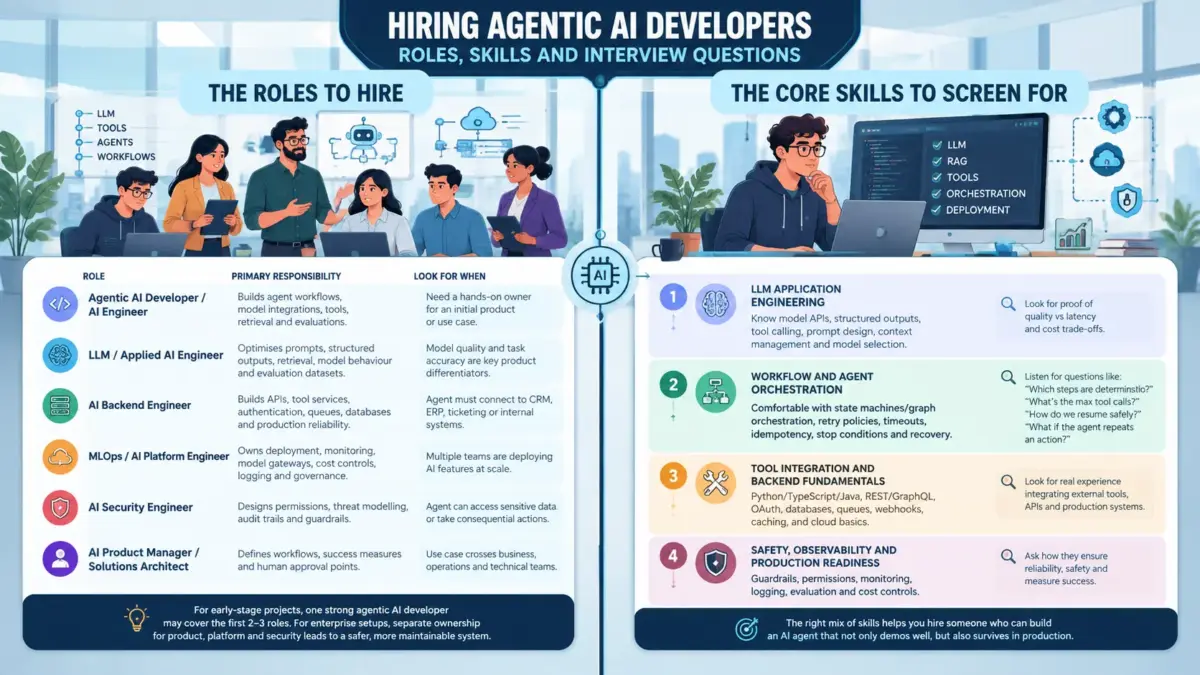
- Data Engineer. Before any model can do anything useful, the data underneath it has to be reliable, accessible and clean. This is the role most companies underinvest in and then regret. Screen for: pipeline design, orchestration tooling, SQL and Python depth, and real reasoning about why a data job fails at scale, not just whether someone can write a transformation script.
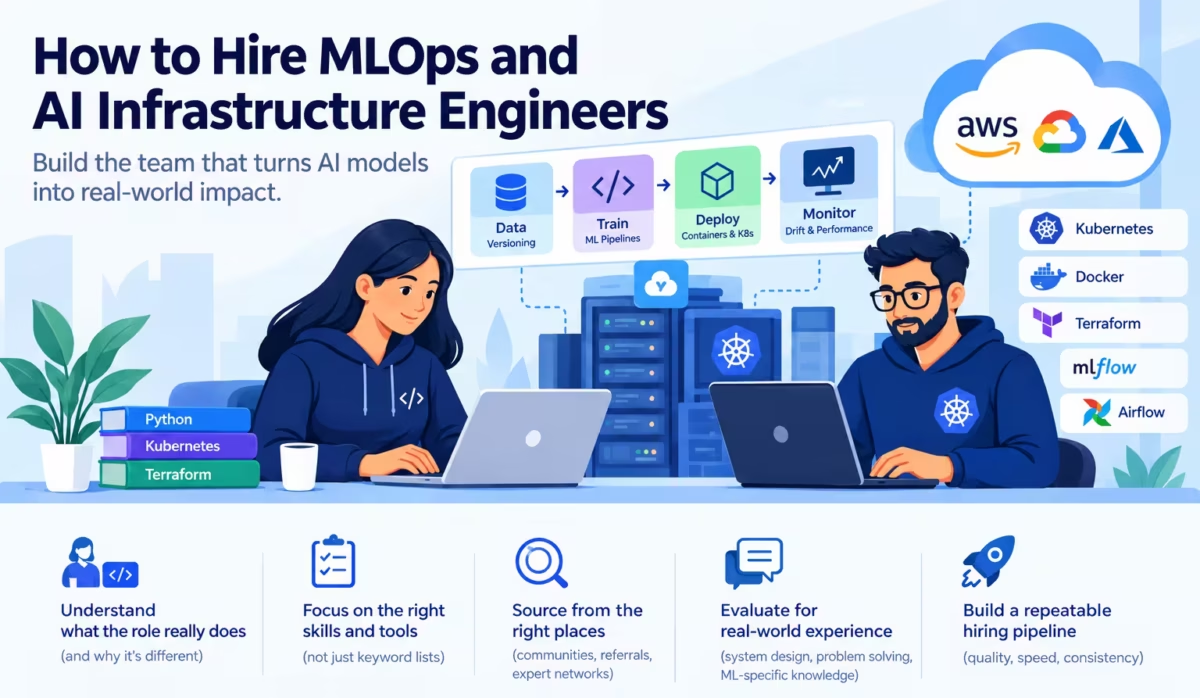
- Machine Learning Engineer. The person who takes a model out of a notebook and makes it run in production, consistently, at cost. Without this role, promising prototypes never ship. Screen for: MLOps tooling like MLflow or Kubeflow, containerisation with Docker and Kubernetes, deployment experience, and the instinct to build for failure rather than for a clean demo.
- Data Scientist. The role most people picture first, though rarely the one to hire first. Strong data scientists frame ambiguous business problems and build models that answer them. Screen for: applied statistics, experiment design, feature engineering, and the judgment to know when a model is quietly failing rather than performing.
- AI / GenAI Engineer. As generative AI moves into products, this role integrates LLM capabilities into systems real users touch. Screen for: hands-on work with RAG pipelines, vector databases, prompt engineering at a professional level, and frameworks like LangChain, plus the critical eye to judge when model output can't be trusted.
- MLOps / AI Infrastructure Engineer. The role that decides whether your AI keeps working six months after launch. This is where a lot of AI value quietly leaks away. Screen for: cloud platforms and deployment on SageMaker, Vertex AI or Azure ML, monitoring and drift detection, cost awareness, and comfort with security in production.
- AI Product Manager. The translator between what the business wants and what a model can realistically do. Often the difference between AI that ships and AI that stalls in endless proof-of-concept. Screen for: enough technical literacy to call a bad idea early, plus the product judgment to prioritise what's worth building at all.
- AI Governance / Responsible AI Lead. As regulation tightens and models make more consequential decisions, someone has to own risk, bias, compliance and accountability. Screen for: familiarity with model risk, data privacy, and the emerging regulatory landscape, alongside the spine to say no when a use case shouldn't ship.
The point running through the list is depth over breadth. Each of these is a distinct discipline, and treating them as interchangeable, hiring one "AI person" to cover four of them, is the single most common reason an AI initiative underdelivers.
Sequencing: Who to Hire First
The order is where good AI workforce planning earns its keep. A common and costly pattern is hiring a star data scientist into an organisation with no clean data and no way to deploy anything. They spend their first six months doing data-engineering janitorial work, get frustrated, and leave. The role was fine. The sequence was wrong.
For most companies, the foundation comes first: the data has to be trustworthy and accessible before modelling means anything, which usually puts a data engineer ahead of a data scientist. Deployment capability comes close behind, because a model that can't ship is worth nothing regardless of how good it is. Governance and product roles tend to grow in importance as the initiative scales from one pilot to several. None of this is a rigid template, a company building a GenAI product feature will sequence differently from one automating an internal workflow, but the principle holds: build the floor before you furnish the room.
Skills Gaps Are Easier to Find Than to Admit
Identifying where you're short sounds simple and rarely is, because the honest answer is often uncomfortable. The most reliable method is to map the specific capabilities each planned AI use case demands, then check them one by one against what your current team can genuinely do, not what their job titles suggest they can do. A title tells you what someone was hired to do years ago; it doesn't tell you whether their skills have kept pace with a field that reinvents itself every eighteen months.
Two blind spots recur. The first is assuming existing technical staff can simply absorb AI work, a strong backend engineer is not automatically an ML engineer, however capable. The second is overlooking the unglamorous roles, data engineering, MLOps, governance, in favour of the ones with prestige. Those overlooked roles are usually exactly where the initiative breaks. A clear eyed gap analysis, done before the hiring starts, saves the far larger cost of discovering the gap eighteen months in.
Build vs Hire vs Partner
Once the gaps are clear, the question becomes how to fill them, and it isn't always a permanent hire. Some capability can be built by upskilling people who already understand your business and just need the technical layer added. Some have to be hired, particularly the scarce, production hardened roles that no amount of training conjures quickly. And some is best brought in through a specialist partner, either to move fast on a critical mandate or to reach the strong candidates who are not browsing job boards. This is where a recruitment partner like Prism HRC tends to earn its place, mapping which of these scarce roles a company actually needs and reaching the people who can fill them, rather than leaving a critical seat open for two quarters while the market moves on.
The Roles Are Still Shifting
It's worth staying humble about how fast this map is changing. The future AI job roles emerging now, agentic AI specialists who build systems that plan and act autonomously, prompt engineers, AI ethicists, roles that barely existed two years ago, are a reminder that any workforce plan built for today needs room to flex. The specific titles will keep evolving. What won't change is the underlying logic: know what you're trying to achieve, be honest about the capability gap between there and here, and build the team deliberately rather than reactively.
Companies that treat their people as the core of their AI strategy, rather than an afterthought bolted onto a software purchase, are the ones that will have working AI while everyone else is still running pilots. Get the workforce right and the technology finally does what the business case promised. Get it wrong and you've bought a powerful engine with nobody who can drive it.
Working AI comes down to hiring the right people in the right order.
Prism HRC helps you find the roles you need and reach the talent that isn't answering job ads.
Build Your AI Team With Prism HRC
Frequently Asked Questions (FAQs)
Tell Us Your Requirement
Ready To Build Your Dream Team With Prism HRC?
Want to explore our range of recruitment, staffing, payroll, compliance, employee welfare and employee global mobility solutions? Fill out this form and our subject matter experts will get in touch with you within 2 working days to address all your requirements at length.
Note to Candidates: Please DO NOT use this form to career related queries or job applications, as all such requests will be DELETED. For any job/career related queries, please go to career page.