AI Recruitment: How AI-Powered Screening Is Changing Candidate Shortlisting
August 4, 2026
Building an AI-Ready Workforce: The Roles Every Company Needs to Hire Next
August 9, 2026
There is a comforting shortcut a lot of companies reach for when they start building an AI team: filter for the degree. A master's in machine learning, maybe a PhD if the budget stretches and the quiet assumption that the credential does the vetting for you. It feels rigorous. It also filters out some of the best people in the field while waving through candidates who can recite the theory but have never shipped a model that survived contact with real users.
The uncomfortable truth is that the degree tells you someone can learn AI. It tells you almost nothing about whether they can do the job you are actually hiring for. The field moves too fast and the gap between academic knowledge and production capability has never been wider. If you want to hire AI talent that performs rather than just impresses on paper, the degree is where you start, not where you decide.
The Degree Proves Foundations, Not Delivery
A strong academic background genuinely matters. It signals that a candidate understands the mathematics under the models, the statistics, the linear algebra, the reasons a particular approach works or fails. That foundation is real and worth valuing, because someone who has it can usually pick up a new framework in days rather than months.
But foundations are not delivered. The person who understands transformers in theory is not automatically the person who can debug why yours is hallucinating in production, reason through a cost blowout on inference, or decide where a model should act autonomously and where it needs a guardrail. Two candidates can hold the exact same qualification and be worlds apart in what they can actually build. The whole job of a good hiring process is to tell those two apart, well before the offer goes out, not six months into a project when the work has stalled and everyone's quietly wondering what went wrong.
What Actually Predicts Performance
The signals that matter sit underneath the credential. The first is demonstrated work: a real project, a shipped model, a system that ran somewhere other than a notebook. A candidate who can walk through something they built, what broke, what it cost, what they'd do differently, is showing the exact judgment a resume can't. Someone who can only describe coursework is showing the opposite. The second is recency and depth. AI moves fast enough that two year old experience can already be stale, so it's worth knowing not just whether someone lists a skill but how recently they used it and on how large a system.
There's a real difference between someone who touched a technology once on a group project and someone who has run it in production, at scale, under pressure. The third signal, and the one most screens miss entirely, is the higher-order stuff generative and agentic AI now demand: framing an ambiguous problem, judging model output critically, translating a business need into something a model can genuinely solve. Those are the abilities that separate a capable engineer from a keyword-matched resume, and none of them show up in a transcript.
Match the Skills to the Role You're Actually Filling
Here's where a lot of AI hiring quietly goes wrong: "AI developer" gets treated as one job when it's really several, each needing a different skill set and a different test. Before screening anyone, define which role you're actually filling, because the skills to look for shift completely depending on the answer.
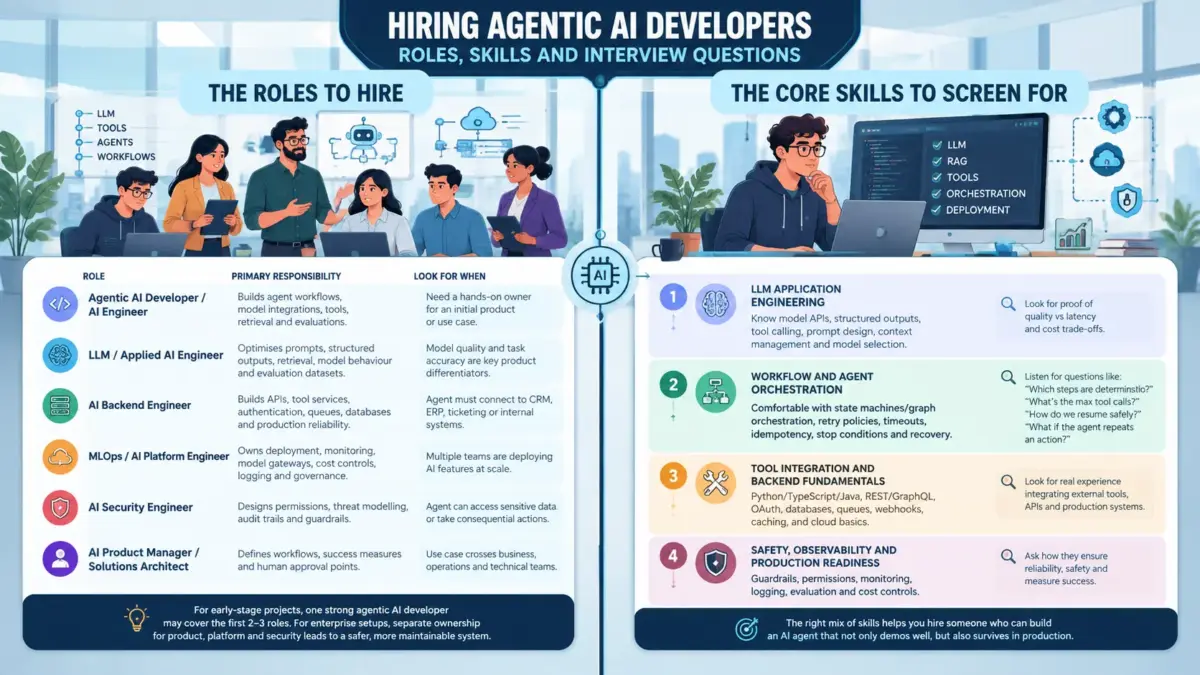
- Machine Learning Engineer (models into production): Deployment and reliability skills, MLOps tooling like MLflow or Kubeflow, container orchestration with Docker and Kubernetes, and the ability to make a model run consistently rather than just run once.
- Data Scientist: Applied statistics, experiment design, feature engineering, and the judgment to spot when a model is quietly failing
- LLM / Generative AI Engineer: Hands-on depth in RAG pipelines, vector databases like Pinecone or FAISS, professional-level prompt engineering, and frameworks such as LangChain or LlamaIndex.
- Agentic AI Specialist: Systems-design thinking, since building an agent that plans across steps, calls tools, holds memory and recovers from failure is as much architecture as modelling. Look for frameworks like LangGraph.
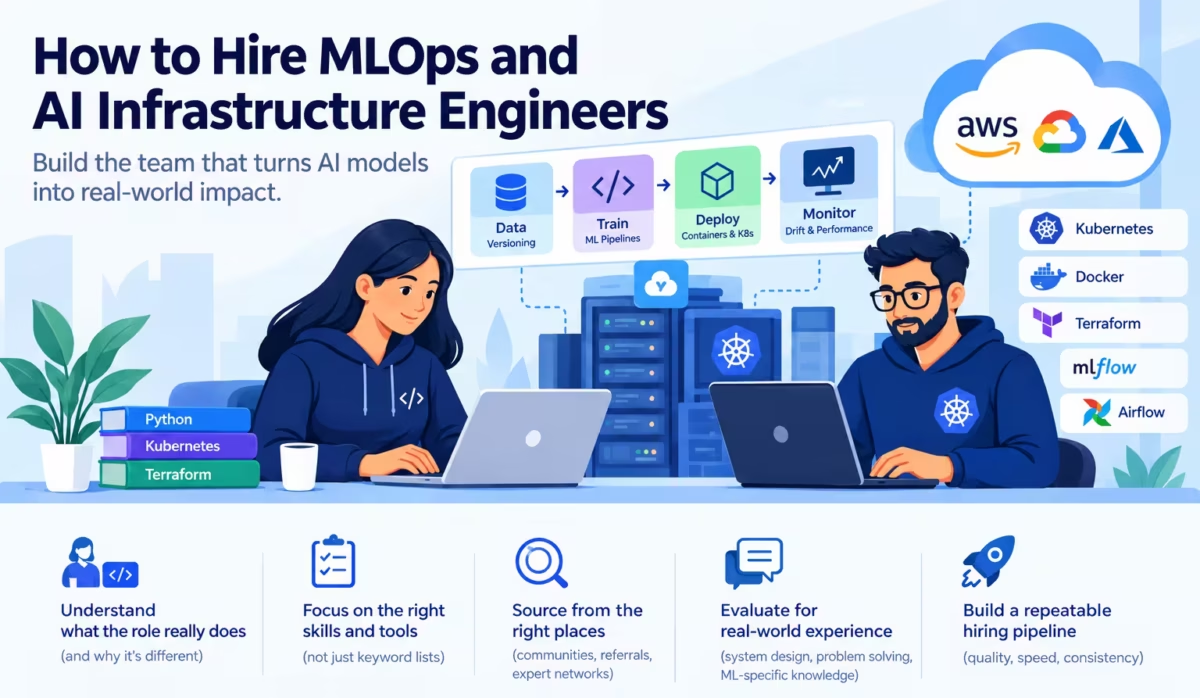
- AI Infrastructure / MLOps Engineer: Cloud platforms and deployment on SageMaker, Vertex AI or Azure ML, security and cost awareness, and the unglamorous monitoring work that decides whether a system holds up over time.
The point running through all of it is depth over breadth. The market is punishing generalists and rewarding people who go genuinely deep on the parts that tend to break. So the skills you screen for should follow the role, not a generic wishlist copied off a job template.
Why This Reshapes AI Talent Acquisition
Once you accept that the degree isn't the signal, the whole approach to AI talent acquisition has to change. Keyword screening breaks down, because the words on the resume stop correlating with the ability behind them. The reliable method is a work sample built on a real problem, hand the candidate a messy dataset, a model that needs deploying, or an agent that needs guardrails, and watch how they reason. It surfaces genuine capability regardless of pedigree, and it quietly rescues strong candidates from tier 2 backgrounds who'd otherwise be filtered out at the resume stage.
This also widens the pool rather than narrowing it, which matters in a market this tight. Some of the most capable people in the field are self-taught, or crossed over from adjacent disciplines like physics or software engineering, or built their skills shipping products rather than writing papers. Screen only for the credential and you never see them. Screen for capability and they're suddenly on the shortlist, along with a lot of people your competitors are still filtering out.
Where the Right People Actually Are
Here's the practical wrinkle. The strongest candidates, the ones who've shipped real AI into production, are usually not on the job market. They're employed, reasonably content, and not browsing portals. Reaching them takes more than posting a role and waiting. It takes knowing which companies are doing serious AI work, mapping who sits where, and making a direct, credible approach that speaks to the scope and the problem rather than just the salary.
That's the part where hiring machine learning engineers stops being a sourcing exercise and becomes a targeted one. The teams winning this race aren't the ones seeing the most resumes. They're the ones who define the exact role first, assess for real capability over credentials, reach passive candidates directly, and move fast, because strong AI people hold multiple offers and stay on the market for days, not weeks.
Pulling It Together
Hiring well in AI comes down to a shift in what you trust. The degree earns a candidate a conversation; it shouldn't earn them the job on its own. What earns the job is evidence, a system they built, a failure they diagnosed, a problem they framed and solved, judged against the specific role you're filling rather than a generic template. Get that right and the cost savings, the speed, and the quality of the team all follow. Get it wrong and you've hired an impressive transcript that can't ship, then spent another two quarters rehiring. In a market where genuinely capable people are scarce and quick to move, the companies that assess honestly and decide fast are the ones that end up with working AI teams while everyone else is still reading resumes.
The best AI hires rarely look best on paper, and they're usually not even applying.
Prism HRC finds them, screening for real capability over credentials and reaching the people who aren't on the market.
Build Your AI Team With Prism HRC
Frequently Asked Questions (FAQs)
Tell Us Your Requirement
Ready To Build Your Dream Team With Prism HRC?
Want to explore our range of recruitment, staffing, payroll, compliance, employee welfare and employee global mobility solutions? Fill out this form and our subject matter experts will get in touch with you within 2 working days to address all your requirements at length.
Note to Candidates: Please DO NOT use this form to career related queries or job applications, as all such requests will be DELETED. For any job/career related queries, please go to career page.