
“Bench Ready” Contractors: What IT Staffing Companies Mean and What to Check
November 16, 2026
Do You Still Need an NLP Engineer When LLMs Handle Most Text Tasks?
November 22, 2026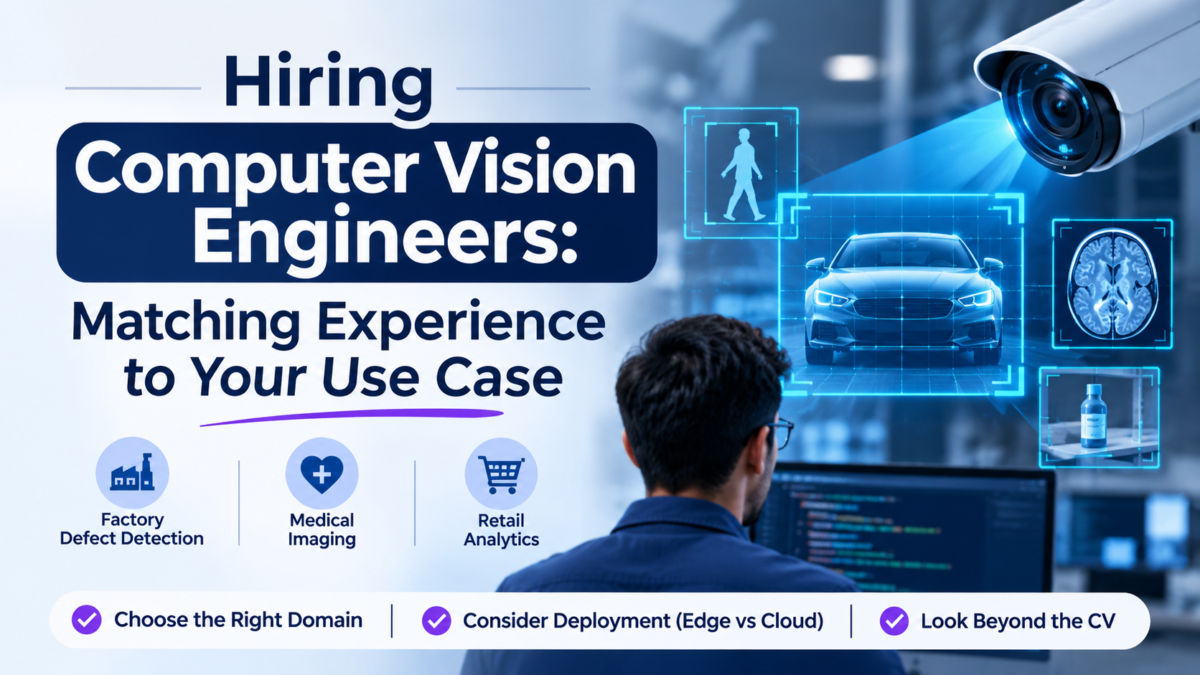
Here’s a trap companies fall into when they start hiring for computer vision. They write a job post for a “computer vision engineer,” collect a pile of impressive CVs, hire the most credentialed person and then wonder why the factory defect detection project stalls. The engineer was genuinely strong. They’d just spent five years on medical imaging and a production line is a different world.
Computer vision is not one job. The person who builds a tumour detection model, the person who catches scratches on a bumper at 60 frames a second and the person who tracks shoppers through a store share a job title and almost nothing else day to day. Hire for the title alone and you’ll often get the wrong fit, no matter how talented. This piece is about matching the computer vision engineer to the actual problem: by use case, by where the model runs and by the parts of the role that are quietly changing.
First, What Is a Computer Vision Engineer?
Before the hiring advice, it helps to agree on the basics. So what is a computer vision engineer? In plain terms, it is someone who builds systems that pull meaning out of images and video. That covers detecting and classifying objects, reading text, taking measurements and tracking movement. They sit between machine learning and real world hardware, which is exactly why the role splinters into such different specialisms. The science is shared. People diverge on what they do with it and where it has to run.
Match the Computer Vision Engineer to the Use Case
The single most useful filter is the domain itself. Each major application rewards a different background and the gap is bigger than most hiring managers expect.
Factory defect detection is unforgiving in its own way. The model has to spot a hairline crack or a missing component, fast, reliably, on a moving line, often in awkward lighting. The engineer you want here has lived with industrial cameras, real time constraints and the frustrating reality that factory data is messy and scarce. Academic benchmark accuracy means little if the system can’t keep up with the conveyor. Look for people who’ve shipped in manufacturing or industrial settings, not just trained models on clean datasets.
Medical imaging is a very different kind of work. Here the premium is on precision, rigour and regulatory awareness. A missed detection can harm a patient, so the work is careful, heavily validated and wrapped in compliance. Engineers from this world are used to small, sensitive datasets, explainability demands and a slow, meticulous pace. Drop one of them onto a fast retail project and they may feel hamstrung; drop a fast moving retail engineer into medical and they may cut corners the domain won’t forgive.
Retail video analytics leans toward scale and messiness. Tracking people across crowded shops, counting footfall, analysing queues, often across many camera feeds at once. The strength here is handling volume, occlusion and the general chaos of real environments, usually with a tolerance for “good enough” that medical would never accept. It’s a pragmatic, throughput-driven mindset.
Taken together, these three show why “computer vision experience” on a CV tells you very little until you know which of these worlds it came from. Ask what they actually built and for whom.
Then Match to Where the Model Runs: Edge vs Cloud
The use case only tells you part of what you need. Deployment matters just as much, because edge and cloud work call for different engineering instincts.
Edge deployment means the model runs on the device itself, a camera, an embedded board, a phone, a machine on the factory floor. That brings hard constraints: limited compute, limited memory, limited power and often a need for real time results with no round trip to a server.
Engineers who thrive here know model optimisation well. They are comfortable with quantisation, pruning and running models on specialised chips, and they can shrink a heavy network until it fits a small processor without falling apart. A lot of strong cloud engineers have simply never had to do this and it’s a real skill in its own right.
Cloud deployment loosens those constraints. The model runs on powerful servers, so you have room for larger architectures and heavier processing. The engineering challenge shifts to scale and pipelines, handling huge volumes of images or video streams, building systems that stay reliable under load. These are different problems, and they build different skills.
The mistake is treating these as interchangeable. An engineer who’s spent their career optimising for edge devices and one who’s built large scale cloud pipelines are not the same hire, even with the same job title. Decide where your system has to live before you decide who to interview.
Don’t Forget the Data Pipeline
There’s a part of computer vision that job posts routinely ignore and it’s often where projects actually succeed or fail: the data labelling pipeline.
Vision models need a lot of labelled data, often thousands of annotated images and sometimes far more. That data has to come from somewhere, stay consistent and keep flowing as the model improves. An engineer who only knows how to train models, but has no feel for sourcing data, setting up annotation, managing labelling quality or handling edge cases in the dataset, will stall the moment the clean tutorial data runs out. On real projects, most of the effort goes into the data. When you assess candidates, probe how they’ve handled data, not just models. The ones who’ve wrestled with messy, insufficient, badly labelled datasets are worth far more than those who’ve only touched polished benchmarks.
How Vision-Language Models Are Changing the Role
There is one more change to understand before you hire. Vision-language models, which connect images and text, are developing quickly and widening what the role involves.
The classic computer vision engineer trained specialised models for narrow tasks. Increasingly, some of the work involves these large multimodal models that can describe an image, answer questions about it, or handle tasks they weren’t explicitly trained for. The traditional skills still matter, but engineers now need to know where these models fit. The strongest candidates now often blend classic computer vision depth with an awareness of where these newer models fit and where they don’t. When you’re hiring, it’s worth gauging whether someone is keeping pace with this change or is anchored entirely to the older way of working. For a long lived product, that adaptability matters.
Computer Vision Engineer Skills to Screen For
The computer vision engineer skills that matter depend on your use case and deployment, but some foundations are common to every role. These include solid Python, strong command of frameworks like PyTorch, OpenCV for vision-specific work and real deep learning fundamentals.
On top of that, add the specifics for your project:
- Factory work: industrial cameras and real-time constraints
- Medical imaging: rigour, validation and compliance
- Retail analytics: handling scale across many camera feeds
- Edge deployment: model optimisation for limited hardware
- Cloud deployment: large-scale data and video pipelines
- Every role: hands-on experience with messy, real-world data
Computer Vision Engineer Interview Questions That Test Judgement
Good computer vision engineer interview questions test judgement rather than trivia. Asking a candidate to define a convolution tells you little. Asking “Your model works in the lab but fails on the factory floor. Walk me through what you would check” tells you a lot more, because it shows whether they have actually shipped something.
A few more questions in the same spirit:
- What was the hardest dataset problem you dealt with, and how did you fix it?
- How did you get a model to run within the compute and memory limits of an edge device?
- Tell me about a model that did well on a benchmark but struggled in production. What did you change?
- Where would you use a vision-language model, and where would a smaller task-specific model do the job better?
How Prism HRC helps you hire the right computer vision engineer
Matching the engineer to the use case and deployment is the judgement a generalist recruiter often misses, and a wrong hire here can cost you months. At Prism HRC, our technology recruitment teams understand these distinctions, that a medical imaging specialist and a factory defect detection engineer aren’t interchangeable and that edge and cloud call for different strengths, so the shortlists you see are filtered for real, relevant capability rather than keyword matches.
We screen for the domain fit, the deployment experience and the data-pipeline reality behind the CV, across computer vision, AI/ML and the wider technology stack. For permanent, contract, project and contract-to-hire requirements, Prism HRC helps you build vision teams whose work holds up in your own setting. To discuss a hiring requirement, visit www.prismhrc.com.
Hiring for a Specific Vision Problem?
Tell Prism HRC what you are building and where the model will run. We will shortlist computer vision engineers who have worked on similar problems, for permanent, contract, project or contract-to-hire roles.
Frequently Asked Questions (FAQs)
Tell Us Your Requirement
Ready To Build Your Dream Team With Prism HRC?
Want to explore our range of recruitment, staffing, payroll, compliance, employee welfare and employee global mobility solutions? Fill out this form and our subject matter experts will get in touch with you within 2 working days to address all your requirements at length.
Note to Candidates: Please DO NOT use this form to career related queries or job applications, as all such requests will be DELETED. For any job/career related queries, please go to career page.