Long Notice Periods Slowing Your IT Hires? How Contract Staffing Closes the Gap
November 10, 2026
“Bench Ready” Contractors: What IT Staffing Companies Mean and What to Check
November 16, 2026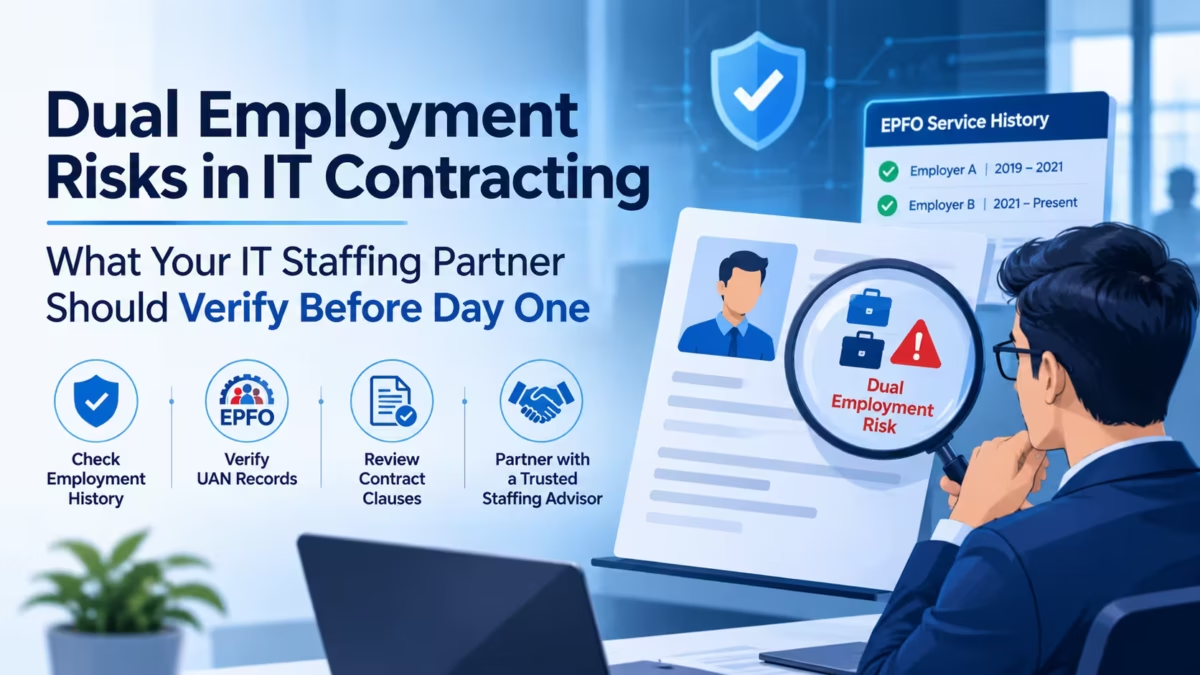
A contractor joins on a Monday. Laptop issued, access granted, first sprint assigned. Three weeks in, something feels off. He misses two stand-ups, his pull requests land at odd hours, and the velocity he showed in the interview has quietly evaporated. Nobody wants to say the obvious thing out loud, so the team works around him for another month.
By the time it surfaces, he has been drawing a full-time salary somewhere else the entire time.
This is not a hypothetical. The most visible case of dual employment in India came in September 2022, when Wipro chairman Rishad Premji told the AIMA National Management Convention that the company had discovered around 300 employees working directly for a competitor while on Wipro’s payroll, and terminated them. As reported by Outlook Business, Premji called it a “complete violation of integrity in its deepest form.”
Three hundred people, inside one company, found in the space of a few months. And that was a firm with full-time employees, HR systems and reporting managers. Contract hiring has less of all three.
Why Contract Roles Carry More Dual Employment Exposure Than Permanent Ones
Permanent hiring has friction built into it. Notice periods, relieving letters, a full verification cycle, a manager who sees the person every day. Contract hiring strips most of that away on purpose, because speed is the entire point.
That speed is what makes IT contract staffing valuable. It is also what creates the gap. A contractor who joins in four days has had four days of scrutiny. If the role is fully remote, nobody ever sees where he is working from or who else might be paying him.
Add the structural reality: contract engagements usually run through a vendor. The client sees a resume and an interview panel. The staffing partner sees the actual employment paperwork. When neither side is clear on who checks what, nobody checks properly.
Is Dual Employment Legal in India? Where the Law Actually Stands
Moonlighting in India sits in an awkward legal space. No single statute says holding two jobs is illegal. What exists is a scatter of provisions that restrict it indirectly, which is why the debate keeps going in circles.
Section 60 of the Factories Act, 1948, titled Restriction on double employment, bars an adult worker from working in a factory on a day when they have already worked in another. The Industrial Employment (Standing Orders) Rules, 1946 restrict additional employment that could harm the employer’s interests. Various state Shops and Establishments Acts limit working across more than one establishment beyond permitted hours.
None of these were written with a remote software engineer in mind, and none of them cleanly prohibit a developer from taking a second coding job.
So is dual employment legal in India for IT roles? There is no clean yes or no. The practical takeaway is that enforcement rests almost entirely on what your contract says. If the agreement does not address exclusivity, confidentiality and conflict of interest in explicit terms, you have very little to act on even after you find out.
The Contract Clauses That Actually Matter
Most IT contracting agreements were drafted for a world where people worked from an office. A few additions close the gap.
- An exclusivity and full-time commitment clause. State plainly that the contractor will not hold concurrent employment or engagement during the term without written consent. Vague “best efforts” language is not enforceable in any useful way.
- A disclosure obligation. Require the contractor to declare any existing or incoming engagement, including freelance and advisory work. Disclosure shifts the burden and makes concealment a breach in itself.
- Written consent for employment verification. Authorisation for EPFO and UAN-based checks, both at onboarding and periodically during the engagement. Without consent you cannot run the check that matters most.
- Confidentiality tied to competitor exposure. The real damage in dual employment is rarely the lost hours. It is client code, architecture detail and data sitting on a machine that another employer also pays for.
- Termination for breach, without notice. If the clause has no teeth, it is decoration.
- Working hours and availability commitments. Specify core hours and expected responsiveness. It gives you something concrete to point at when attendance patterns start drifting.
The EPFO and UAN Check: What It Shows and What It Misses
The single most useful verification tool in the Indian market is the EPF record attached to a candidate’s Universal Account Number. Every formal employer contributing to provident fund files against that UAN, so overlapping contributions from two employers in the same month become visible.
EPFO’s Unified Member Portal now carries a Service History section showing the complete employment history linked to a UAN, including current and previous employers with dates of joining and exit, as Business Today reported in August 2026.
What the check shows you:
- Overlapping EPF contributions from two employers in the same period
- The full employment history linked to a single UAN
- Gaps and inconsistencies between declared dates and contribution dates
- Multiple UANs issued to the same person, which is a flag worth pulling on its own
What it does not show:
- Employers who do not deduct PF, including small firms and most overseas clients
- Freelance, consulting and contract work paid as professional fees
- Engagements paid through a family member’s account or a private entity
- Anything happening right now, since contribution filings lag by weeks
So the UAN check catches the clearest and most common case, two formal salaried jobs running at once, and misses the more deliberate arrangements. Necessary, but not sufficient on its own. Which is why delivery-side monitoring matters just as much.
The useful part is that this check no longer needs to slow anything down. The usual objection to background verification (BGV) for employees in contract hiring is turnaround time, and for traditional previous-employer verification that objection is fair. For UAN-based employment history, it is not.
If you are working out how to handle dual employment in the BGV process, put the UAN check at the start of it, not the end. Collect consent in the onboarding pack, run the employment history check before the profile goes to the client and let the slower previous-employer checks run alongside. When the check flags an overlap, ask the candidate to explain it in writing before deciding anything, because someone who changed jobs mid-month can show contributions from two employers in the same month without doing anything wrong.
Who Is Responsible: The Staffing Partner or the Client?
This is where most engagements get vague, so it helps to make it explicit in the contract itself.
|
Verification step |
Usually sits with |
Why |
|
UAN / EPFO employment history check |
Staffing partner |
They hold the candidate relationship, consent and documentation |
|
Previous employer verification |
Staffing partner |
Same reason, and it runs before the client ever sees the profile |
|
Identity and address verification |
Staffing partner |
Standard onboarding scope |
|
Exclusivity and disclosure clauses |
Both |
Partner drafts for the contractor, client mirrors it in the MSA |
|
Technical authenticity during interviews |
Client, with partner support |
The client’s panel assesses capability; the partner prevents proxy candidates reaching them |
|
Attendance and delivery monitoring |
Client |
Only the client’s team sees day-to-day working patterns |
|
Periodic re-verification in long engagements |
Staffing partner |
Needs consent and verification access |
|
Acting on a confirmed breach |
Both |
Partner handles employment action, client revokes access |
The pattern is simple enough. Anything requiring candidate consent, documentation or a verification vendor belongs with the staffing partner. Anything requiring daily visibility belongs with the client.
Problems happen when the client assumes the partner is monitoring delivery, or the partner assumes the client ran its own checks. Worth settling in writing before the first contractor joins, rather than during the awkward conversation afterwards.
The Signs That Show Up in Delivery
Verification catches dual employment at the gate. Delivery catches what slips through. These patterns rarely prove anything alone, but they cluster:
- Stand-ups missed or joined late, repeatedly. Someone juggling two jobs has two sets of meetings competing for the same 10 am slot.
- Camera consistently off, or long silences on calls. Not suspicious by itself. Suspicious alongside everything else here.
- Output well below what the interview suggested. The clearest signal, and the one teams rationalise for longest.
- Commits and messages concentrated late at night or very early. Work being fitted around another full day rather than during one.
- Slow responses in core hours, fast responses outside them. The inversion is the tell.
- Resistance to unplanned calls or screen sharing. Always busy, always happy to send a written update instead.
- Vague answers about current availability. Particularly around extending hours or joining an urgent session.
- Leave clustering around month-end or quarter-end. Another employer’s crunch period showing through.
- Reluctance to use client-issued devices or VPN. Usually framed as a convenience preference.
Any one of these has an innocent explanation. Five of them in the same contractor in the same month is worth a conversation.
This is also a close cousin of a different problem, where the person who cleared the interview is not the person who joins. We covered that separately in our post on proxy interviews, worth reading alongside this one. [Internal link: proxy interviews blog URL]
What Good Looks Like in Practice
A staffing partner that takes this seriously does a handful of things before day one, not after.
Documentation gets checked before the profile is submitted, not after selection. UAN-based employment history runs as part of standard onboarding rather than as an escalation. The contract carries real exclusivity and disclosure language. And for engagements running six months or longer, re-verification happens mid-term, because someone clean at onboarding can pick up a second job in month four.
At Prism HRC, dual employment screening sits inside standard onboarding for contract placements rather than as a paid add-on, and the same logic shapes the clause set in our IT staffing services agreements. The reasoning is plain: a check that runs by default catches more than a check someone has to remember to request.
The broader point holds whoever you work with. Contract hiring buys you speed, and speed is worth paying for. But the verification you skip to get there does not disappear. It just arrives later, as a delivery problem, usually at the worst possible point in the project.
Speed shouldn’t cost you a contractor you can trust.
At Prism HRC, UAN checks and exclusivity clauses are part of every contract placement, so your contractors are verified before day one.
Frequently Asked Questions (FAQs)
Tell Us Your Requirement
Ready To Build Your Dream Team With Prism HRC?
Want to explore our range of recruitment, staffing, payroll, compliance, employee welfare and employee global mobility solutions? Fill out this form and our subject matter experts will get in touch with you within 2 working days to address all your requirements at length.
Note to Candidates: Please DO NOT use this form to career related queries or job applications, as all such requests will be DELETED. For any job/career related queries, please go to career page.