

IT Recruitment Agency Fees in India: How the Pricing Models Work and What You Should Get for the Money
November 7, 2026
Dual Employment Risks in IT Contracting: What Your IT Staffing Partner Should Verify Before Day One
November 13, 2026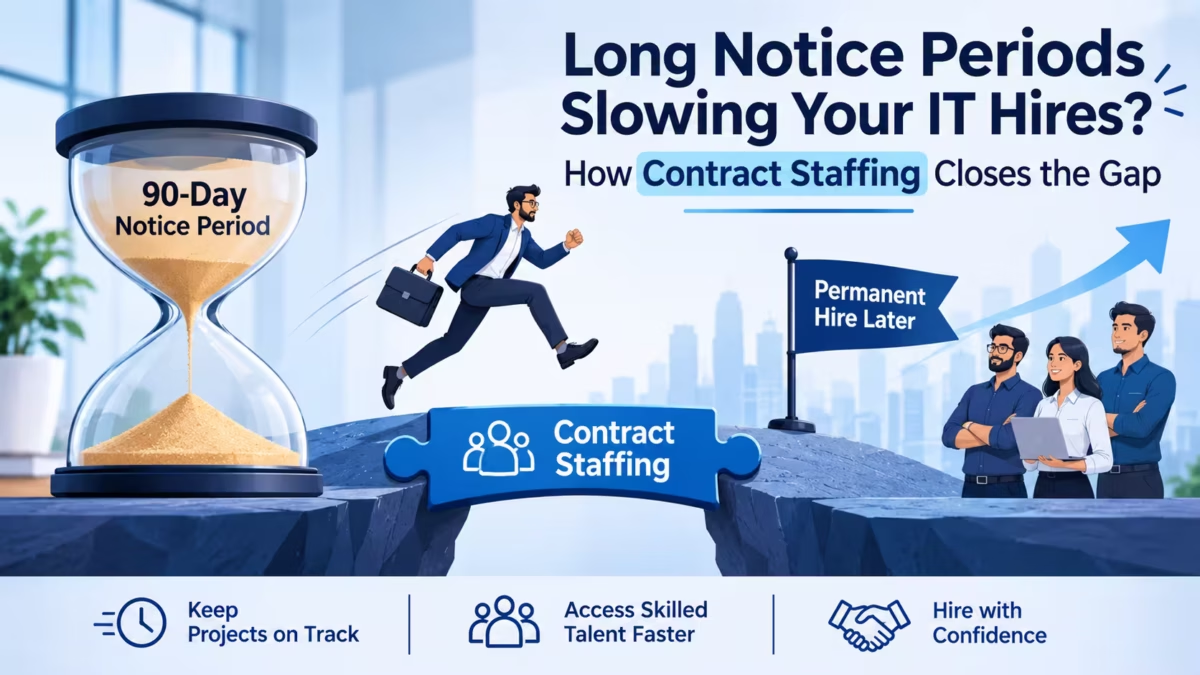
Every hiring manager in Indian IT knows the feeling. You run a thorough search, interview hard and finally land on the one candidate who ticks every box. The offer goes out, it comes back signed and just as you start to relax, you remember the detail that undoes so many good hires: they cannot join for ninety days.
At Prism HRC, we spend a lot of our time in that exact gap and we have learned to respect how much damage it can quietly do. A long notice period looks like a simple delay on the surface. Underneath, it is a stretch of time in which your project drifts, your team overextends and your carefully chosen candidate turns into the most sought-after person in the market. The wait is rarely neutral and treating it as if it were is where companies lose both time and people.
This blog looks at what actually happens during that waiting period, how to think clearly about a buyout, when bringing someone in on contract, or on a contract to hire basis, is simply the faster way to close the gap and how to judge which long notice period candidates are worth the wait in the first place.
What a Long Notice Period Really Costs You
The first cost is the one everyone sees: the project slips. Whatever you needed that engineer for, the data migration, the security remediation, the release, now sits either untouched or propped up by colleagues doing double duty. Three months of that is enough to blow a deadline, burn out a team, or force an awkward conversation with a client about timelines.
The second cost is the one people miss and it is often the bigger one. A long notice period is the precise window in which a candidate is most exposed to being pulled away. The day they resign, their current employer starts working to keep them and counter offers tend to arrive fast. A raise, a promotion, a sudden interest in their career that was not there last month. Stretch that over ninety days and the pressure compounds, while other recruiters, sensing someone on the move, quietly add offers of their own.
So the person you believe you have hired is, for a full quarter, still on the market in every meaningful sense. You have committed, but they are being courted and you may not discover that the commitment wobbled until the joining date passes and the desk stays empty. Understanding that this window is active rather than idle is the starting point for handling it well, because it changes what you do during those ninety days instead of simply counting them down.
Weighing a Buyout Against the Cost of Delay
The instinctive fix is to pay the gap away. A notice period buyout, where you cover part or all of what the candidate owes their employer so they can leave sooner, feels like a decisive move. Sometimes it is exactly the right one. But it is a decision worth making with open eyes rather than reflex and that starts with honestly pricing both sides.
Put the payout next to the real cost of the delay and the comparison usually sharpens quickly. A stalled project is seldom a clean figure, but it is tangible: missed milestones, a launch that slides past a commercial or regulatory date, the overtime your existing team absorbs to keep things moving and in some contracts, penalties or lost revenue attached directly to the schedule. When a few weeks of acceleration protects something worth many times the payout, paying to shorten the wait can be straightforwardly sensible.
The complication is the second order effect and it is the one we make sure our clients see before they commit. A willingness to pay for speed tells the candidate something useful about how much you want them and how quickly and not everyone keeps that to themselves. Some take it back to their current employer or a competing offer and use it as leverage to extract something better elsewhere. You can end up having advertised your urgency, strengthened the other side of the table and in the worst case funded a bidding war you then lose. A buyout works best when the commitment is genuine and the role is hard to replace and worst as a rescue for a shaky yes, because at that point you are often paying to become more vulnerable, not less.
When Contract Staffing Closes the Gap Faster
The more useful question is often not “how do we get this person in sooner” but “how do we get this work moving now, without staking everything on one joining date.” Framed that way, the answer frequently stops being a buyout at all. This is where contract staffing earns its place. Rather than leave the seat empty while a permanent hire serves out a long wait, you bring in a skilled professional on contract to carry the work in the meantime, so delivery continues and the team stops absorbing a load it was never sized for.
The reason this moves quickly is structural. When someone is engaged through an agency payroll, the staffing partner handles the employment, statutory compliance and administration, so the person is genuinely available to deploy rather than knotted into a three month exit of their own. A good contract staffing service keeps a bench of pre-screened specialists, including people between assignments who can start in days and be scoped precisely to the length of the gap. There is a quieter strategic benefit too: once your delivery is covered, the leverage problem from earlier simply dissolves. A buyout becomes a convenience you might choose rather than a lever someone can pull on you and you negotiate the permanent role from a position of calm.
What Is Contract to Hire and Why It Suits a Long Notice Period
So what is the contract to hire? It is an arrangement where a professional joins your team on contract, usually on the staffing partner's payroll, for an agreed period. At the end of that period, you can offer them a permanent role if the fit is right. You get someone working on the project now and both sides get time to see how it goes before anyone commits.
That makes a contract to hire a useful option when your shortlisted candidates are all stuck on long notice periods. The contractor you bring in to cover the gap may turn out to be the person you want to keep. If they are, you convert them and the long wait stops mattering. If they are not, they hand over to your permanent hire when that person joins and the project never stalls.
The contract to hire process usually runs in four stages:
- You agree on the role, the skills needed and the length of the contract with your staffing partner, along with the terms for converting the person to permanent later.
- The partner shortlists screened candidates who can start soon and you interview them as you would for any hire.
- The person you pick joins on the partner's payroll and the partner handles their salary, statutory compliance and administration.
- Towards the end of the contract, you decide whether to convert them to a permanent employee, extend the contract or end it.
The conversion terms in the first stage are the part people most often skip and agreeing them early saves an awkward negotiation later.
Contract to hire vs direct hire mostly comes down to timing and certainty. With a direct hire, the person gets a permanent offer from day one. That is the right route for roles you are sure about, but it is also where long notice periods hurt most, because nothing starts until the person joins. Contract to hire gets the work started sooner and lets you judge the fit on real work before you commit, though it adds a conversion step at the end.
None of this means contract is the answer for every role. The capabilities that define your business, long term architecture, product ownership, engineering leadership, still belong with permanent employees and the trade offs deserve a proper look rather than a quick assumption. We have already written that comparison in detail, so instead of repeating it here it is worth reading our breakdown of IT contract staffing versus permanent hiring and our guide to choosing the right staffing model for your tech projects alongside this piece. The through-line in both is that the two models are partners, not rivals: permanent holds the core and contract covers the gaps and the peaks, which is exactly what keeps a roadmap intact while a long wait plays out.
When to Avoid a Long Notice Period Candidate and When to Take One On
Not every long notice period is worth waiting out and the decision usually comes down to how firm the work around that hire actually is. It makes little sense to commit to a ninety day wait when you have only one open position and no cover for it, because the whole project then rests on a single joining date with nothing behind it. The same caution applies when the project duration itself is uncertain. Waiting a quarter for someone to join a scope that might shrink, shift, or get shelved is a poor trade, since you may end up onboarding at exactly the moment the need evaporates. Add to that any role tied to a hard client deadline, a candidate who seems lukewarm or is openly weighing other offers, or a budget that could be pulled mid-wait and the long notice period stops being a delay you manage and becomes a risk you absorb.
There are, though, plenty of situations where taking on a long notice period candidate is the right call. If the role is a core, long term position rather than a stopgap, three months is a small cost against years of contribution and rushing it rarely pays off. It also makes sense when the skill set is genuinely rare, because a scarce specialist is worth waiting for when the alternative is restarting a search that already took months. A candidate who is clearly committed, backed by a stable project with funding and scope you trust, is exactly the kind of hire where patience is justified. And when you can keep delivery moving in the meantime, through existing team capacity or a contract bridge, the wait costs you very little, since the work does not stall while the clock runs. In short, avoid the wait when the ground under the role is shaky and embrace it when the role is solid, the talent is scarce and the gap can be covered.
How Prism HRC Approaches the Gap
In our experience, the companies that ride out long notice periods well are not the ones with the deepest buyout budgets. They are the ones who refuse to let a single joining date dictate whether a project lands on time. They secure a permanent hire for the long haul and, when the clock is tight, bridge the interval with contract talent who can begin almost immediately.
That is the discipline we try to bring. We maintain a network of screened IT contractors ready to move at short notice, we can set those engagements up as contract to hire when you want the option to make someone permanent, we help clients weigh the genuine cost of delay against both the price and the risk of a buyout rather than defaulting to the cheque and we structure the bridge so the permanent search can run at a considered pace instead of a panicked one. Used this way, contracting its staffing is not a compromise on quality. It is a way to keep standards high and timelines intact at the same time, which is usually the whole point.
Long notice periods are a fixed feature of the Indian IT market and they are not loosening any time soon. But with the right blend of permanent recruitment and contract cover, they stop being the thing that decides whether your project ships. If a long wait is currently sitting between you and a critical hire, that gap is almost always closable and the only real mistake is treating the wait as your only option.
Facing a project that cannot afford to wait out a notice period?
Talk to Prism HRC about a contract bridge that keeps your delivery moving while your permanent hire works through their notice.
Frequently Asked Questions (FAQs)
Tell Us Your Requirement
Ready To Build Your Dream Team With Prism HRC?
Want to explore our range of recruitment, staffing, payroll, compliance, employee welfare and employee global mobility solutions? Fill out this form and our subject matter experts will get in touch with you within 2 working days to address all your requirements at length.
Note to Candidates: Please DO NOT use this form to career related queries or job applications, as all such requests will be DELETED. For any job/career related queries, please go to career page.