
Hiring Computer Vision Engineers: Matching Experience to Your Use Case
November 19, 2026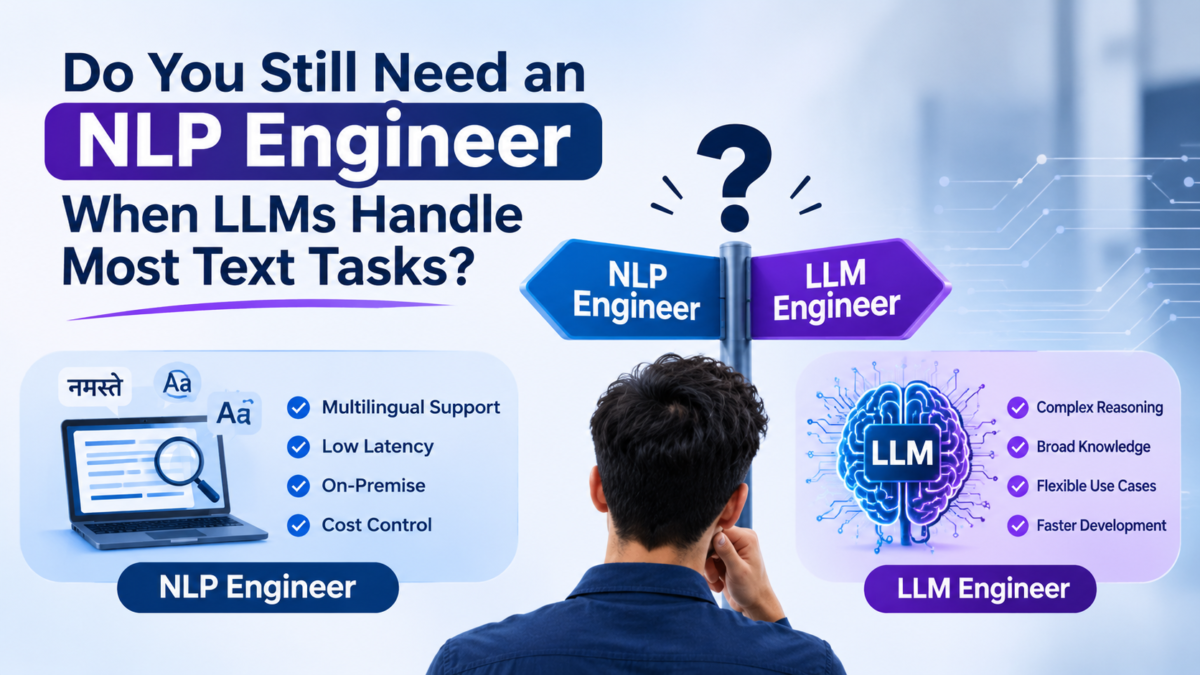
It’s a fair question and a lot of hiring managers are quietly asking it. If a large language model can summarise, classify, translate and answer questions straight out of the box, why would you hire someone to build text systems from scratch? Just call an API and move on.
For plenty of use cases, that is genuinely the right call. But “most text tasks” is not “all text tasks,” and the hiring decision depends on which side of that gap your product sits. There are still real situations where classical NLP wins outright and getting the hire wrong, in either direction, is expensive. So before you decide you don’t need an NLP engineer anymore, it is worth understanding where the old approach still beats the new one and who you actually need on the team.
What Is an NLP Engineer?
So what is an NLP engineer, especially now? Traditionally, it is someone who builds systems that process and understand human language. That covers tokenization, classification, named entity recognition, sentiment analysis, search and translation, often using smaller, purpose-built models they train and tune themselves. LLMs have not erased that work. They have handled the tasks where an API is good enough, which leaves the NLP engineer focused on the cases where it is not. Understanding how language systems work, rather than only prompting one, still matters, and in some settings nothing else will do.
NLP vs LLM: Where Classical NLP Still Wins
The case for a specialist rests on a handful of situations where throwing an LLM at the problem quietly falls apart. For a lot of Indian businesses, these situations are the core of the product.
Indian languages are the clearest example. General-purpose LLMs are strong in English and increasingly decent in major world languages, but performance across India’s many languages and the dialects, code-mixing and scripts that come with them, is uneven at best. If your product has to work properly in Hindi, Tamil, Bengali, Marathi and the rest and especially in the messy Hinglish real users actually type, you often need someone who can build and fine-tune language-specific models rather than hoping a general LLM covers it. This is specialist work and it does not go away because an API got better at English.
Low latency systems are another. LLMs, particularly the large hosted ones, can be slow. If your application needs an answer in milliseconds, for example in real-time classification, instant routing or live filtering, the round trip to a large model may simply be too slow. A smaller, purpose built NLP model running close to the application can be far faster. When speed is the main requirement, the large model is often ruled out.
On premises deployment matters wherever data cannot leave the building. Plenty of organisations in finance, healthcare and government cannot send sensitive text to an external API for privacy, security or regulatory reasons. When everything has to run on your own infrastructure, the convenient hosted LLM is off the table and you need someone who can build and deploy models in house. That is classic NLP engineering territory.
And then there is the cost at high volume. One LLM call is cheap. Millions of them a day is not. When you are processing text at serious scale, the per call cost of a large model stacks up fast and a lean, specialised model you own can be dramatically cheaper to run. At volume, the economics alone can justify the specialist.
All four cases come down to the same thing. The NLP vs LLM decision depends on your specific constraints: your languages, your latency needs, your data rules and your volume. Which technology looks better in general matters much less.
NLP Engineer or LLM Engineer: Who Should You Hire?
Once you see it that way, the hiring question gets clearer. There are broadly three people you could bring in and the right one depends on what you are building.
Hire an NLP specialist when your problem falls into the areas above: Indian-language work, low-latency systems, on-premises deployment or high-volume processing where cost matters most. You want someone who understands language models from the ground up, can build and train their own and is not dependent on a hosted API to get results.
Hire an LLM engineer when your work is mostly about building on top of large models. That includes prompt engineering, retrieval, connecting LLMs to applications and getting the most out of models that already exist. This is the right hire when the hosted models genuinely solve your problem and the job is to apply them well, fast.
Hire someone who can do both when your needs are mixed, which is true for most companies. Plenty of real products use LLMs for the broad, flexible tasks and fall back on specialised NLP for the parts where the big model is too slow, too costly, too weak in a given language, or simply not allowed to see the data. An engineer comfortable across both worlds is increasingly the most valuable hire, because they can pick the right tool for each piece instead of forcing everything through one.
Screening Questions for Each Role
How you interview should change depending on which of the three you’re after. Here are a few questions that help you tell strong candidates from weak ones.
For an NLP specialist, probe the fundamentals and the hard cases. Ask how they’d build a classifier for a low resource Indian language with little training data, or how they’d get a model fast enough for a real time system. Ask about a time an off-the-shelf model was not good enough and what they built instead. You’re listening for someone who understands what’s happening under the hood, not just which library to import.
For an LLM engineer, probe practical application and judgement. Ask how they’ve handled hallucination in production, how they’d cut the cost of a high-volume LLM feature, or how they decide between prompting, retrieval and fine-tuning. You want someone who has dealt with these problems in a live product, beyond a polished demo.
For an engineer who works across both, probe the decision-making itself. Give them a scenario, such as a multilingual, high-volume product with a tight latency budget, and ask when they’d use an LLM and when they’d build something specialised. The quality of that reasoning tells you more than any single technical answer. The best people understand the trade-offs well and don’t default to one approach.
Start With Your Constraints
LLMs have genuinely changed the field. For a lot of text tasks, you no longer need a specialist, and hiring one anyway wastes money. That still leaves the cases LLMs don’t handle well. The moment your product runs into Indian language complexity, hard latency limits, on premises constraints or serious volume, the specialist stops being optional. In the NLP vs LLM debate, the useful step is to understand your constraints first. Then hire the person, or the mix of skills, that fits them.
How Prism HRC helps you hire the right fit
The hard part is knowing which of the three you actually need before you start interviewing, and that is where a generalist recruiter often gets it wrong. At Prism HRC, our technology recruitment teams understand the difference between classical NLP depth and LLM application skill and the growing value of engineers who bridge both, so we help you define the role around your real constraints rather than the job title.
We source and screen for real capability across the wider AI/ML stack, including Indian-language NLP, low-latency and on-premises deployment, and LLM and GenAI application work. For permanent, contract, project and contract-to-hire requirements, Prism HRC helps you hire the NLP or LLM talent that actually fits what you are building. To discuss a hiring requirement, visit www.prismhrc.com.
Not Sure Whether You Need an NLP or LLM Engineer?
Tell Prism HRC about your languages, latency needs, data rules and volume. We will help you define the role and shortlist NLP, LLM or cross-skilled engineers who fit it, for permanent, contract, project or contract-to-hire roles.
Frequently Asked Questions (FAQs)
Tell Us Your Requirement
Ready To Build Your Dream Team With Prism HRC?
Want to explore our range of recruitment, staffing, payroll, compliance, employee welfare and employee global mobility solutions? Fill out this form and our subject matter experts will get in touch with you within 2 working days to address all your requirements at length.
Note to Candidates: Please DO NOT use this form to career related queries or job applications, as all such requests will be DELETED. For any job/career related queries, please go to career page.