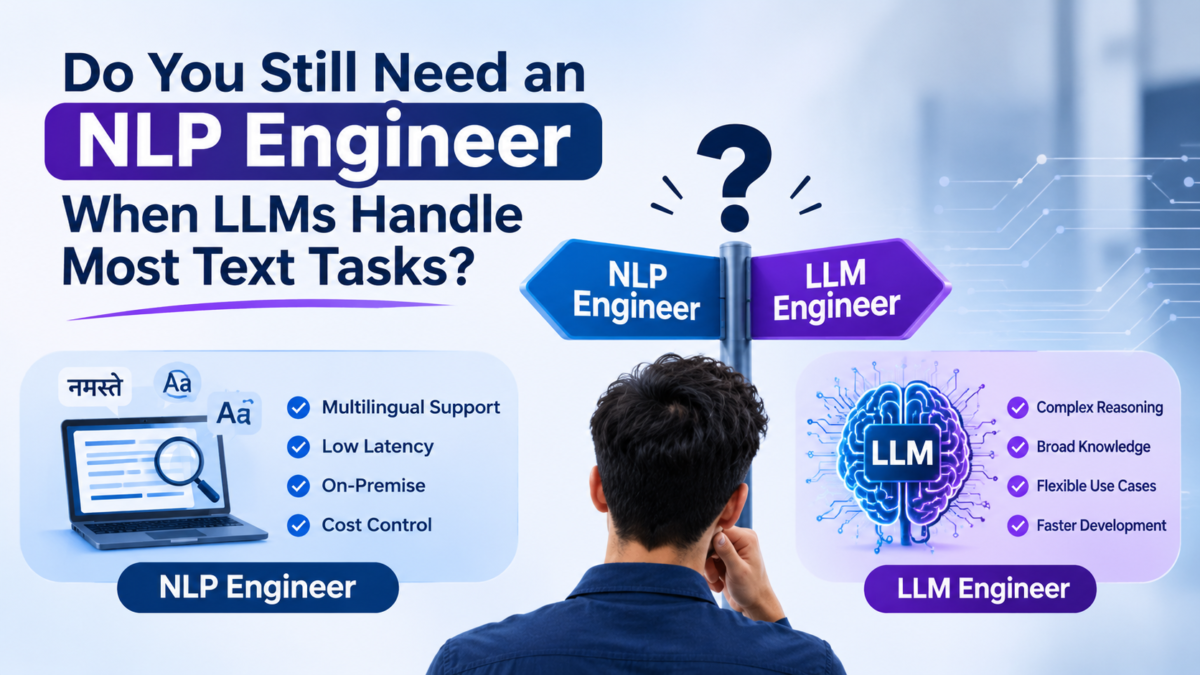
Do You Still Need an NLP Engineer When LLMs Handle Most Text Tasks?
November 22, 2026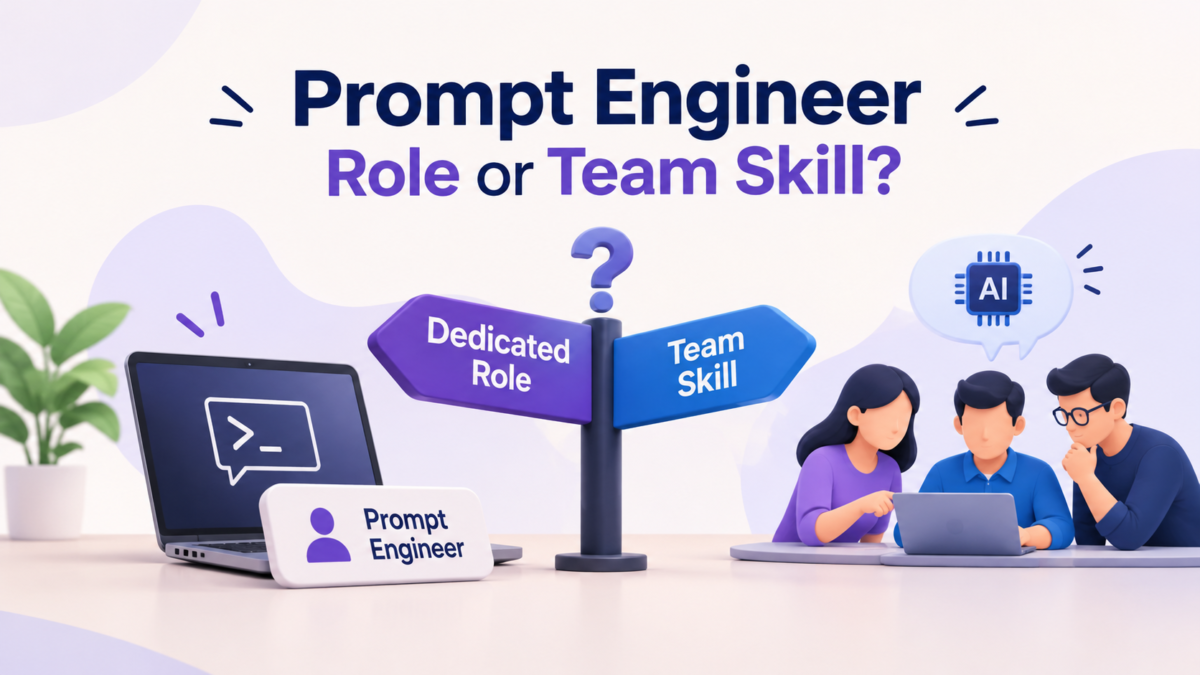
Open any AI hiring page, including ours, and you will find prompt engineer on the list. Fair enough, because clients ask for it. But the more useful question, and the one most hiring managers skip, is whether they need a person in that seat or a capability spread across the team they already have.
Those are different problems with different price tags. Getting the distinction wrong is how companies end up with a specialist who runs out of work in month four, or a product team quietly shipping prompts nobody ever evaluated.
What Is a Prompt Engineer, Honestly
The job title describes someone who designs, tests and maintains the instructions given to a language model so it produces reliable output at scale. In practice the work splits into three parts, and only one of them is the part people picture.
Writing the prompt. The visible bit. Structuring instructions, examples, constraints and output formats. Genuinely a craft, and also the part that any competent engineer picks up reasonably fast.
Building the evaluation. The part that actually takes skill. Defining what “good output” means in measurable terms, assembling a test set, scoring runs, catching regressions when a model version changes under you. This is closer to QA engineering than to writing.
Maintaining it over time. Models get updated. Products change. A prompt that worked beautifully in March quietly degrades by August, and somebody has to notice.
Worth being direct about something: the title carries more weight online than in hiring. Writing in Fast Company in May 2025, reporter Henry Chandonnet quoted Indeed economist Allison Shrivastava saying the prompt engineer title was never large enough for her team to track mathematically. That matches what we see in the market. Search volume for the term comes overwhelmingly from people trying to learn the skill rather than companies trying to buy it.
So if you are weighing a dedicated hire, do not take the term’s online popularity as evidence of a hiring norm. It isn’t one.
When a Dedicated Role Actually Makes Sense
Three situations where the standalone hire earns its salary.
Evaluation-heavy products. If your product’s core output is model-generated and user-facing, every prompt change is a production change. A legal summarisation tool, a medical triage assistant, an automated underwriting narrative. Somebody has to own a proper eval harness, with a labelled test set, scoring rubrics and regression runs before each release. That is a full job, and it is not one an AI engineer absorbs between sprints.
Content operations at volume. Teams generating thousands of outputs a week, product descriptions, support macros, localisation, marketing variants, need someone who owns template libraries, quality thresholds, brand and tone consistency, and the review workflow. Close to a content ops role with technical teeth. Usually sits in marketing or operations rather than engineering, and often does not need an engineer at all.
Internal enablement. Large organisations rolling AI tooling out across non-technical teams need someone who builds internal prompt libraries, runs training, collects what is actually working, and codifies it. This is a change management and training role wearing a technical label. Easy to underestimate and genuinely valuable in a 5,000-person company.
Notice what links them: volume, repeatability and consequence. Enough recurring work to fill a week, with real cost attached to getting it wrong.
When It Belongs Inside an AI Engineer’s Job
Most of the time, in other words.
If you are building RAG pipelines, agent workflows or LLM features inside an application, prompting is one layer of a stack that also includes retrieval, chunking, tool calling, context management, caching, latency and cost. Splitting the prompt layer off from the rest creates a handoff where no handoff should exist.
The practical failure mode: a prompt engineer tunes instructions in isolation and hands them over, then the engineer discovers the output format breaks a downstream parser, or the token count triples inference cost, or the real problem was never the prompt but the retrieval step feeding it bad context. You have added a coordination cost to a problem that needed a single owner.
For most product teams under 50 engineers, the right answer is to hire a strong AI engineer who prompts well and build the evaluation discipline into the team’s definition of done.
|
Dedicated prompt engineer |
Skill inside the AI engineer role |
|
|
Product shape |
Model output is the product, user-facing and consequential |
LLM is one feature among many |
|
Volume |
Thousands of outputs weekly, or a large eval suite |
A handful of prompts per feature |
|
Where it sits |
Content ops, enablement, or a dedicated quality function |
Inside the engineering team |
|
Main deliverable |
Eval harness, prompt library, quality thresholds |
Working features that meet an output bar |
|
Team size that justifies it |
Usually 100+ engineers, or a product built entirely on generation |
Nearly everyone else |
Prompt Engineer Skills Worth Screening For
If you have decided the dedicated role fits, these are the capabilities that separate a serious candidate from someone who has read a lot of threads.
- Evaluation design. Can they define success criteria for a fuzzy task and build a test set that catches failures rather than confirming successes?
- Failure analysis. Given twenty bad outputs, can they group them into failure modes instead of fixing them one at a time?
- Structured output discipline. Getting reliable JSON or schema-conformant output under adversarial inputs, and handling the cases where the model does not comply.
- Context and token awareness. Understanding what context window pressure does to instruction adherence, and the cost implications of a verbose prompt at scale.
- Model behaviour knowledge. Practical, hands-on familiarity with how different models respond to the same instruction, not vendor marketing claims.
- Domain reading ability. The capacity to learn what “correct” means in your domain well enough to write a rubric for it.
- Version discipline. Treating prompts as versioned artefacts with change logs, not strings edited in a config file by whoever is on call.
Two things conspicuously not on that list: certificates, and the ability to recite prompting frameworks by name.
How to Test for It: Give Them a Task, Not a Quiz
Most prompt engineer interview questions circulating online are quiz items. Define chain-of-thought. What is few-shot prompting. What does temperature do. These test vocabulary, which is the easiest thing in this field to acquire in a weekend.
Replace the quiz with a take-home or live exercise. Here is a structure that works.
Give them a real failure, not a clean brief. Hand over a prompt that half works and twenty sample outputs, of which maybe eight are wrong in different ways. Real data from your product if you can share it, synthetic if you cannot. Ask them to diagnose and fix it.
Make them define “good” before they fix anything. The strongest signal in the whole exercise. A good candidate writes down what correct output looks like and how they would score it, before touching the prompt. A weak one starts rewriting instructions immediately.
Require a test set. Ask for ten to fifteen test cases including edge cases, and the reasoning behind each. You learn more from the cases they choose than from the prompt they write.
Change the conditions mid-interview. For a live exercise, switch the model or add a constraint partway through, a stricter output format, a token limit, a new input type. Watch whether they adapt systematically or start guessing.
Ask them to explain a trade-off they rejected. A real practitioner has opinions about approaches they chose not to take and can tell you why. Someone working from memorised patterns usually cannot.
Budget two to three hours for a take-home, and pay for it if the task uses your actual data. What you should look at when it comes back is the reasoning document rather than the prompt itself. The prompt is the output. The method is the hire.
This cuts both ways in a useful sense. The same exercise, given to an AI engineer candidate, tells you whether the skill is already present in the people you were going to hire anyway. Often it is, which answers the original question for you.
Deciding Before You Write the Job Description
Three questions, in this order.
Is model output the product, or a feature inside it? If it is a feature, the skill belongs in the engineering role.
Would the person have a full quarter of work? Write out what they would do in weeks five through twelve. If that list is thin, you are describing a project, not a position.
Who owns quality today? If the answer is nobody, your problem is an ownership gap rather than a headcount gap, and those get solved differently.
At Prism HRC we run this conversation with clients before sourcing starts, because the brief for an ai prompt engineer and the brief for an AI engineer who prompts well pull from very different candidate pools. Starting the search before that is settled tends to produce a shortlist nobody is happy with.
The underlying point is not that the role is fake. It is real, and in the right context it is valuable. It is just narrower than the internet suggests, and the companies getting the most out of this skill are usually the ones who built it into the team rather than bought it as a seat.
Get the brief right before you search
A prompt engineer and an AI engineer who prompts well come from different talent pools. Prism HRC helps you work out which one you need before sourcing starts.
Frequently Asked Questions (FAQs)
Tell Us Your Requirement
Ready To Build Your Dream Team With Prism HRC?
Want to explore our range of recruitment, staffing, payroll, compliance, employee welfare and employee global mobility solutions? Fill out this form and our subject matter experts will get in touch with you within 2 working days to address all your requirements at length.
Note to Candidates: Please DO NOT use this form to career related queries or job applications, as all such requests will be DELETED. For any job/career related queries, please go to career page.